
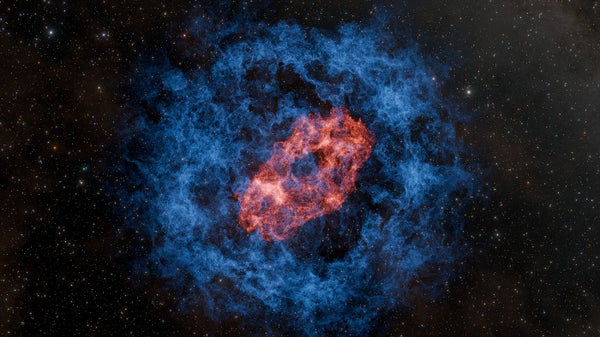
Astronomers may have discovered a never-before-seen cosmic explosion that effectively combines a supernova with a kilonova—the blast that results when two dead, dense stars collide.
When massive stars run out of fuel for nuclear fusion, they collapse, triggering a huge explosion called a supernova that blasts light out into space. These cataclysms sometimes leave behind a small dead core—a dense object made mostly of neutrons called a neutron star. When two neutron stars collide, the resulting explosion is known as a kilonova. Just one kilonova has ever been confirmed. Now astronomers think they’ve seen a rare combination of the two.
According to California Institute of Technology astronomer Mansi Kasliwal, a co-author of a new study describing the findings, observations from gravitational-wave detectors and telescopes around the world together suggest the combo produced a third kind of powerful explosion: a superkilonova.
On supporting science journalism
If you're enjoying this article, consider supporting our award-winning journalism by subscribing. By purchasing a subscription you are helping to ensure the future of impactful stories about the discoveries and ideas shaping our world today.
“We could rule out all other candidates except this one,” she says.
Kasliwal and her colleagues propose that, unlike in a typical supernova or kilonova, this event arose after a massive, rapidly rotating star collapsed into a supernova, birthing two neutron stars instead of the usual one.
Theorists have suggested this might happen when the core of a massive, spinning star splits into two in a process called fission. The two dead stars then collided, the scientists propose, generating a kilonova. Together, the combined explosions represent a possible superkilonova, she says. If confirmed, it would be the first observation of its kind.
“Nature is very creative,” Kasliwal says, “and when we attempt to unlock its mysteries, we should do so with eyes wide open!”
The study was published Monday in The Astrophysical Journal Letters.