
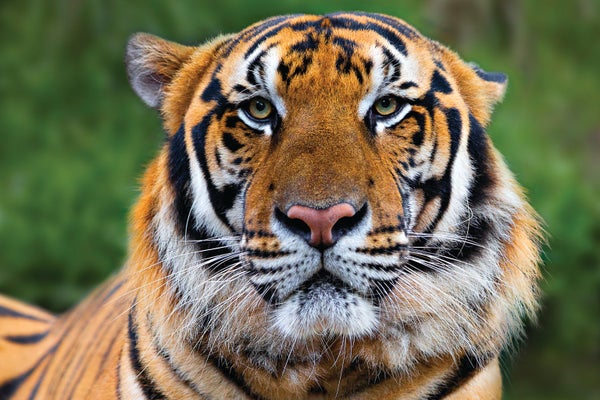
A decade ago carnivore biologists identified a remote protected area in northern Laos, called Nam Et-Phou Louey, as the country's probable last haven for wild tigers. To formally test this supposition, researchers set up camera traps in 2013 and quickly confirmed two tigers' presence. But the success was short-lived: over their study's four-year course, they never saw those or any other tigers again.
This result, reported last October in Global Ecology and Conservation, confirms that tigers are now functionally extinct in Laos. The researchers also found that leopards, formerly presumed to still live in the park, have vanished as well. “For the constellation of remaining protected areas in Southeast Asia for tigers, this was an important one—maybe even a potential jewel in the crown,” says senior author David Macdonald, a wildlife conservationist at the University of Oxford. “To find that that jewel has blinked out is devastating.”
Laos's tiger loss is part of an alarming trend across Southeast Asia; the animals have already disappeared from Vietnam and Cambodia. In almost every study site Macdonald and his colleagues have surveyed, wild tigers—which number fewer than 4,000 worldwide—are in steep decline or completely absent. So are once common leopards. Habitat loss is partly to blame, but Macdonald says that the main driver is “the astonishing, corrosive tide of poaching.”
On supporting science journalism
If you're enjoying this article, consider supporting our award-winning journalism by subscribing. By purchasing a subscription you are helping to ensure the future of impactful stories about the discoveries and ideas shaping our world today.
Akchousanh Rasphone, the study's lead author and the first Laotian woman to earn a doctoral degree from Oxford, and her colleagues installed and monitored 300 camera stations across Nam Et-Phou Louey's nearly 6,000 square kilometers of rugged, steep mountain ridges and dense forest. Over four years they observed 43 mammal and bird species—but no leopards and, after 2013, no tigers. Leading international nonprofit groups support antipoaching efforts in Laos's main protected areas, but as in many other countries, poachers still find ways to kill wildlife.
“These findings are not at all surprising,” says Ullas Karanth, a carnivore biologist at the Center for Wildlife Studies in Bengaluru, India, who was not involved in the research. “There's so much forest and so much habitat at this study site and throughout Southeast Asia, but without ground-level protections against local people doing industrial-scale hunting, the wildlife will go.”
Tigers can thrive in human-dominated landscapes: India has the world's second-highest human population, but it has prioritized tiger conservation and now hosts two thirds of the planet's remaining wild tigers. Macdonald says the respective examples of India and Laos offer lessons for countries such as Thailand, which still has about 200 wild tigers; conserving habitat is critical but so is weeding out corruption, cracking down on poaching and reducing demand for big cat parts. “One way or another,” he adds, “people have to change.”