
Astronomers just captured a never-before-seen detail of how matter makes its way from stars into planets and eventually even living things—and they did it entirely by accident.
One night in November 2025, Pieter van Dokkum and Roberto Abraham were putting the Modular Optical Telephoto Hyperspectral Robotic Array (MOTHRA) telescope in Chile through its paces. Fatefully, they chose to test the instrument, which remains in development, by observing the iconic Helix Nebula, a slowly expanding cloud of debris from a recently expired star some 650 light-years from Earth.
What they saw lurking within the resulting “mind-paralyzingly awesome images,” was something neither of them had expected, says Abraham, an astrophysicist at the University of Toronto.
On supporting science journalism
If you're enjoying this article, consider supporting our award-winning journalism by subscribing. By purchasing a subscription you are helping to ensure the future of impactful stories about the discoveries and ideas shaping our world today.
“It happens a few times in your career, that you take an image and realize no one’s ever seen this before,” says van Dokkum, an astrophysicist at Yale University. “It’s the best feeling.”
Astronomers have long known that most elemental building block of life—carbon, oxygen and nitrogen, for example—are created by stars. When stars die, they release those elements back into space, where they can go on to contribute to the creation of new stars, planets and even—at least our own small terraqueous orb—life. But many granular details of this process of stellar destruction and creation remain mysterious.
“That grand recycling of material ultimately ends up in us and creates everything we know around us,” van Dokkum says.
Now, for the first time, we can see the exact moment in which material expelled from dying stars mix with interstellar gas, he adds. The researchers’ finding appears in a paper published today in Nature.
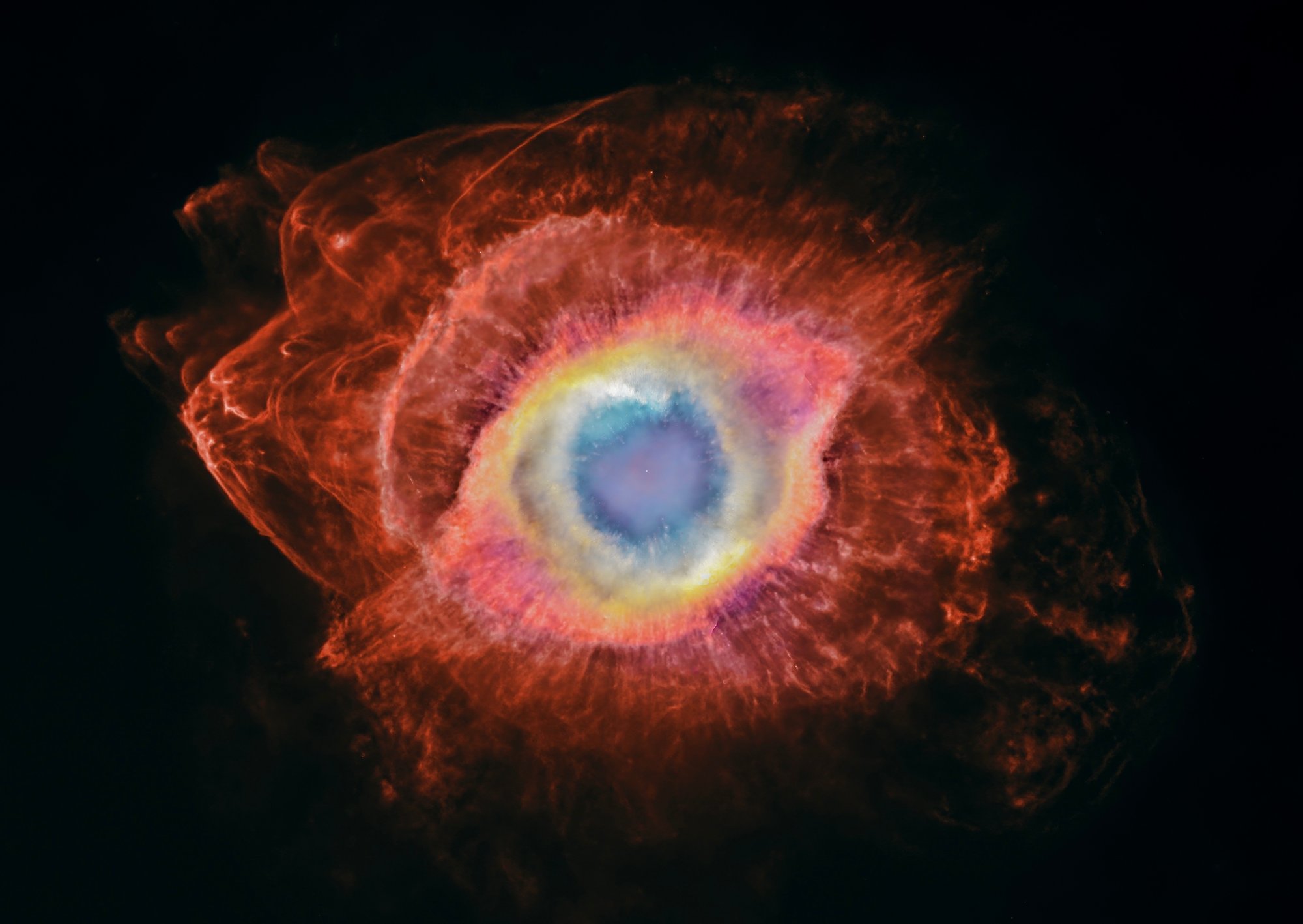
Interstellar shockwaves called bow shocks appear as bright arcs at the edges of the Helix Nebula in this panoramic view based on data from MOTHRA, the Hubble Space Telescope and the Kitt Peak 4-meter telescope.
Andrew McCarthy
The new images capture more than 20 bright “bow shocks” rippling through the sprawling Helix Nebula. Each of these features marks where faster-moving clumps of ejecta from the nebula’s now deceased stellar progenitor raise shock waves as they plow through gas and dust in surrounding interstellar space. When these collisions happen, the clumps erode and shed some of their star-forged elements. The stellar debris, van Dokkum and Abraham estimate, lingers for about 10,000 years before it fully disperses.
The images show how the stellar debris moves not in a “smooth outflow,” as astrophysicists once thought, but as “shrapnel” hurtling through space, says Michael Shull, an astrophysicist at University of Colorado Boulder, who was not involved in the study. “It’s rare that I see some pictures that really knock my socks off,” as these have, Shull adds, noting how the images so clearly delineate a key step in the “ecological cycle” of stars and galaxies.
Because of its relatively close proximity to Earth, the Helix Nebula is one of the best-studied deep-space objects in our sky, and mighty facilities such as NASA’s James Webb Space Telescope have already captured it in detail.
But MOTHRA’s observations are different from any performed for the Helix Nebula before. Instead of using a mirror to gather starlight, MOTHRA has many telephoto lenses, like those on a camera, which can capture faintly glowing wisps of gas and other feeble emanations across a wider field of view. This allowed the researchers to observe the less studied regions at the outskirts of the Helix Nebula that proved to harbor the bow shocks.
“Normally you have to finish an instrument before you can make discoveries with it, but this thing is so powerful that even in this very early phase, when we’re just starting to take data, we stumble upon entirely new things,” van Dokkum says. MOTHRA will eventually incorporate 1,140 telephoto lenses, but only a small fraction of this planned total was installed and operational for the test observations.
Now the duo and their MOTHRA collaborators are wondering exactly how this process occurs for other stars—including our own sun, which, billions of years from now, will produce a similar nebula from its own death throes and release our solar system’s hard-won elements back into the galaxy. With MOTHRA, Abraham says, we can glimpse more of those processes unfolding elsewhere in the cosmos and then build better theoretical frameworks to understand not only the majestic interstellar cycling of elements but also our small supporting role in it.
“This instrument is just going to reveal comparably cool things in pretty much everything we point it at until other people build a similar thing. It’s going to be spectacular,” he says. “This is the very first thing we tried, so it’s just a harbinger of things to come.”