
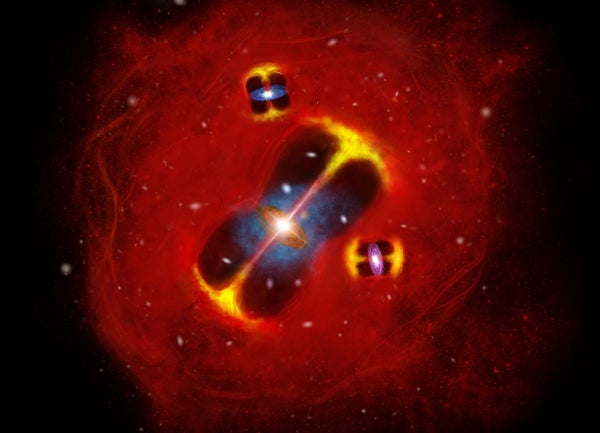
A scorchingly hot galaxy cluster in the early universe has left scientists baffled. The cluster was already blistering hot when the universe was just 1.4 billion years old—it is at least five times hotter than past theories had suggested could exist at that moment in our cosmos. The findings were detailed in a new study published on Monday in Nature.
“We didn’t expect to see such a hot cluster atmosphere so early in cosmic history,” said Dazhi Zhou, a Ph.D. candidate at the University of British Columbia and lead author of the paper, in a statement.
Zhou and his colleagues found that the gas that is threaded between the 30 or so active galaxies in this cluster, known as SPT2349-56, is much hotter and more plentiful than it should be. The gas is far hotter than the sun, Zhou told New Scientist, and far hotter than what many astronomers find in present-day clusters.
On supporting science journalism
If you're enjoying this article, consider supporting our award-winning journalism by subscribing. By purchasing a subscription you are helping to ensure the future of impactful stories about the discoveries and ideas shaping our world today.
Using the Atacama Large Millimeter/submillimeter Array, or ALMA, Zhou and his team were able to peer back to the early universe. Their findings suggest that there were more objects like SPT2349-56 producing vast amounts of energy during a moment in the universe’s early history in which scientists had thought such objects simply didn’t do so.
The team doesn’t know why the gas is so hot, but future research to find out could help astronomers better understand how the universe as we know it evolved. “Understanding galaxy clusters is the key to understanding the biggest galaxies in the universe,” which mostly reside in clusters, said Scott Chapman, a professor at Dalhousie University and a co-author on the new study, in the same statement.