
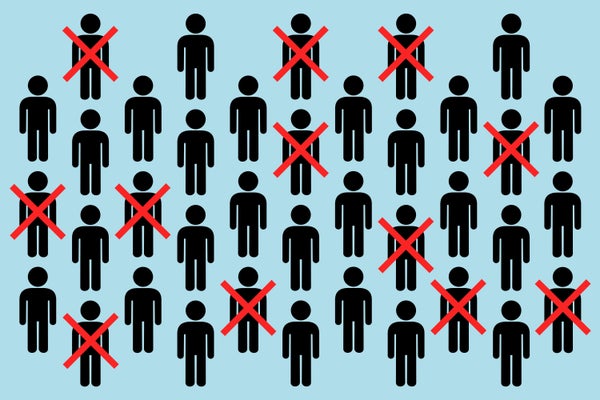
People are generally bad at assessing probabilities. That’s why we have irrational fears and why we overestimate our odds of winning the lottery.
Whenever I have to travel by plane, for example, my palms sweat, my heart races and my thoughts take a gloomy turn. I should be much more worried when I get on my bike in Darmstadt, Germany, where I live. Statistically, I’m in much greater danger on the road than in the air. Yet my bike commute doesn’t cause me any stress at all.
Recently, a friend told me about a concept within decision theory that is supposed to help people get a better sense of hazards and risks. In 1980 electrical engineer Ronald Arthur Howard coined the micromort unit to quantify life-threatening danger.
On supporting science journalism
If you're enjoying this article, consider supporting our award-winning journalism by subscribing. By purchasing a subscription you are helping to ensure the future of impactful stories about the discoveries and ideas shaping our world today.
One micromort corresponds to a one-in-a-million chance of dying during a certain activity. Do you want to run a marathon? The risk is seven micromorts. Are you going under general anesthesia? That’s 10 micromorts. To arrive at these figures, you first need detailed statistics. How many people engaged in these activities and died in the process? And the results depend heavily on the group of people being studied (their age, gender, and so on), as well as the geographic location.
Better Living through Statistics
Surprisingly, the history of statistics doesn’t go back very far. In the 17th century, British demographer John Graunt pioneered mortality statistics by analyzing records of deaths and baptisms. But it would take another 200 years for society to recognize the social benefits of these approaches.
Today the utility of this mathematical subfield is undisputed. Insurance companies and banks use statistics to carry out risk assessments. Statistical surveys make it possible to investigate psychological and sociological phenomena. Physical research would be unthinkable without statistics.
Thanks to Howard and the micromort, the risks in our everyday lives can also be estimated with the help of statistics. By examining the proportion of people who die while undertaking a particular activity, he was able to create a general mortality risk for those activities.
But more recently, mathematician David Spiegelhalter noticed something missing in Howard’s analysis: the micromort unit merely indicates how likely it is that a very specific action will kill us. This may make sense for a one-off activity such as climbing a mountain. But for long-term habits, such as regularly eating fast food, the measure is of only limited use.
For example, smoking a cigarette causes just 0.21 micromort and would therefore be significantly less risky than getting out of bed in the morning at the age of 45 (which results in six micromorts). Smoking, however, has long-lasting negative consequences for the body that getting up in the morning does not. The long-term risk is therefore not recorded.
So Spiegelhalter introduced the “microlife” measure to take into account the long-term effects of different activities. This quantifies how much life you lose on average by carrying out an activity. Each microlife that is lost reduces your life expectancy by half an hour. Two hours of watching TV each day might cost one microlife, for instance.
One of the most significant differences between micromorts and microlives is that one of the two types of units compounds over time, and the other does not. If I survive my morning bike ride to the Darmstadt train station, my micromort count for that ride drops back to zero. The next day I start the journey again with the same risk.
It’s different with microlife data: if I smoke a cigarette and then a second one an hour later, the time I’ve lost adds up. And of course, the mere ticking of the clock also shortens my available years of life. Every day 48 microlives are lost.
But unlike micromorts, I can regain microlives. For example, a 20-minute walk provides me with around two microlives—that is, an extra hour of life expectancy. And eating a healthy diet with fruits and vegetables could gain you four microlives daily.
Reality Check
All these facts and figures are entertaining to read about and can make for interesting conversation starters—“Hey, did you know that this beer shortens your life by about 15 minutes?”—at least with the right crowd. But how do you calculate the microlives you lose as a result of an action?
First, you have to compare the life expectancy of different people. For example: How does the life expectancy of smokers and nonsmokers differ? By taking this difference and dividing it by the average number of cigarettes smoked, we can calculate the average amount of time that each cigarette robs us of.
This result is clearly inexact. The difference in life expectancy will also depend on factors such as a person’s gender, place of residence and age. These data can still be captured, but when it comes to general lifestyle factors, things get complicated. For example, studies show that many smokers generally have an unhealthier lifestyle and exercise less.
Such correlations cannot always be calculated and accounted for. When it comes to smoking, however, there have been long-term studies that followed many people, some of whom stopped smoking at some point in their life, over several decades.
These data make it easier to isolate the effect that smoking has on a person’s life expectancy. Such research suggests that a single cigarette is likely to rob a person of slightly less than the originally calculated 15 minutes of life if they have the other lifestyle habits of a nonsmoker. So should we be consulting statistics at the start of every day to maximize our lifespan? Perhaps we should be studying these analyses to engage in activities with as few micromorts as possible and try to gain, rather than lose, microlives?
Not exactly. Micromorts and microlives can help you better assess risks. But you shouldn’t attach too much importance to them. After all, our world is complex. You may gain back two microlives during a walk, but you could also get in an unlucky accident along the way and be hit by a car. Ultimately, micromorts and microlives are just too simple a tool to evaluate the full range of consequences associated with an action. Exercise can improve your state of mind, which has a positive effect not only on your quality of life but also on your lifespan.
That said, it can still be a source of comfort to turn to statistics—particularly when we want to understand if our fear is rational or not. For my part, I will try to remind myself of how few micromorts are associated with flying. Maybe that will help.
This article originally appeared in Spektrum der Wissenschaft and was reproduced with permission.