
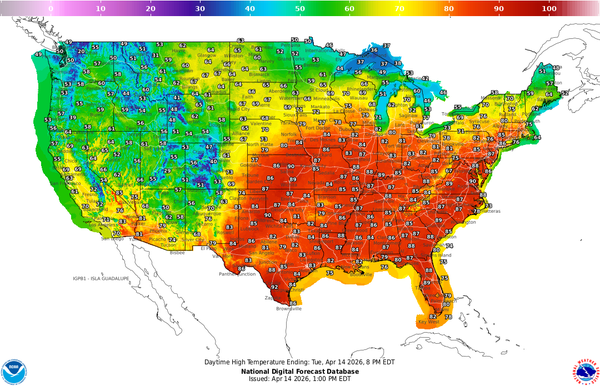
It may be April, but for most of the country, summer feels very much like it’s already here. This week East Coast states are seeing unusually hot days, with temperatures in some major cities reaching as high as the 90s Fahrenheit (mid-30s Celsius).
On April 15 New York City’s Central Park reached 90 degrees F (32 degrees C), three degrees F higher than the previous record high for the date, which was set in 1941. Ronald Reagan Washington National Airport in Washington, D.C., hit the same temperature, breaking the previous record, also from 1941, by one degree F. Philadelphia hit 91 degrees F (nearly 33 degrees C), breaking its 1941 record by three degrees F. Raleigh, N.C., tied its April 15 record of 92 degrees F (more than 33 degrees C) but still has the potential to see records fall in the coming days.
The scorching temperatures are driven by an area of high pressure across the eastern U.S., with wind flow from the South and not a lot of cloud cover, says Maryland-based NWS meteorologist Frank Pereira. A low chance of storms, which can help break the heat, is also not helping.
On supporting science journalism
If you're enjoying this article, consider supporting our award-winning journalism by subscribing. By purchasing a subscription you are helping to ensure the future of impactful stories about the discoveries and ideas shaping our world today.
Wednesday was expected to be this week’s hottest day in much of the mid-Atlantic. The NWS warned that parts of North Carolina, Virginia, New Jersey and Pennsylvania would have a “moderate” risk of heat-related health effects such as heat stress, with pockets of “major” risk around Washington, D.C.
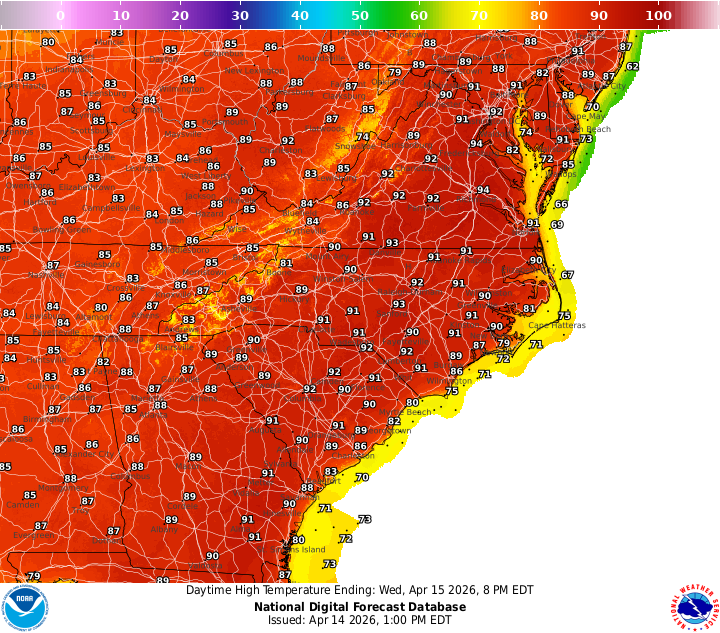
A high temperature forecast for the mid-Atlantic on April 15.
“This is impressive heat for mid-April, arriving weeks earlier than we typically see in many cities,” said Matt Benz, a senior meteorologist at AccuWeather, in a statement. “Early-season heat can hit harder than people expect because it arrives before routines, clothing and outdoor plans have adjusted to summerlike conditions.”
In New York City, for instance, April temperatures in Central Park typically fall somewhere in the 40s and 50s F (single digits to mid-10s C), according to data collected by the NWS dating back to the late 1860s. The highest April temperature ever recorded in the park was 96 degrees F (36 degrees C) in 1976 and 2002.
This year has already seen several broken heat records. In March at least eight states saw the highest temperatures for that month ever recorded. And nine western states experienced their hottest winters in 2025. More records could fall: forecasters are increasingly predicting that an El Niño will return this summer, and it may drive up global temperatures.
More immediately, for the eastern U.S., relief is on the horizon—a “pretty strong” cold front will likely move in this weekend, and the high temperatures will abate, Pereira says.
Editor’s note (4/16/26): This story has been updated to include details about conditions experienced this week.