New Issue: Orbital Catastrophe Ahead? Read Now

The Eclectic Works of Scientific American's Founder Rufus Porter

The latest science book recommendations from our editors

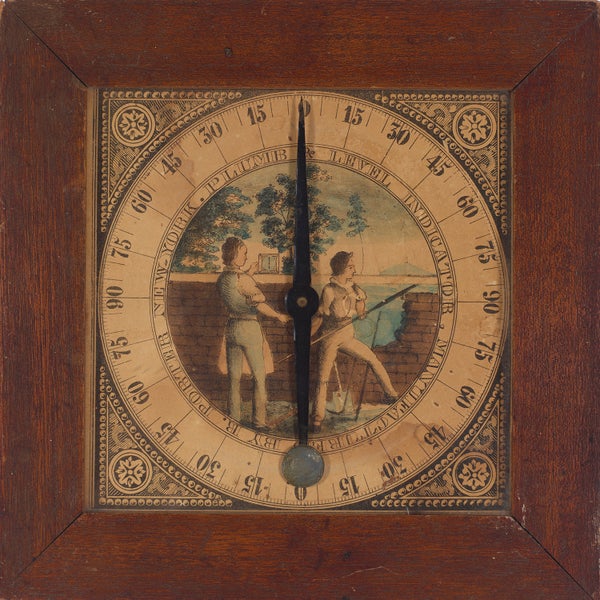
Plumb and level indicator, circa 1846

Plumb and level indicator, circa 1846.

Luc Demers Bowdoin College Museum of Art, Brunswick, Maine

We’re celebrating 180 years of Scientific American. Explore our legacy of discovery and look ahead to the future.

Art and Invention in America, 1815-1860
Edited by Laura Fecych Sprague and Justin Wolff
Pennsylvania State University Press, 2019 ($39.95). Exhibit:12/12/19 to 5/31/20, Bowdoin College Museum of Art


On supporting science journalism

If you're enjoying this article, consider supporting our award-winning journalism by subscribing. By purchasing a subscription you are helping to ensure the future of impactful stories about the discoveries and ideas shaping our world today.


In his obituary in this magazine, published on September 6, 1884, Rufus Porter is described as a “remarkable natural genius” who had a peculiar tendency to move quickly from one occupation and place to another. “Although he might be doing well at the business which for the time engaged his attention, he would sell out and abandon it the moment a new idea came into his mind,” the writer remarked. “His brain was an overflowing fountain of new ideas and active projects.”

Porter was a prolific inventor and is credited with dozens of inventions, including a flying ship, a portable camera obscura, a rotary plow, and more. He left many of his projects unfinished—this happened with a revolving almanac he was perfecting in 1823, when he quickly changed gears to work on a new kind of boat intended to traverse the Connecticut River. He made his primary living as an artist, painting portraits, landscapes and architecture.

Luc Demers Bowdoin College Museum of Art, Brunswick, Maine (1); Courtesy Howard W. and Jean Lipman Papers Archives of American Art, Smithsonian Institution (2); Courtesy American Antiquarian Society (3); Scientific American (4)

In 1845 he published the first issue of Scientific American, which he ran for less than a year before moving on to his next occupation. Thankfully, this endeavor endured well beyond his lifetime. The image of our first issue is in this new collection of Porter's works and part of an exhibition alongside many of his portraits and illustrations of his inventions, housed at the Bowdoin College Museum of Art in Brunswick, Maine.

  1. Plumb and level indicator, circa 1846, New York, N.Y.; hand-colored engraving, metal pointer, wood frame. By Rufus Porter, 1792–1884, designer; and unidentified engraver.

  2. Rufus Porter, circa 1872; photographic print by an unidentified photographer.

  3. Revolving almanack, circa 1841; framed engraving by Samuel Maverick (1789–1845), engraver, after Rufus Porter.

  4. The first and other early issues of Scientific American, established in 1845.

Andrea Gawrylewski is chief newsletter editor at Scientific American. She writes the daily Today in Science newsletter and oversees all other newsletters at the magazine. In addition, she manages all special editions and in the past was the editor for Scientific American Mind, Scientific American Space & Physics and Scientific American Health & Medicine. Gawrylewski got her start in journalism at the Scientist magazine, where she was a features writer and editor for "hot" research papers in the life sciences. She spent more than six years in educational publishing, editing books for higher education in biology, environmental science and nutrition. She holds a master's degree in earth science and a master's degree in journalism, both from Columbia University, home of the Pulitzer Prize.

More by Andrea Gawrylewski
Scientific American Magazine Vol 322 Issue 2This article was published with the title “Recommended” in Scientific American Magazine Vol. 322 No. 2 (), p. 67
doi:10.1038/scientificamerican0220-67

Subscribe to Support Independent Journalism

Great science journalism requires human expertise, time, effort and creativity. And it costs money. That’s why I and the journalists here at Scientific American hope you’ll join our community.

When you subscribe, you are supporting staff and freelance journalists who are passionate about telling science stories that are true, important and compelling. Our editors and reporters are often experts in their fields, which means they understand the nuances of big discoveries and can untangle the breakthroughs from the hype. With a subscription, you are also supporting rigorous fact-checking to ensure the words we publish are precise and accurate. And you’re supporting original illustrations, graphics and photos that bring you closer to an advanced laboratory, an ice sheet in Antarctica or a space mission in orbit. You’re helping us craft other types of high-quality journalism as well: Our newsletters are carefully written, edited and curated by staffers you have or will come to know and love. Our Science Quickly podcast is based on original reporting, collaboration with editors and scientists and exacting production.

Subscriptions keep this engine running so we can continue to deliver thoughtful, rigorous and independent science journalism to you. In an era of viral misinformation, this work is crucial. If you value what we do, I hope you’ll consider joining us as a subscriber

Thank you,

Jeanna Bryner, Editor in Chief, Scientific American

Subscribe