
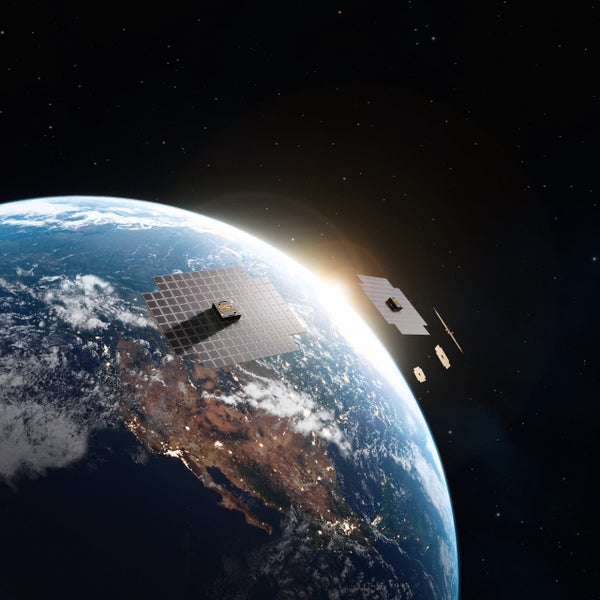
The largest-ever communications satellite of its kind took a major step toward operation Tuesday: operator AST SpaceMobile announced the record-breaking spacecraft, whimsically called BlueBird 6, has successfully unfolded its humongous antenna.
Spanning some 2,400 square feet (223 square meters), it is the largest commercial communications array antenna ever deployed in low-Earth orbit. AST SpaceMobile hopes it will be the first of many: the Texas-based public company has six smaller satellites already operating in low-Earth orbit, with plans for scores more behemoths like BlueBird 6. Ultimately these will form a cellular broadband network aimed specifically at smartphones.
BlueBird 6 is huge. Whereas Starlink satellites are about the size of a large table and have an array that extends about 100 feet, BlueBird 6’s array spans an area a little shy of a doubles tennis court. It is also very bright, says Peter Plavchan, an associate professor of physics and astronomy at George Mason University, who is not involved with the satellite company.
On supporting science journalism
If you're enjoying this article, consider supporting our award-winning journalism by subscribing. By purchasing a subscription you are helping to ensure the future of impactful stories about the discoveries and ideas shaping our world today.
“These satellites are going to be so bright that they will be easily visible to the eye,” he says, more luminous than Saturn. Having such bright, numerous manmade objects in the sky means that ground-based astronomy—whether professional or amateur—will ultimately be affected, he says.
“The view of our sky is changing,” Plavchan says. “Even in dark-sky locations now, things are going to look different.”
Samantha Lawler, an associate professor of astronomy at the University of Regina, agrees, stressing that objects so bright will muddy astronomy—and more.
“Having many of these satellites in the sky will be detrimental to astronomy research, devastating for naked-eye observers and could even cause serious issues for migratory birds and other animals that navigate by the stars,” Lawler says.