
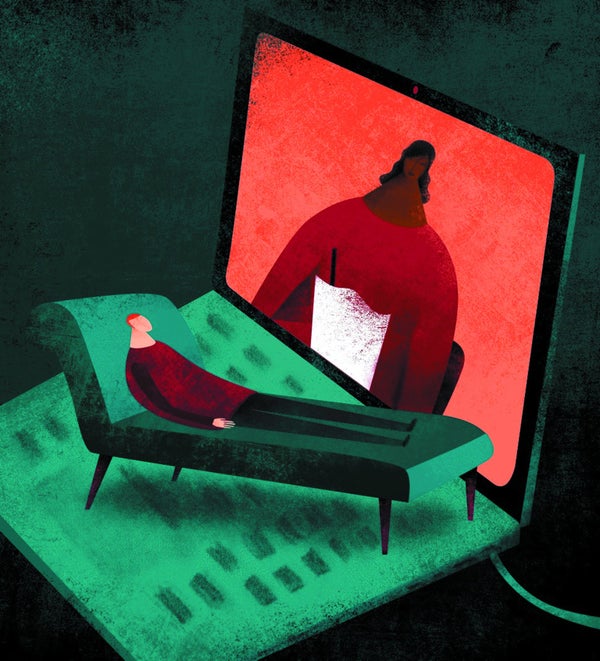
In the before times, clinical psychologist Leslie Becker-Phelps met with patients in a tidy private office in Basking Ridge, N.J., carefully observing their demeanor, body language and, with couples, interpersonal vibe. That changed with COVID’s social-distancing exigencies. “My office is a 14-foot by 14-foot room,” she explains, “and I am not going to do therapy with masks that cover something that is so important in therapy—the face.” Today her sessions take place by videoconference or, sometimes, phone. “I’ve found that it works,” she says. “I was surprised.”
Becker-Phelps is hardly alone in switching up her practice during the pandemic. In a survey of 1,141 clinical psychologists released in October by the American Psychological Association (APA), 96 percent said they were providing remote or “telehealth” services to patients, and an equal portion judged them to be effective. As recently as 2019, only 21 percent of psychologists reported offering videoconferencing as an option, says Lynn Bufka, senior director for practice transformation and quality at the APA. Still, patients might wonder: Is meeting with a therapist on video really equivalent to an in-person session? What about the initial diagnostic process? Are some types of therapy better suited than others to remote delivery? For some of these questions, we have solid answers; for others, not quite yet.
Long before COVID, researchers began to look at how well remote psychotherapy works. Most studies focused on people with depression treated with cognitive-behavioral therapy (CBT). This approach, which aims to change negative patterns of thought and behavior, “lends itself well to research because it has a clear structure and process,” Bufka notes. In CBT, patients work through a series of information modules and exercises. A 2018 meta-analysis of 20 studies involving more than 1,400 patients found that the therapy is equally effective for depression, as well as a range of anxiety disorders, whether delivered in person or online. “You can do it individually or in groups, by telephone or by Internet interventions, and the effects are not different,” says clinical psychologist Pim Cuijpers of Vrije University in Amsterdam, a co-author of the meta-analysis and of many studies on remote therapies.
On supporting science journalism
If you're enjoying this article, consider supporting our award-winning journalism by subscribing. By purchasing a subscription you are helping to ensure the future of impactful stories about the discoveries and ideas shaping our world today.
Some alternatives to CBT have also been studied, though in less depth. Cuijpers, along with his colleagues in the Netherlands and Australia, has found that interpersonal psychotherapy—another highly structured approach—is about as effective for depressive symptoms as CBT when delivered online, and a 2020 meta-analysis concluded that even psychodynamic therapy, which focuses more on the roots of problems than on outward behaviors, can be delivered effectively via technology. The same seems true of therapies designed to treat post-traumatic stress disorder, according to a 2017 review of 41 studies of teletherapy for veterans with PTSD.
Remote technology can work well for diagnosis, too. In many studies of teletherapy, however, the initial diagnostic screening was done in person. “There was a concern about capturing the severity of the individual’s presentation,” Bufka explains. But now insurers have loosened rules around remote diagnosis and treatment, and clinicians are using teletherapy for first assessments. “I was concerned about a loss of subtle and nonverbal communication—not catching things on a camera the way you might if you are sitting in the room,” says psychiatrist Peter Halperin of the Cooley Dickinson Health Care system in Northampton, Mass. Instead he sees some advantages: “It is tough for somebody to go to a new building, see a new person, and in that first hour talk about highly charged emotional stuff. I found that people are more facile at doing it when they are talking to me from their homes.”
There can, of course, be glitches. The APA survey found that the top challenges were technical and connectivity problems and patients finding a private space for sessions. “It’s not unusual for people to do therapy from their car,” Becker-Phelps says. Some of her patients miss in-person proximity, and she does, too. In a shared space, she can use her own physical presence, leaning forward with compassion when a patient is upset or to take control when couples get overheated in therapy.
Like telecommuting, teletherapy seems destined to stay. There are battles ahead about whether insurers will reimburse it at the same rates as in-person therapy, Bufka says, and clinicians will need to use platforms that meet federal privacy requirements, if they are not already doing so. But given the rising demand for mental health services in the COVID era, having more options for accessing care is not merely convenient; it is essential.