
Editor’s Note (6/23/23): On June 22 the U.S. Coast Guard announced that a remotely operated vehicle found debris from the Titan submersible. OceanGate Expeditions, the company that owns the vehicle, declared that the Titan and all five people onboard were lost. For more coverage of the submersible, see “What Happened to Imploded Titanic Tourist Sub?” For more on the deep-sea environment where the debris was discovered, read “See How Crushing Pressures Increase in the Ocean’s Depths.”
Global media have been obsessed with the search for the missing submersible Titan, four of whose five occupants spent $250,000 each to get close to the famous wreck of the Titanic. In Germany, where I live, the German Press Agency (dpa) described the underwater voyage as a “modern adventure” that became a “life-threatening nightmare.” At Spektrum der Wissenschaft, we wrote about a “race against time.” And our English-language sibling publication, Scientific American, covered the “perils of deep-sea exploration.” The U.S. Coast Guard has deployed a number of forces for the search, the British government has offered to help, and France has sent a special ship.
The submersible’s disappearance is a tragedy for its occupants and their families. But why do we give these missing people so much more sympathy and attention than the hundreds of migrants who have died in the Mediterranean in recent days? Why does the fate of a few people who volunteered for an intrepid adventure touch us so much more than that of thousands of desperate people who chose to escape war and poverty? We look at the missing submersible and look away from the capsized lifeboat.
On supporting science journalism
If you're enjoying this article, consider supporting our award-winning journalism by subscribing. By purchasing a subscription you are helping to ensure the future of impactful stories about the discoveries and ideas shaping our world today.
One likely answer: The fate of daring millionaires seems closer to us than that of people fleeing a war. One story smells of adventure, curiosity and luxury; the other smells of fear, despair and misery. If the businessmen are rescued, they will return home to their mansions and villas. With the migrants, on the other hand, new questions arise, including which emergency accommodation they will be taken to and at whose expense. Others wonder whether they shouldn’t be sent straight back to their home countries, which they have just left under nerve-racking duress. You might see yourself in one of these two vessels, if you only had the money. You hope to never be in the other, not for all the money in the world.
Shouldn’t suffering through no fault of one’s own trigger a stronger reflex to help than a disaster born of the thirst for adventure? Not necessarily. As studies from social psychology show, our sense of empathy for others can overwhelm us. We often ignore people’s pain to release ourselves from feeling responsible. In the case of the migrants, one could almost speak of an emotional numbing process. When the influx of migrants into Germany was about to peak in 2015, its then chancellor Angela Merkel made entry into the country easier. She was celebrated for her welcoming culture—until the mood suddenly changed and nearly reversed. The German population felt overwhelmed, as did our political parties. The asylum seekers were criminalized, fueling public resentment against them. Now no one hesitates to discuss the need to monitor European borders more closely.
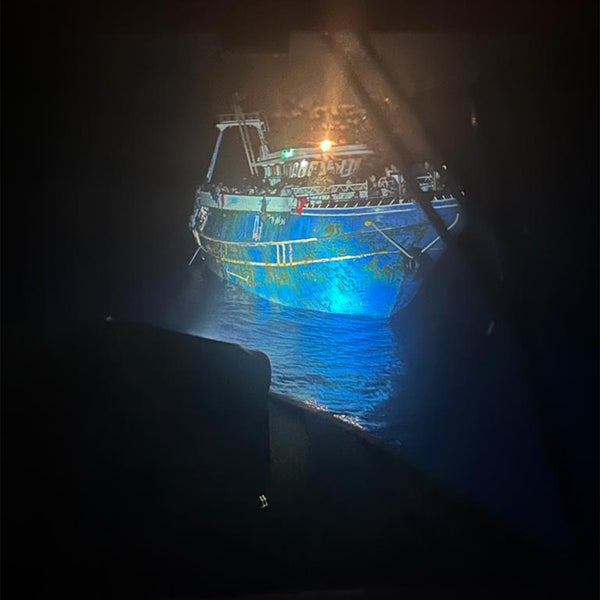
In the current situation off the coast of Greece, in which more than 500 migrants may have drowned, it looks as if the Greek coast guard inspected the hopelessly overloaded ship from a distance hours before it sank. But the coast guard did not help the people inside. And apparently nobody else felt responsible either. The European Border and Coast Guard Agency, also known as Frontex, which has flying thermal cameras, reportedly learned about the ship’s hopeless situations a day before it sank. Yet Frontex did not act.
In the case of the Titan, on the other hand, many media outlets have anxiously watched and counted down the hours until the occupants may have run out of oxygen. People have asked what exactly could have happened, whether the boat got tangled up in the wreck of the Titanic or whether a power failure paralyzed the technology. There was speculation that knocking noises picked up by a Canadian search plane could have been signs of life from the crew. And there has been much discussion of why some people consciously seek out thrills and risks.
The migrants did not want thrills. They only accepted the risk of boarding an overcrowded ship because staying would have been even riskier. Humanity demands that we look again at their plight and seek solutions together, with the same anxious urgency as we do for the Titan.
This article originally appeared in Spektrum der Wissenschaft and was reproduced with permission.
This is an opinion and analysis article, and the views expressed by the author or authors are not necessarily those of Scientific American.