
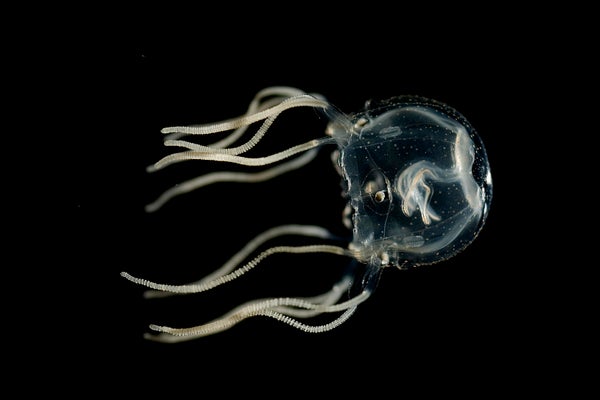
Tiny, brainless jellyfish just did something that on the surface may seem impossible: the adorable creatures showed evidence of learning.
Even with just 1,000 neurons active at a time and no central brain, Caribbean box jellyfish (Tripedalia cystophora) can learn from experience, researchers argue in a new paper published September 22 in the journal Current Biology. The results aren’t surprising, say several scientists not involved in the project, but are a reminder for people to think more broadly about learning.
“If you’re an animal and have to navigate the world, you have to learn cues and consequences. Otherwise you’re dead, and you can’t reproduce,” says Christie Sahley, a neuroscientist at Purdue University who was not involved in the new research. “It’s just a fundamental process, and it doesn’t take a higher brain.”
On supporting science journalism
If you're enjoying this article, consider supporting our award-winning journalism by subscribing. By purchasing a subscription you are helping to ensure the future of impactful stories about the discoveries and ideas shaping our world today.
Scientists categorize learning into two types. Nonassociative learning includes phenomena such as habituation: if you gently poke an animal several times, it will eventually stop recoiling or shying away. Associative learning is more complex because it requires an animal to connect cues in its environment; the classic example is Ivan Pavlov’s experiment, which showed that dogs repeatedly fed after hearing a bell ring will eventually salivate solely at the sound of the bell.
But not many experiments have demonstrated associative learning in simple animals such as jellyfish, says Ken Cheng, an animal behaviorist at Macquarie University in Australia who was not involved in the new research but wrote a commentary on it for the same issue of Current Biology. In 2021 Cheng published a review of learning in Cnidaria—a group that includes jellyfish, corals, sea anemones, and more—and found only a handful of studies that tested for associative learning, all of which were on sea anemones.
That’s in part because scientists bring human assumptions and priorities to the experiments they design, says Jan Bielecki, a neurobiologist at Kiel University in Germany and co-author of the new research. He sees that as a mistake.
“You can’t judge a fish by its ability to climb trees,” Bielecki says. “The parameters that you use have to make sense to the animal,” he adds. “You kind of have to meet them where they are at.”
Bielecki and his colleagues looked for associative learning in small jellyfish that sport four eye structures called rhopalia that each contain six eyes and about 1,000 neurons, he says. (Each rhopalium takes turns acting as the jellyfish’s noncentralized nervous system.) Then the team designed an experiment that made use of the animal’s instinct to protect its bell, the main structure from which its tentacles sprout. In their native, sometimes cloudy, waters, these jellyfish must use their vision to navigate around tree roots.
So scientists put the jellyfish in tanks that were painted with three different levels of contrast: high-contrast black-and-white vertical stripes that represented nearby tree roots; medium-contrast gray-and-white vertical stripes that presented an optical illusion of tree roots far beyond the tank’s walls; or solid gray with no contrast. The jellyfish navigated the black and white stripes without issue—the contrast was stark enough that they never actually hit the tank’s walls. But without the experience of hitting the tank, they didn’t learn to avoid it. The jellyfish in the plain gray tanks also didn’t learn; they bumped into the walls throughout their time in the tank.
Only the jellyfish in the gray-and-white striped tanks learned to associate the décor with the risk of collisions, Bielecki and his co-authors found. Early in the 7.5-minute trial period, these jellyfish bumped into the tank walls, but by the end of the trial, they were successfully staying clear of the wall.
Impressively, the jellyfish were successfully associating the stripes with wall after just three to five bumps. “What was surprising was how fast they would learn this,” Bielecki says.
Although it’s a clever experiment, says Catharine Rankin, a behavioral neuroscientist at the University of British Columbia who was not involved in the new research, she’d like to see additional tests to better understand what precisely the jellyfish are doing and how advanced the learning is.
“Show me extinction. Show me if you present that same visual cue over and over again, and the animals never bump into anything—will they stop avoiding it?” Rankin says. Sahley, who has studied learning in a host of other simpler species, also notes that she’d want to test how long the jellyfish can remember the association between the gray stripes and the impact risk.
Still, scientists say the new study provides valuable information about how learning works across the diversity of animal life. Simple animals such as jellyfish can better show the basic processes of neurons than a human or mouse brain can—with hundreds of thousands of times more neurons, their interactions are harder to unravel.
“You don’t need something like a hippocampus or a cortex [to learn],” Cheng says. “These animals don’t have that, and that should make us look at even simpler animals—and even at single cells.”