
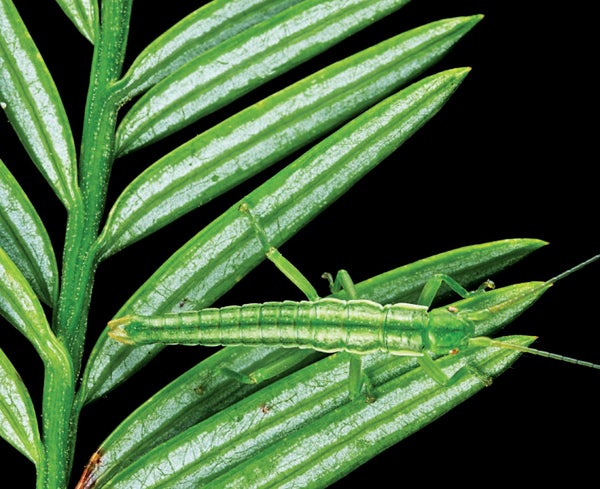
Certain wingless, sticklike insects that hide in bushes and trees across central California have no need for males: these insects in the Timema genus are nearly all female and reproduce without sex by creating genetic clones of themselves, a process called parthenogenesis.
But entomologists occasionally stumble on male Timema insects, which seem to have no reproductive function. “We initially assumed that the males were just errors, as loss of a single X chromosome can result in an egg developing into a male,” says ecologist Susana Freitas, who led the study while working at the University of Lausanne in Switzerland.
Freitas and her team found that the uncommon males may engage in infrequent flings with the females. This “cryptic sex” introduces genetic diversity into stick insect populations and might aid their long-term survival. The team's genetic analysis was recently published in the Proceedings of the Royal Society B.
On supporting science journalism
If you're enjoying this article, consider supporting our award-winning journalism by subscribing. By purchasing a subscription you are helping to ensure the future of impactful stories about the discoveries and ideas shaping our world today.
Parthenogenesis (meaning “virgin birth”) is common among invertebrates and even occurs in some species of birds, lizards and snakes. For some, it's a last resort when mating options are limited; for others, it's their only method of reproduction. But creating offspring through cloning results in low genetic diversity, leaving a population vulnerable to harmful mutations and limiting its ability to adapt to environmental changes.
To examine the genetic diversity of the stick insects, researchers extracted DNA from females and rare males in eight Timema populations across four species. They then tracked the position of various genetic markers in each insect. These markers stay linked on chromosomes during asexual reproduction but are reshuffled with another individual's genes during sexual reproduction.
Most offspring genetically resembled their female parents. But offspring in two Timema species showed greater genetic diversity and fewer linked genes, indicating cryptic sexual relations. Tellingly, the genetic profiles of the uncommon males matched what would be expected from a rare sexual encounter.
The discovery “reinforces the hypothesis that many of the species previously thought to be anciently asexual in fact engage in sexual reproduction or other forms of genetic exchange,” says Olga Vakhrusheva, an evolutionary biologist at the Skolkovo Institute of Science and Technology in Moscow, who was not involved in the new work.
These rare interactions, also known to occur among small crustaceans and water invertebrates, “could be helping to wash away any deleterious mutations,” says Alexis L. Sperling, a crop scientist at the University of Cambridge, who also was not involved in the new study. She notes that many agricultural pests such as aphids, wasps and flies reproduce asexually. Cryptic sex or similar strategies could help these pests thrive, Sperling suggests— “but we need more research to be sure.”