
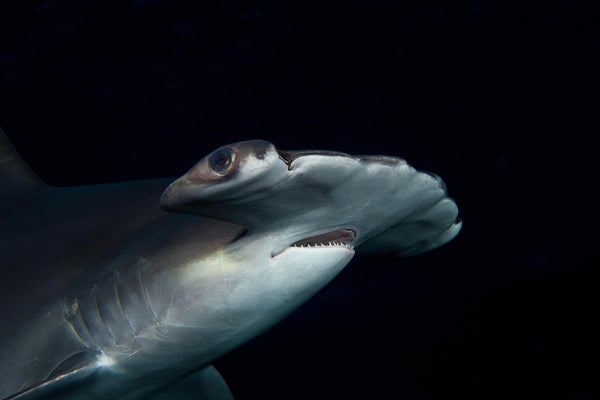
A dramatic-looking shark holds its breath for about 17 minutes to stay warm during hunting dives in cold water, scientists have found.
Scalloped hammerhead sharks (Sphyrna lewini) are found in warm, near-surface ocean waters around the world, particularly coastlines, and can reach up to around a dozen feet in length. But these sharks do venture into deep, chilly water to hunt. That’s potentially problematic because scalloped hammerheads, like most sharks, are cold-blooded, which means their body temperature matches that of their immediate environment. “When you go into cold water, if your body cools down, you can’t hunt as effectively,” says Mark Royer, a shark biologist at the Hawaii Institute of Marine Biology. “In order to be an effective hunter, it’s important to keep yourself warm as much as possible.”
Some fish such as bluefin tuna, great white sharks (Carcharodon carcharias) and swordfish have special muscles and blood vessels that allow them to keep their brain, eyes and swimming muscles warm even in cold waters—but scalloped hammerheads don’t. Yet as Royer and his colleagues analyzed 106 deep dives made by six individual scalloped hammerhead sharks, they saw that the animals stayed mysteriously warm long into these excursions, according to sensors that recorded the sharks’ muscle temperatures, orientations, and diving depths and the ambient temperatures of the water around them.
On supporting science journalism
If you're enjoying this article, consider supporting our award-winning journalism by subscribing. By purchasing a subscription you are helping to ensure the future of impactful stories about the discoveries and ideas shaping our world today.
“We looked at the body temperature data, [and] right off the bat, we could see that these sharks were doing something very interesting and very different, compared to any other fish,” Royer says. “It’s obviously not simple thermal inertia that these sharks are relying on to maintain their body temperature on these deep dives. There’s something much more complex.”
The researchers found that the sharks were making steep, fast descents to spend a few minutes feasting in deep waters, then speeding most of the way back to the surface. The animals stayed warm until the point where their ascent slowed—on average, 17 minutes, Royer says. The team’s findings were published on May 11 in Science.
The researchers think the mystery lies in the sharks’ gills. These organs act as lungs, pulling oxygen from seawater. But gills come with a downside because vast quantities of water pass through them. “Gills are like giant radiators strapped to your head,” Royer says. “Whenever a shark or a fish goes into colder water, it’s going to very quickly lose its body heat through its gills because the gills have all that large surface area.”
The team couldn’t monitor the sharks’ gills directly, although Royer says that in the future, he’d like to equip sharks with pectoral-fin cameras pointing toward the gills. But for now, the scientists think that the sharks are closing their gills—holding their breath, essentially—during their daring dives. (Royer notes that other researchers have footage of one scalloped hammerhead diving with its gills shut.)
“It’s definitely something that hasn’t, as far as I know, been put forward for an ectothermal [cold-blooded] fish yet that I think is going to create really cool avenues for future research,” says Ashley Stoehr, a marine biologist at Sacred Heart University, who specializes in fishes and wasn’t involved in the new research.
Scalloped hammerhead sharks may not be unique in employing this technique for deep dives, Royer says. Oceanic whitetip sharks (Carcharhinus longimanus) don’t make these dives as often as scalloped hammerheads do, he says, but they are still known for dramatic dives. And scientists know that these sharks also lack the specialized muscles and blood vessels that can keep fishes warm. Still, it seems scalloped hammerheads’ breath-holding technique is a rare approach to daring cold waters. “It’s an incredible and unexpected behavior from a remarkable species,” Royer says.