
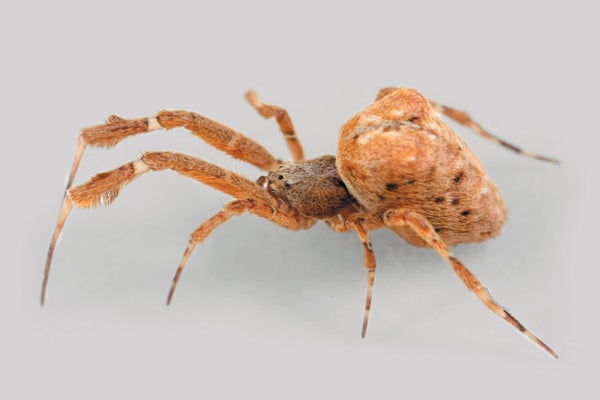
You don’t always need a book or movie for a good horror story. Sometimes, if you dare look closely enough, you can find one in your own backyard. Researchers have just confirmed the inner workings of a brutal food-prep technique some spiders use: wrapping their web-snagged prey tightly in silk strands, then puking up toxic digestive fluids to soak the entire package to marinate their meal alive.
Spiders from the Uloboridae family, usually just a few millimeters long, have puzzled scientists because they seemed to lack venom—a substance that is widespread among spiders and “really linked to their evolutionary success,” says Alex Winsor, a neuroethologist at the University of Massachusetts Amherst, who wasn’t involved in the new research.
And there was another mystery. Uloboridae spiders were already known to wrap their prey in hundreds of meters of silk and then regurgitate on them, but researchers hadn’t fully pinned down the function of their dramatic vomit. Intrigued, a study team took a closer look at how these predators prepare a snack for themselves. The findings were published in BMC Biology.
On supporting science journalism
If you're enjoying this article, consider supporting our award-winning journalism by subscribing. By purchasing a subscription you are helping to ensure the future of impactful stories about the discoveries and ideas shaping our world today.
By analyzing one species called Uloborus plumipes, the researchers confirmed that these spiders lack venom glands and thus are unable to administer venom in the classic spider way: injecting it into their prey with a fanged bite. But the scientists did find genes actively producing toxinlike proteins in the spiders’ digestive system—particularly in the midgut area—and these potential toxins “appear to be very strong,” says study co-author Giulia Zancolli, an evolutionary biologist at the University of Lausanne in Switzerland.
Injecting these digestive fluids into fruit flies in the laboratory proved their high toxicity: just 230 nanograms—billionths of a gram—killed more than half the flies within an hour. The researchers theorize that these spiders do indeed marinate their prey to death this way. Strangely, some spiders from other families that kill with the usual venomous bites are also known to have toxins in their digestive fluids, Zancolli says. This fact raises what she calls a “fascinating question”: What role do these substances play for species outside the Uloboridae family?
The study’s finding “solves a puzzle within spider biology,” Winsor says. A next step, he adds, could be to investigate whether digestive-system toxins appear in other animal species, such as some lizards. “If these compounds do have some special ability to subdue insects, then you might expect them to emerge in other groups of animals,” Winsor says. If that proves true, “then maybe these are a recurring answer in the animal kingdom.”