
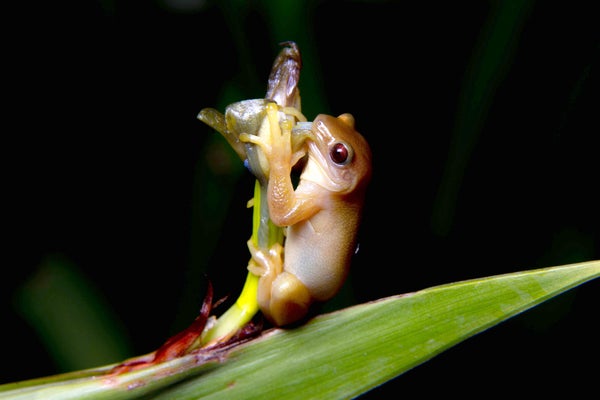
On rainy nights on the verdantcoastal plains outside Rio de Janeiro, groups of tree frogs sometimes gather around the pearly white flowers of the milk fruit tree. But while most tree frogs are on the prowl for night-flying insects, one species is after the sugary nectar in the flowers. The tiny, orange Xenohyla truncata’s sweet tooth might make it the world’s first known pollinating amphibian. And the discovery adds to growing evidence that we need to broaden our understanding of which animals act as pollinators beyond the well-known birds and insects.
During a visit to a spot near the Brazilian town of Armação dos Búzios in December 2020, researchers witnessed a group of the frogs—commonly known as Izecksohn’s Brazilian tree frog—feeding on milk fruit. The stomach contents of museum specimens had previously shown that the species is one of the few amphibians in the world to eat fruit, says team member Carlos Henrique de-Oliveira-Nogueira, a biologist at the Federal University of Mato Grosso do Sul in Brazil. The researchers saw one of the frogs wiggle into a flower in search of nectar, then emerge with pollen clinging to the secretions on its moist back. This led them to suggest that the amphibians might play a role in carrying pollen from bloom to bloom, aiding the tree’s reproduction. The team’s findings recently appeared in Food Webs. “Some species are photographed in flowers, but nobody’s ever seen a species interacting with a flower,” de-Oliveira-Nogueira says.
On supporting science journalism
If you're enjoying this article, consider supporting our award-winning journalism by subscribing. By purchasing a subscription you are helping to ensure the future of impactful stories about the discoveries and ideas shaping our world today.
The discovery is an encouraging first step, but more research is needed to prove the frogs are pollinators, says Ruth Cozien, a biologist who researches pollination at the University of KwaZulu-Natal in South Africa and was not involved in the new study. Future research could include long-term monitoring of flowers with cameras or the use of frog-barring cages to see if milk flowers are less successful at reproducing when frogs can’t access them.
There are other questions that still need to be answered as well, de-Oliveira-Nogueira says, such as whether the secretions on the frogs’ back harm the pollen or stop it from brushing off on different flowers. The researchers also wonder whether the frogs visit enough flowers to make a difference in the trees’ reproduction.
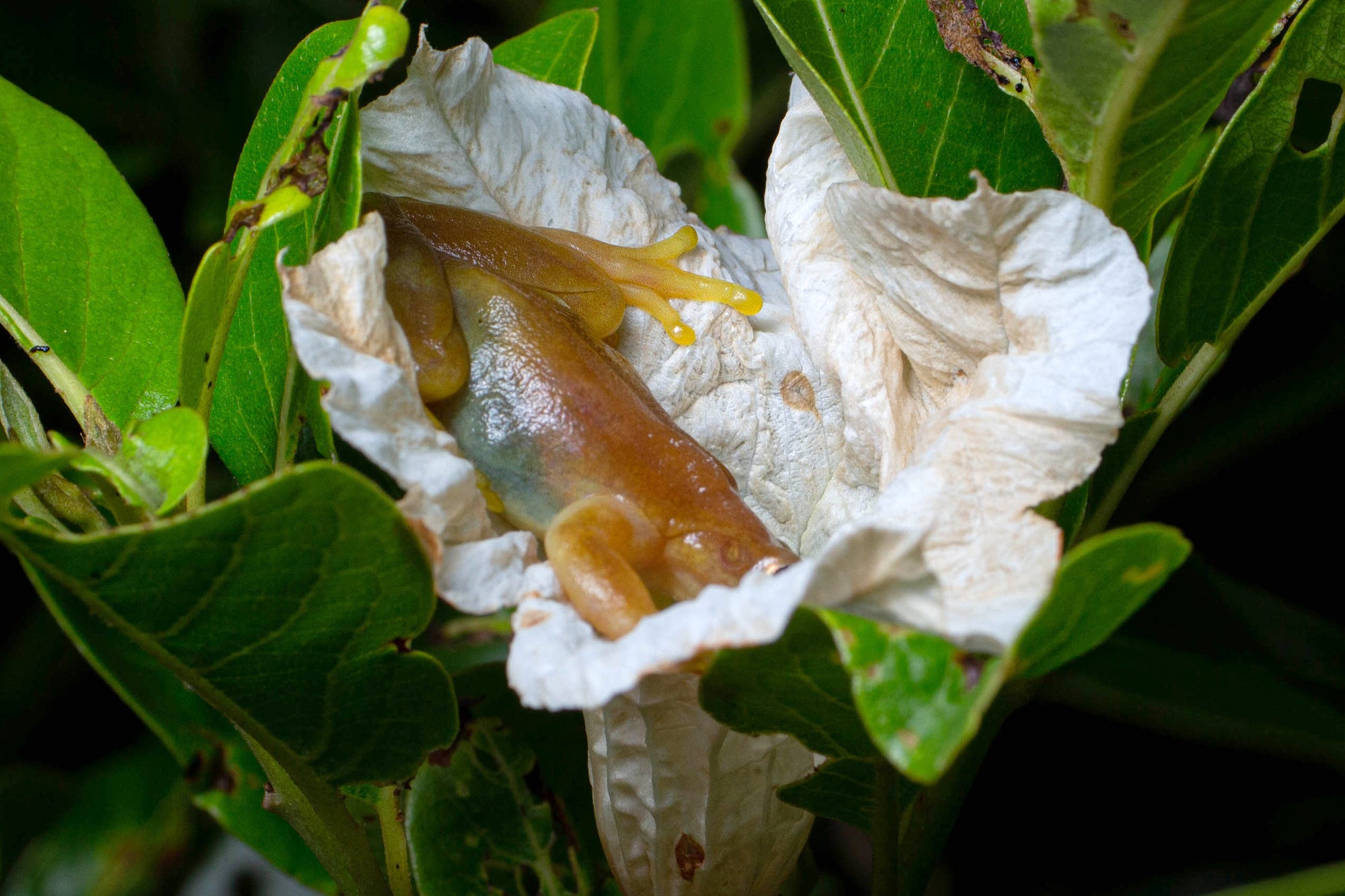
X. truncata within a Cordia taguahyensis flower. Credit: Henrique Nogueira
For Cozien, the possible frog-mediated pollination illustrates how unexpected ecological interactions are still out there to be discovered when people do basic fieldwork. The past decade has seen a boom in descriptions of unexpected pollinators, including lizards, opossums, brown rats and cockroaches. Many of those finds came from technology such as camera traps, Cozien says. These devices make it easier to catch secretive species in the act. Lizard pollination in South Africa, for example, has never been directly seen by humans, just in video footage, she says.
The new tree frog observations are also an intriguing glimpse into a species that gets little respect in its homeland, de-Oliveira-Nogueira says. “For most people, it’s just one more frog,” he adds. In Brazil, frogs that brush up against human habitation, including X. truncata, often meet unhappy ends, thanks to predatory cats or panicky homeowners.
“It’s maybe a game changer because now we have some visibility for these species,” de-Oliveira-Nogueira says. “This is a threatened species and maybe the only species [of amphibian] in the world that acts as a pollinator. So if we lose this species, we lose a unique ecological interaction between plants and amphibians.”