New Issue: Orbital Catastrophe Ahead? Read Now

This Gloriously Weird Fish Has Teeth on Its Forehead for Sex

Researchers have finally traced the origin of the spotted ratfish’s bizarre forehead teeth, which are used for mating

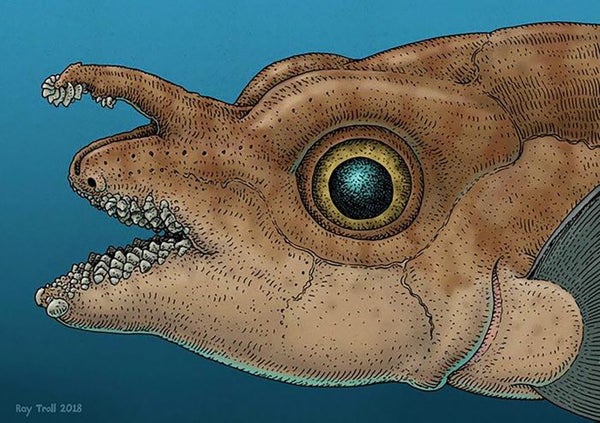
Erect tenaculum on spotted ratfish, illustration

The researchers identified teeth on the tenaculum of ancient relatives to the modern adult male spotted ratfish. This fossil record helped them establish the historical significance of this structure, brought to life by local artist Ray Troll.

Ray Troll (CC BY 4.0)

Join Our Community of Science Lovers!

The spotted ratfish is a two-foot-long fish with a big head and a long, skinny tail that lives in the northeastern Pacific Ocean. It belongs to a group of fish called chimaeras that are closely related to sharks. (Chimaeras are sometimes called ghost sharks.) Like most vertebrate creatures, it has teeth in its mouth. Unlike other vertebrates it also has teeth in another location: its forehead. It uses these forehead teeth for sex.

Researchers have long wondered where the ratfish’s forehead teeth come from. New research, published on September 4 in the Proceedings of the National Academy of Sciences USA, has traced their origin.

The ratfish’s extra teeth line a cartilaginous appendage called a tenaculum that in males can be erected and deployed to grasp a female during mating. Many fish have clasping appendages near the pelvis that they use to hold their mate close during the deed. The spotted ratfish has the tenaculum in addition to pelvic claspers.


On supporting science journalism

If you're enjoying this article, consider supporting our award-winning journalism by subscribing. By purchasing a subscription you are helping to ensure the future of impactful stories about the discoveries and ideas shaping our world today.


Scientists have known about the ratfish’s toothy tenaculum for a while. But they weren’t sure exactly how the teeth originated or how they ended up in this weird location outside the mouth. Many of the ratfish’s close relatives—the sharks, rays and skates—have toothlike structures in their skin called denticles that are made of the same material as teeth but are not true teeth. Are the ratfish’s forehead teeth just modified skin denticles, or do they share their structure and origin with mouth teeth?

To find out, Karly Cohen of the University of Washington and her colleagues traced the development of the ratfish’s tenaculum using micro-CT scans and tissue samples, and they compared the modern fish with fossil ancestors. The researchers determined that the ratfish’s forehead teeth are true teeth—they develop from a structure called the dental lamina that is present in the jaw but not in skin denticles. The dental lamina has never been found outside of the mouth until now.

“This insane, absolutely spectacular feature flips the long-standing assumption in evolutionary biology that teeth are strictly oral structures,” Cohen said in a press release. Who knows where they’ll turn up next?

Kate Wong is an award-winning science writer and was formerly senior editor for features at Scientific American, where she focused on evolution, ecology, anthropology, archaeology, paleontology and animal behavior. She is fascinated by human origins, which she has covered for nearly 30 years. Recently she has become obsessed with birds. Her reporting has taken her to caves in France and Croatia that Neandertals once called home to the shores of Kenya’s Lake Turkana in search of the oldest stone tools in the world, as well as to Madagascar on an expedition to unearth ancient mammals and dinosaurs, the icy waters of Antarctica, where humpback whales feast on krill, and a “Big Day” race around the state of Connecticut to find as many bird species as possible in 24 hours. Wong is co-author, with Donald Johanson, of Lucy’s Legacy: The Quest for Human Origins. She holds a bachelor of science degree in biological anthropology and zoology from the University of Michigan. Follow her on Bluesky @katewong.bsky.social

More by Kate Wong

Subscribe to Support Independent Journalism

Great science journalism requires human expertise, time, effort and creativity. And it costs money. That’s why I and the journalists here at Scientific American hope you’ll join our community.

When you subscribe, you are supporting staff and freelance journalists who are passionate about telling science stories that are true, important and compelling. Our editors and reporters are often experts in their fields, which means they understand the nuances of big discoveries and can untangle the breakthroughs from the hype. With a subscription, you are also supporting rigorous fact-checking to ensure the words we publish are precise and accurate. And you’re supporting original illustrations, graphics and photos that bring you closer to an advanced laboratory, an ice sheet in Antarctica or a space mission in orbit. You’re helping us craft other types of high-quality journalism as well: Our newsletters are carefully written, edited and curated by staffers you have or will come to know and love. Our Science Quickly podcast is based on original reporting, collaboration with editors and scientists and exacting production.

Subscriptions keep this engine running so we can continue to deliver thoughtful, rigorous and independent science journalism to you. In an era of viral misinformation, this work is crucial. If you value what we do, I hope you’ll consider joining us as a subscriber

Thank you,

Jeanna Bryner, Editor in Chief, Scientific American

Subscribe