
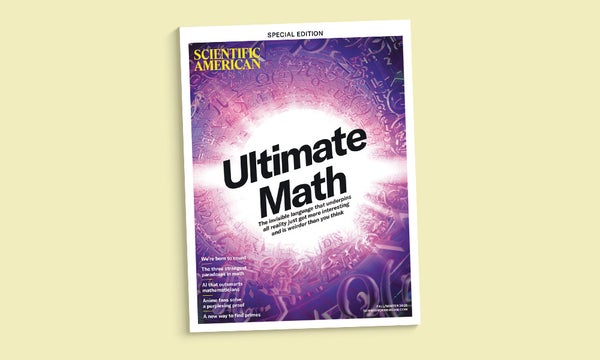
In October 2024 Luke Durant, an independent researcher in San Jose, Calif., announced that he had discovered the largest known prime number—so enormous it would take years to write out in full. One might suspect only mathematicians would celebrate such a feat. But primes are often considered the building blocks of mathematics, and math itself is the scaffolding that supports everything from quantum theory and smartphone algorithms to the stability of bridges and even the odds at a casino. This special issue invites you to explore that hidden architecture—through paradoxes, proofs, strange shapes and playful puzzles. Mathematics is not only an esoteric vocation but also indispensably alive and deeply human.
Humans are natural mathematicians, and trials have shown that babies are born with an inherent sense of numbers. For some this natural ability leads to a lifelong devotion: in 2023 precocious high school students published a proof of the Pythagorean theorem that uses trigonometry, and the winner of the 2025 Abel Prize in mathematics was Masaki Kashiwara, who has studied the field for nearly seven decades.
The quest for larger primes continues, and researchers are devising new ways to seek them out, including a method that involves integer partitions. Many questions in math have long histories, such as the Langlands conjecture, which has stumped scientists for more than 50 years. The field is replete with paradoxes. For example, if you run the equation 1 – 1 + 1 – 1 + 1 – 1 + ... forever, the answer is not zero and not straightforward. Or consider the following: In a small town, a barber shaves the beards of all men who don’t shave their own. Does he shave himself? Such puzzles (and all statistics) rely on probability, which in itself is something of a paradox because no one really knows what it is.
On supporting science journalism
If you're enjoying this article, consider supporting our award-winning journalism by subscribing. By purchasing a subscription you are helping to ensure the future of impactful stories about the discoveries and ideas shaping our world today.
Math, naturally, is integral to physics, cosmology and our comprehension of the universe. So-called complex numbers are a crucial element of quantum theory. And in 2025 a group of mathematicians claimed to have made a breakthrough on “Hilbert’s sixth,” one of the core math problems posed in 1900 by German mathematician David Hilbert. The team’s lofty proof unifies three physical theories that explain the motion of fluids. Math gives meaning to form, and topology (the math of deformable geometric shapes) is influencing data analytics. Another puzzle that has endured for at least 100 years: find a shape that can cover an infinite plane with patterns that never repeat—an einstein tile.
Math shows up in everyday life in surprising ways. Equations govern the stability of infrastructure such as bridges and airplanes. One of several statistical theories increases the odds of winning at gambling, just as algorithms govern one’s success at poker. And a recently developed computational model can optimize citizens’ assemblies to make them fair reflections of the populations they represent, improving democracy. Math even addresses the mundane problem of moving a sofa around a corner.
For thousands of years math has shown itself to be a powerful tool for understanding not only the shape of our world but ways to optimize all aspects of life. An invisible equation seems to undergird every facet of reality, including the human mind. In that sense, mathematics is not alien at all but a mirror held up to ourselves.