
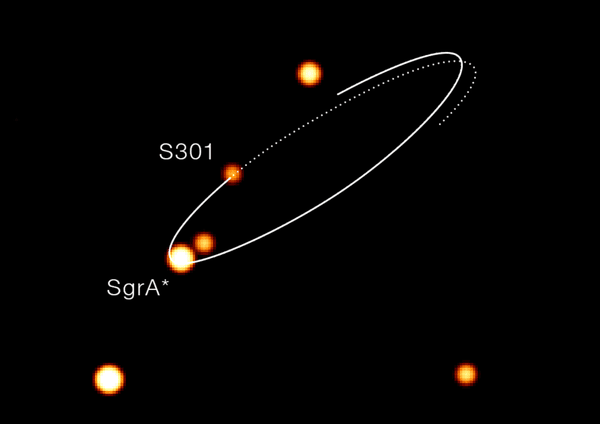
There are a lot of weird stars in the universe, but if I had to pick the very weirdest, it would be S301.
The name is prosaic, but it hides profundity. Ironically the star itself isn’t really peculiar at all. It’s much like the sun, though somewhat more massive, hotter and more luminous. There are billions more just like it in the galaxy at large.
If this star was almost anywhere else in the universe, it would be downright mundane. But as any cosmic real estate agent will tell you, it’s all about location, location, location. It’s not the star; it’s the neighborhood.
On supporting science journalism
If you're enjoying this article, consider supporting our award-winning journalism by subscribing. By purchasing a subscription you are helping to ensure the future of impactful stories about the discoveries and ideas shaping our world today.
S301, you see, orbits Sagittarius A* (Sgr A*), the supermassive black hole that inhabits the exact geometric center of our Milky Way galaxy. And from there, its view of the cosmos is odd—more than odd, really, because the star experiences severely warped time and space.
At 4.3 million times the sun’s mass, Sgr A* dominates the region. Its gravity is extremely strong, of course, holding sway over a menagerie of objects around it. This includes a swarm of stars called the S-star cluster. Dozens of very luminous stellar cluster members are known, but this area likely has far more stars that are fainter hidden behind a vast smog of opaque dust between the center of the galaxy and the sun.
Using huge infrared telescopes that can see through that veil of dust, astronomers have been able to watch some of these stars swirling around the black hole. Most are on elliptical trajectories, dipping closer in and then sweeping farther out over their orbits. Until recently the black-hole-diving record holder was a star called S2, which got as close as 18 billion kilometers to Sgr A*.
But then, in August 2026, that record was shattered when astronomers announced the discovery of a star they dubbed S301. On its greatly elongated orbit, S301 gets as close to the black hole as about 1.7 billion km—not much farther out than the average distance between the sun and Saturn.
And that makes the sky from S301 unlike any other known place in the galaxy.
In 2022 a global consortium of astronomers announced that they had captured images of Sgr A* that showed a doughnut-shaped ring of material swirling around it. The hole in the center of the ring is SgrA*’s “shadow,” the volume of space around it where light can actually orbit the black hole before falling in; because no light gets out, this region appears dark. S301 gets so close to the black hole that this shadow is more than a degree across in the star’s sky—that is, more than twice the size of our full moon, as seen from Earth. The ring of material surrounding Sgr A* would be about four degrees across—about half the apparent size of your outstretched fist.
Mind you, the combined might of radio telescopes spread across our planet could just barely make out the shape of that material, showing only a fuzzy ring. From S301, you’d have a far better view by simply looking up.
That would come with a cost, though. Astronomers have found that, just 200 years or so ago, material falling into Sgr A* got so hot that it emitted bright flares in x-rays—blasting them out at a rate hundreds of thousands of times the sun’s entire luminosity. Even from 1.7 billion km away, that’s a lethal dose of radiation.
Happily—if that’s the right word to use—there are probably no planets orbiting S301. At that distance from Sgr A*, the black hole’s gravity is so powerful that it would destabilize any world orbiting more than just a few million kilometers from the star. While it’s possible planets could persist with a closer orbit to S301, the star itself is so hot that they’d be cooked.
That is too bad. Discounting those deadly, ultrapowerful x-ray outbursts, what a view it would be!
Seeing a supermassive black hole up close is a spectacular, if unsettling, thought, but that’s not the only oddity to be seen from S301. What matters in this case is not so much the star’s location but its velocity. When the star is at perigalacticon (a delightful term meaning “closest point in its orbit to the galactic center,” which is Sgr A* for S301), the gravity of the black hole is so strong that S301 whips around Sgr A* at a speed of 90 million kilometers per hour.
That’s 8 percent the speed of light.
If we looked out from the star, this demonically rapid motion would change what we’d see—literally.
At such high velocities, light becomes noticeably redshifted and blueshifted because of the relativistic Doppler effect. This is similar to how the sound of, say, a passing motorcycle drops in pitch as the vehicle zooms away from you. At S301’s speed around the black hole, that shift is substantial, changing the perceived color of cosmic objects. For example, the iconic red color of hydrogen clouds in the Milky Way would look to us to be orange as S301 swung toward them and a deeper red as it moved away.
Even weirder is the aberration of light. Despite the strange terminology, you’re already familiar with this effect: when you drive a car through rain, the drops always appear to come at you at an angle from vertical no matter what direction you move. This is a result of the combination of the velocity of the raindrops as they fall downward and your velocity as you move toward them.
This also happens with light. The effect is extremely small unless you’re moving very rapidly, but at S301’s speed around Sgr A*, that angle can change by more than four degrees. This means the stars on one side of the sky will appear to shift their positions by about nine degrees, relative to stars on the other side of the sky! This would make mapping the sky difficult, to say the least. Entire constellations would appear to shift positions over the star’s 8.7-Earth-year-long orbit.
Even time itself changes for S301. Einstein’s special theory of relativity shows that, compared with a stationary observer, time flows more slowly for moving objects. Again, this effect is small until speeds get large; at 8 percent the speed of light, this time dilation effect is really obvious. At the star’s maximum speed, clocks on S301 would lose about 11 seconds per hour relative to clocks on Earth. Worse, that difference itself would change as the star moved to the other side of its orbit and lost some velocity. Anyone traveling along with the star would say their clocks moved at a constant speed, whereas clocks very far away would be off—that’s relativity in a nutshell. But in the end, trying to time celestial events from S301 would be irksome.
All this is, frankly, bizarre. A sky that twists and changes color and flagrantly disobeys the idea of linear time is difficult to comprehend. And yet it could be worse: S301 is decently bright yet still difficult to spot, meaning as-yet undiscovered, fainter stars could very well be orbiting closer to Sgr A*, where all these effects would be magnified even more.
Theoretically speaking, being an astronomer there would be amazing. In practical terms, though, I think I prefer the sky from Earth.