
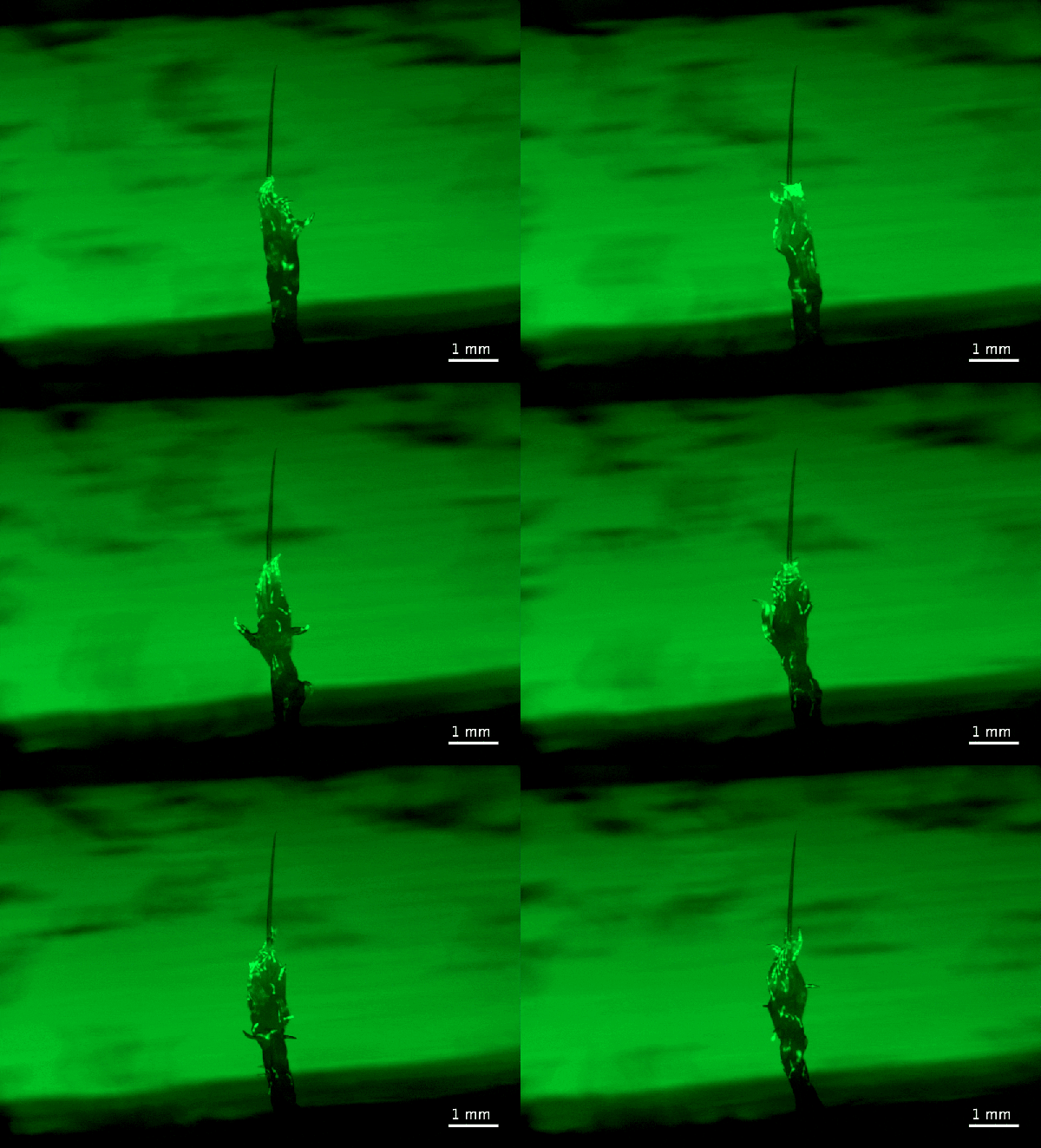
When food runs out, certain tiny roundworms, barely visible to the naked eye, crawl toward one another and build living, wriggling towers that move as one superorganism. For the first time, we’ve caught them doing that in nature on video.
Scientists spent months pointing their digital microscope at rotting apples and pears to finally catch a glimpse of these living towers formed by Caenorhabditis roundworms in an orchard that is just downhill from the Max Planck Institute of Animal Behavior’s location in Konstanz, Germany. “It wasn’t that hard to find. It’s just the people didn’t have the interest or time or funding for this kind of research,” says biologist Daniela Perez, lead author of the study.
Perez and her team at the Max Planck Institute of Animal Behavior then studied this behavior in a laboratory to learn more. To spur the towering, they placed groups of Caenorhabditis elegans in a dish without food, alongside a toothbrush bristle that could work as a scaffold. Dozens of worms quickly climbed on top of the bristle and one another to form a structure that moved in an eerily coordinated manner. The tower responded to the touch of a glass pipe by attempting to latch onto it; it stretched to bridge the gap between the bottom of the dish and its lid; and it even waved its tip around to probe the surrounding environment. The results were published Thursday in Current Biology.
On supporting science journalism
If you're enjoying this article, consider supporting our award-winning journalism by subscribing. By purchasing a subscription you are helping to ensure the future of impactful stories about the discoveries and ideas shaping our world today.
Researchers had previously observed this towering in the lab but didn’t know that it was an actual survival strategy in the wild. “Discovering [this behavior] in wild populations is really important as it shows this is a part of how these animals live and not just a lab artifact,” says William Schafer, a geneticist at the University of Cambridge, who studies C. elegans and was not involved in the study.
Why do the worms do this? The researchers think towering helps worms set out to find richer food sources. When resources are limited, “it probably makes sense for microscopic organisms to cooperate for dispersing by forming something bigger,” says the study’s senior author Serena Ding. The towers could allow some of their members to reach new places or to hitchhike on other organisms such as fruit flies.
The bigger question is how the worms communicate within the towers. If the worms on top latch onto a fly, how do those at the bottom know to detach from where they’re anchored? They could communicate chemically through pheromones and mechanically through movement patterns, Schafer suggests. Perez says her team plans to test this next. “Every time we have a meeting, we end up with 10 new project ideas,” she says. “There are so many directions we can take this.”