
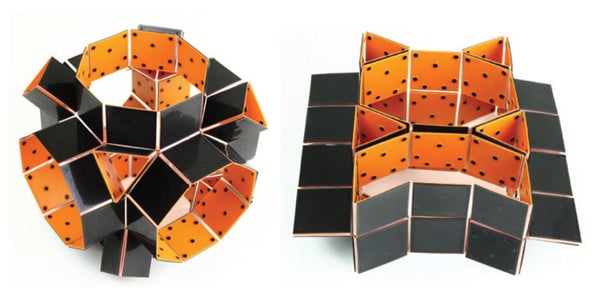
The sculpture-like objects in Bas Overvelde's laboratory at the Netherlands' Atomic and Molecular Physics (AMOLF) Institute are not as simple as they appear. Made of multiple prism-shaped building blocks, each face connected by flexible hinges, they can easily flip from shapes such as 3-D stars into cylinders, balls, and more.
Think of a classic slap bracelet, Overvelde says: a structure that has two stable positions, one straight and one curled up. But his lab's objects can fold along their many hinges to pop into dozens of predictable positions when pressure is applied. Beyond building a collection of these physical objects, Overvelde and his fellow researchers used computer simulations to explore even more complex assemblies of the building blocks, finding every potential shape many combinations can form. Some large virtual constructions reached more than 100 stable configurations. The study was detailed last December in Nature Communications.
By designing and simulating objects that fold into predictable shapes when pushed on, the researchers hope to make it easier to manufacture very tiny robots and materials with changeable structures. If such items can easily morph into specific, stable forms, fewer tools are needed to bend or assemble them. Plus, certain shapes and internal structures can add strength and make objects resilient: for instance, “bone has a microstructure that makes it lighter, but it stays stiff,” Overvelde says. “We try to do the same kinds of things with our materials.”
On supporting science journalism
If you're enjoying this article, consider supporting our award-winning journalism by subscribing. By purchasing a subscription you are helping to ensure the future of impactful stories about the discoveries and ideas shaping our world today.
This study explores the “centimeter scale” (roughly the size range of traditional paper origami made with human hands), but Overvelde notes such objects would work the same way if much larger or much smaller. For now the group is focusing on the basics: “We're not people who do ... manufacturing at small scale,” he says. “We try to come up with new concepts.”
These concepts have impressed some of Overvelde's peers in materials science. Itai Cohen, who leads similar research at Cornell University and was not involved in this study, says the new work is “a real tour de force” in its research and implications. “These are all devices that are done with [the equivalent of] cardboard and double-sided sticky tape—but the real question is, Could you start to make robotic systems?” Cohen adds. “In robotic systems, the number of configurations that you can go through dictates how much the robot is able to do, how many [light-diffracting] gratings you can make or chemical surfaces you can expose.”