
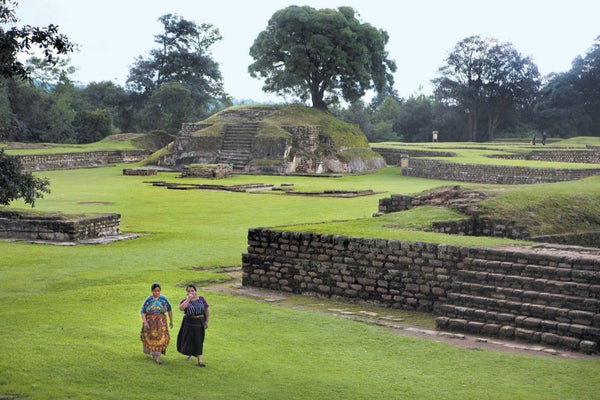
Maya civilization once stretched hundreds of miles across Mesoamerica and the Yucatán Peninsula, with bustling cities, a thriving economy, and a booming arts and culture scene. But between the eighth and 10th centuries C.E., it endured sudden population fluctuations, increased conflict and abandoned urban centers. Archaeologists and other researchers have considered landscape degradation, volcanoes and drought as possible drivers of this dramatic instability throughout Maya society.
For a recent study in the Proceedings of the National Academy of Sciences USA, researchers probed a lake bed near the ancient Maya city of Kaminaljuyú to investigate another possible stressor: harmful algae in the water supply. Chemicals called cyanotoxins, which make some algae blooms poisonous, were preserved in sediments at the bottom of central Guatemala’s Lake Amititlán—along with green pigments that record algae’s presence. Study lead author Matthew Waters, a limnologist at Auburn University, and his colleagues sampled a 5.5-meter core of lake-bed muck and found a 2,100-year record of algae blooms, possibly caused by runoff from settlements and farms in the watershed. The findings suggest these toxic blooms would have rivaled their modern counterparts. In Lake Amititlán (which frequently hosts harmful algae blooms today), cyanotoxin concentrations rose throughout the period in which Maya civilization reached—and then fell from—its zenith. A previous study showed ancient algae in a lake near the Maya city of Tikal, but Waters says his team’s is the first to provide definitive evidence of cyanotoxins.
The Maya were concerned about contaminated water reservoirs as early as C.E. 200, says Liwy Grazioso, an archaeologist at the Universidad de San Carlos de Guatemala who was not involved in the new study. “They knew from observing nature that there were episodes when the water did not have good quality,” she says, “so they brought in sand from 30 kilometers away to create a filtering system.”
On supporting science journalism
If you're enjoying this article, consider supporting our award-winning journalism by subscribing. By purchasing a subscription you are helping to ensure the future of impactful stories about the discoveries and ideas shaping our world today.
Today’s scientists are just beginning to grasp the extent of water-quality issues during the period of Maya instability. Because that time span featured widespread droughts, Waters says, quantity of water has been studied more than quality. The blooms alone were likely not responsible for societal instability, he notes—but having toxic reservoirs amid the droughts could not have helped.
Together with research on the makeup of ancient algae blooms, Waters adds, the study “starts to build a case that water quality and water potability need to be added to the list of environmental stressors” on Maya civilization. Lake Amititlán’s history provides a stark reminder to carefully manage land, as well as water, to avoid pitfalls of the past.