
NASA’s Artemis II mission is continuing its voyage back to Earth after a mind-bending trip around the moon’s far side on Monday.
The crew spent the lunar flyby racing from one choreographed task to the next to make the most of the rare scientific opportunity. So yesterday—day seven of the 10-day mission—they finally got some well-earned rest and a more leisurely schedule.
Before the astronauts awoke in the morning, NASA began releasing some of the coveted photographs they took during the epic lunar encounter—more than 175 gigabytes of imagery—and the views did not disappoint. Highlights included breathtaking close-ups of the moon’s surface that showed craters of every size in stark relief, images of a solar eclipse that were alien even to those who have seen totality from Earth and an “Earthrise” photograph to rival the iconic 1968 image from Apollo 8.
On supporting science journalism
If you're enjoying this article, consider supporting our award-winning journalism by subscribing. By purchasing a subscription you are helping to ensure the future of impactful stories about the discoveries and ideas shaping our world today.
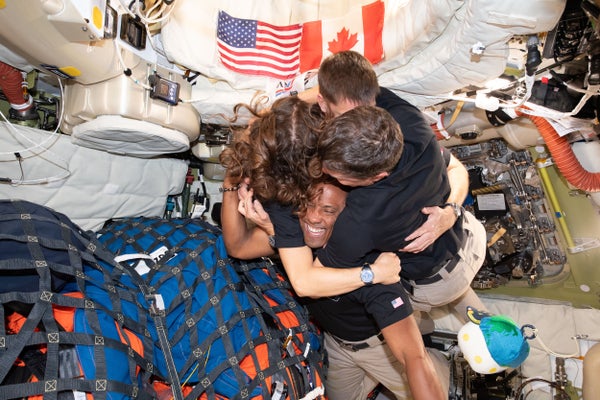
Orion’s four astronauts—Victor Glover, Jeremy Hansen, Christina Koch and Reid Wiseman—then spoke with the crew onboard the International Space Station (ISS) in an audio-only call. It was the first “ship to ship” call of its kind, one between a moon mission and an orbital habitat. Koch—who previously worked on the ISS—mused to her “astro sister” Jessica Meir, a NASA astronaut on the ISS, about the stunning void surrounding our precious home planet, viewed from afar.
Next, the crew spoke with ground control again to relay more of their experiences from moon day. Finally, Integrity—the name the crew chose for their craft—capped off a relatively quiet day on Tuesday by burning a small amount of fuel to stay on course for their return. At 1:23 P.M. EDT that afternoon, they exited the lunar sphere of influence: Earth’s pull on them is now stronger than the moon’s and is gravitationally guiding them home.
And in at least one respect, their homecoming can’t happen soon enough. Integrity’s space toilet—the first ever to fly on a lunar mission—has, for lack of better terms, pooped out periodically throughout the mission, forcing the crew to use backup collapsible plastic urine containers for relief. The leading hypothesis had been that a frozen vent had been preventing waste dumps into space. But at a press conference yesterday afternoon, Artemis II entry flight director Rick Henfling downplayed that theory, noting that the blockage had persisted even after hours of warming Integrity’s vent in direct sunlight. Instead, he suggested, the problem might be debris from an antimicrobial chemical reaction in the wastewater that has been clogging a filter.
Today is the last day before the astronauts need to start preparing for splashdown. They’ll spend it checking off some final tests for Integrity and for in-flight safety. First, they’ll practice constructing a radiation shelter by piling bulky items from stowage along the least-protected walls of the Orion capsule. In the event of inclement space weather, astronauts will need to act fast to minimize the amount of exposure they’ll receive—a crucial consideration not only for lunar missions but also for potential longer-haul voyages to Mars. Next, they’ll test Orion’s manual piloting capabilities, practicing tilting it away for the sun or placing a specific heavenly body in one of its view ports.
The following days will be all about getting the astronauts home. “I’ll breathe easier when we get through reentry, and everyone’s under chutes and in the water,” said NASA administrator Jared Isaacman at yesterday afternoon’s press conference. The crew will spend tomorrow prepping for Friday’s splashdown, which is scheduled for 8:07 P.M. EDT.