
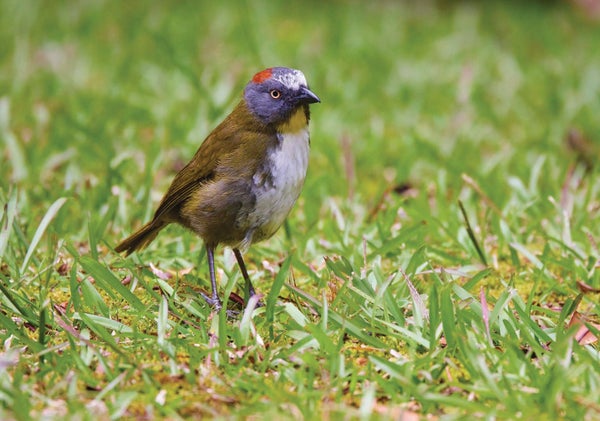
Locals in Papua New Guinea called the birds spicy. When University of Copenhagen evolutionary ecologist Kasun Bodawatta handled feathers from the Regent Whistler and the Rufous-naped Bellbird, his eyes teared up and itched like he was chopping onions. It was the ecologist's first experience with toxic birds.
The island's toxic birds were first described scientifically in 1992, and researchers have since identified a few more species. Their feathers and skin all carry the same type of potent neurotoxin found in South American poison dart frogs. If these substances, called batrachotoxins, bind to neurons' sodium-channel proteins, they cause the neurons to fire nonstop. High-enough doses can cause muscle paralysis and death.
In a paper in Molecular Ecology, Bodawatta, ecologist Knud Jønsson of the Natural History Museum of Denmark and their colleagues identify two new species of toxic birds and show that each independently evolved resistance to batrachotoxins' effects via mutations that change the proteins where they bind. Like how fish and whales separately evolved fins, these birds have “arrived at the same way of dealing with” the toxins, Jønsson says.
On supporting science journalism
If you're enjoying this article, consider supporting our award-winning journalism by subscribing. By purchasing a subscription you are helping to ensure the future of impactful stories about the discoveries and ideas shaping our world today.
California Academy of Sciences ornithologist Jack Dumbacher first pinned batrachotoxins as the source of birds' toxicity three decades ago. At the time batrachotoxins had been found only in poison dart frogs, half a world away. Researchers now hypothesize that the birds acquire batrachotoxins by eating poisonous beetles of the genus Choresine, like the frogs do—but no one is certain.
Whatever the source, storing the toxin in skin and feathers may help protect the birds against parasites, Jønsson says. Of course, for this strategy to work, the birds must avoid poisoning themselves. And just as toxins are common in biology, so is resistance to them, says University of California, Berkeley, ecologist Rebecca Tarvin.
Using computer simulations, the researchers studied how each species had evolved different variations in the neuron binding site—the same part of the protein altered in poison dart frogs—to thwart the toxin. But Tarvin isn't convinced yet. She pointed to a 2021 study in frogs in which sodium-channel mutations did not demonstrate protection from batrachotoxins in some species, although Jønsson notes that the species tested had lower than average levels of the toxins among Papua New Guinean birds. Tarvin says the new study highlights the variation among sodium channels, but there remains much to learn about toxin resistance in general.
“Understanding biodiversity and the diversity of adaptations, especially these extreme phenotypes,” she says, “can give us really great ideas for medicine, for agriculture and for understanding how animals adapt to pollution.”