
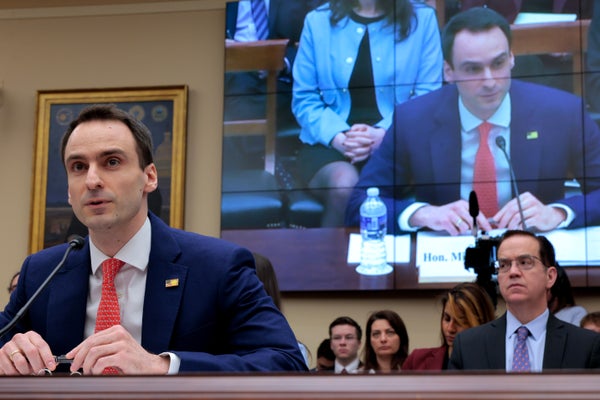
Overall federal funding for scientific research is set to decline in 2027, the most senior White House science figure said on Wednesday. The government, however, pledged to spend $5 billion on promoting artificial intelligence in science.
Michael Kratsios, the White House’s science and technology adviser, told the House Committee on Science, Space, and Technology that the money will be drawn from the National Science Foundation (NSF) and NASA, as well as other federal agencies.
The goal is to produce “the premier AI for science ecosystem in the world,” he said. The funding will be earmarked for “research awards, funding opportunities, specialized scientific datasets and research facilities,” the White House said in a statement.
On supporting science journalism
If you're enjoying this article, consider supporting our award-winning journalism by subscribing. By purchasing a subscription you are helping to ensure the future of impactful stories about the discoveries and ideas shaping our world today.
The remarks go some way to help define the Genesis Mission, a White House effort aimed at promoting U.S. dominance in AI that was announced last November but had no defined budget at the time.
The administration hopes to bolster AI in research conducted by government science agencies and departments, such as NASA and the Department of Energy, Kratsios said. The administration is also interested in funding a “scientifically relevant quantum computer,” he added.
At the hearing, Kratsios fielded lawmakers’ questions about major cuts to NSF grants under the Trump administration. When asked about nearly $1 billion in NSF grants that have been held up, as well as the “very large discrepancies” between planned spending and actual allocations for 2026, Kratsios said he wasn’t aware of the details. The NSF must be “more deliberative” on what research receives funding, he said.
A point of contention was a proposed change to how science grants are awarded that has drawn widespread criticism from researchers. If enacted, the revision to Office of Management and Budget regulations would give political appointees, not peer reviewers, the power to choose which research proposals receive federal funding. Thousands of scientists, including several Nobel laureates, have criticized the rule change as damaging to U.S. science.
Kratsios said that the change is necessary because of a “real decline in the types of grants that want to achieve groundbreaking or out-of-the-box type of ideas” and that NSF awards will continue to be merit-based.