
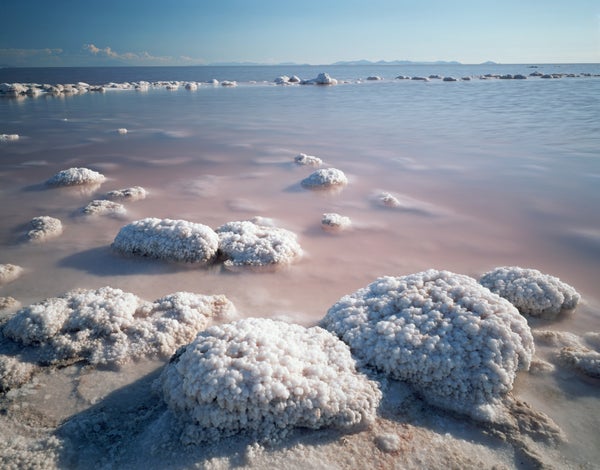
Utah’s Great Salt Lake may be concealing a massive reservoir of fresh water, new research suggests. The finding seems counterintuitive: the Great Salt Lake is the Western Hemisphere’s largest saltwater lake. But as its water levels have hit a historic low in recent years, scientists have noticed mysterious, reed-covered mounds, dozens of meters wide, emerging from the lake bed. And now it turns out that these islands may be a sign of fresh water bubbling up from below.
The potential reservoir—likely fresh-water-saturated bedrock or sediment—may lie as deep as three or four kilometers, or around two miles, below the lake bed, according to the study, which was published last month in Scientific Reports.
“We were able to answer the question of how deep this potential reservoir is, and what its spatial extent is beneath the eastern lake margin,” said Michael Zhdanov, the paper’s lead author and a professor of geology and geophysics at the University of Utah, in a statement.
On supporting science journalism
If you're enjoying this article, consider supporting our award-winning journalism by subscribing. By purchasing a subscription you are helping to ensure the future of impactful stories about the discoveries and ideas shaping our world today.
“If you know how deep, you know how wide, you know the porous space, you can calculate the potential freshwater volume,” he added.
Zhdanov and his team calculated the depth of this possible reservoir by flying a helicopter that was kitted out with electromagnetic equipment over a section of the of the lake and combined these observations with magnetic measurements to study the structure of the reservoir. Underneath one of the sampled mounds, they revealed a plume of fresh water.
The results could one day help mitigate the problem of toxic dust spewing from the drying lake bed onto Salt Lake City—the Great Salt Lake’s bed is laced with arsenic, a toxic substance that, when people are exposed to it as dust, may cause cancers, respiratory problems and heart disease. As the lake’s waters continue to recede, experts are increasingly worried about the potential for major dust events in the area.
The new study’s results are preliminary, however. They only cover a small section of the lake, and more research is needed to confirm the full size and extent of any reservoir below the rest of the lake.
“This is why we need to survey the entire Great Salt Lake. Then we’ll know the top and the bottom,” Zhdanov said.