
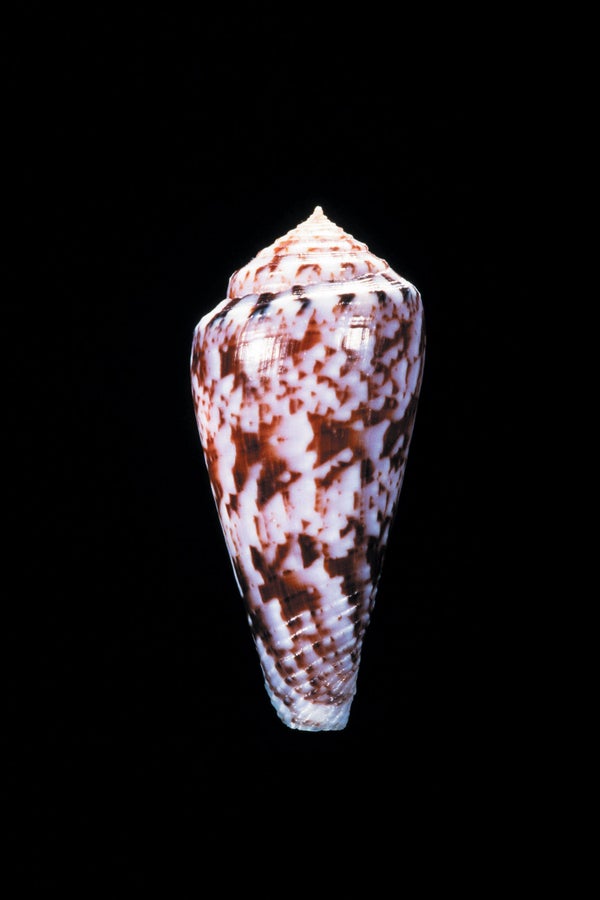
Grabbing a live cone snail while collecting seashells could get you jabbed with a fanglike dart full of potentially fatal—and incredibly fast-acting—venom. But studying how this substance hijacks key bodily systems so efficiently may inspire lifesaving medications: cone snail venom includes insulin, a hormone that helps cells metabolize blood glucose and that many people with diabetes need to routinely inject.
And there is something special about cone snail insulin, which quickly drops their prey animals' blood sugar. Human insulin works much more slowly. It tends to form clumps, which stabilize the substance for easier storage in the body—but it cannot act until these clumps dissolve. The cone snail could offer insight into creating nonclumping insulin for faster diabetes treatment.
For a study in Nature Chemical Biology, University of Copenhagen biologist Helena Safavi-Hemami and her colleagues probed the peculiar anatomy of the Kinoshita's cone snail's insulin. The researchers incorporated unique regions of the molecule into human insulin, creating a hybrid that lacks the human version's clumping region.
On supporting science journalism
If you're enjoying this article, consider supporting our award-winning journalism by subscribing. By purchasing a subscription you are helping to ensure the future of impactful stories about the discoveries and ideas shaping our world today.
The researchers had performed a similar feat in 2020 using insulin from the geographer cone snail. They then checked other species and found the Kinoshita's cone snail produced insulin that acts in a never-before-seen manner. The human insulin molecule's clumping region is also crucial for binding to cells' receptors, and this region is truncated in the geographer cone snail's insulin. Conveniently, Kinoshita's cone snail insulin lacks this part altogether. Instead it has a unique elongated region that binds to receptors but does not produce clumps.
When Safavi-Hemami showed the new snail insulin to her collaborator Danny Hung-Chieh Chou of Stanford University, “he said, ‘It's been done,’” Safavi-Hemami recalls, “but when we looked, the biology was so different.” They used cutting-edge imaging technology to clearly visualize how the new hybrid attaches to a cell's insulin receptor and changes its shape—a detail that was unknown about the previous hybrid. These findings can help better illuminate how insulins work in general, says Mike Strauss, a biochemist at McGill University, who was not involved in the study. “This opens up possibilities for synthetic insulins,” Strauss adds.
Now the team is further investigating the hybrid's safety and stability—challenges for nonclumping insulin designs that this strangely shaped molecule might overcome. Still, it has many tests to pass. “That's why it's good to have a repertoire,” Safavi-Hemami says. Different cone snail species have distinct venom cocktails, likely including unique insulin types and other valuable molecules. With venom made of thousands of substances, cone snails have plenty to offer if we just keep looking—carefully.