
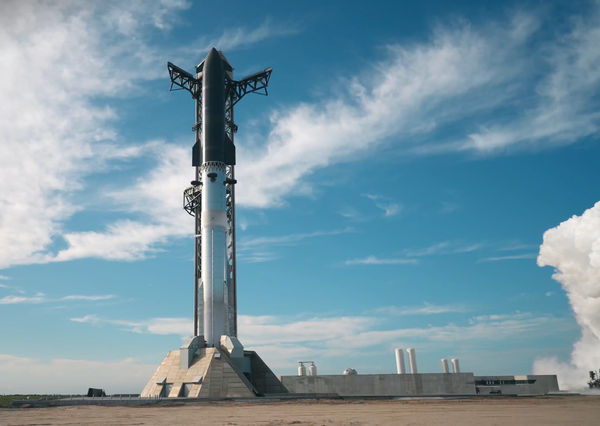
SpaceX is gearing up to launch its Starship megarocket. On Thursday, no earlier than 6:45 P.M. EDT, Elon Musk’s space company will attempt a 13th flight test of Starship that will see the rocket put through its paces once again.
But as with its last test flight, Starship will not enter Earth orbit; nor will SpaceX try to catch the vehicle’s Super Heavy V3 first stage. Instead, after helping Starship to briefly reach space, the technically reusable booster will attempt a controlled descent and splashdown in the Gulf of Mexico.
Overall, this flight will look much like the last one, which was largely a success. Riding atop the Super Heavy V3 booster, Starship will lift off from SpaceX’s complex in Starbase, Tex., an incorporated city largely devoted to SpaceX operations. Its payload includes a cache of Starlink V3 satellites—next-generation spacecraft that are the largest and heaviest yet launched for SpaceX’s relentless expansion of its broadband Internet megaconstellation. Ultimately, SpaceX wants this flight to iron out the kinks that arose in the last test: chief among them are performance issues with the Raptor engines that provide thrust for Starship and its booster.
On supporting science journalism
If you're enjoying this article, consider supporting our award-winning journalism by subscribing. By purchasing a subscription you are helping to ensure the future of impactful stories about the discoveries and ideas shaping our world today.
The flight will also test various upgrades to Starship’s heat shield—one of the most crucial components for the spacecraft, which is designed to be fully reusable.
That reusability, SpaceX hopes, will eventually allow the company to phase out its partially reusable workhorse rocket, the Falcon 9, in favor of launching Starships multiple times per day, with a mass-to-orbit price tag that competitors won’t be able to beat.
The system, in short, is SpaceX’s all-in bet for continuing its global dominance of space launch and satellite communications. If successful, it could catapult the now publicly traded company and the world alike into a revolutionary new era of spaceflight.
SpaceX will have a 90-minute window in which to launch Starship, with a livestream of the rocket beginning some 30 minutes before liftoff on X and SpaceX’s website.
Once in space, Starship will attempt to deploy its batch of 20 Starlink satellites. These will seek to connect to the Starlink network via laser-based communications; six of the satellites carry cameras to relay images of Starship’s heat shield to engineers on the ground. All 20 satellites are expected to burn up on reentry in Earth’s atmosphere about 20 minutes postdeployment.
The whole test, from launch to splashdown in the Indian Ocean, should last just more than an hour.
Even without its core goal of full reusability, Starship would be extremely ambitious. It’s SpaceX’s largest vehicle—indeed, the spacecraft is the world’s largest rocket. Fully stacked with its booster, the vehicle is 124 meters (about 408 feet) tall and has enough thrust to launch 100 metric tons of cargo into space. Leaving aside SpaceX’s lofty business goals, NASA hopes to use Starship to further U.S. moon base ambitions as part of its Artemis program.
If SpaceX can get a NASA-sponsored lunar lander variant of Starship ready on time, the space agency could use it to send humans to the surface of the moon—for the first time in more than 50 years—as soon as 2028. A watchdog report published in March made it plain that SpaceX wasn’t keeping to schedule, however, and NASA is also funding the development of a Blue Origin lunar lander for the task.
The clock is ticking for both companies: NASA’s Artemis III, a crewed mission to test key capabilities for both vehicles in low-Earth orbit, is targeted for launch before the end of next year. But regardless of what happens on Starship’s 13th flight, the vehicle—and the nation—still has a long and perilous journey ahead, with many more test flights to come before bringing astronauts to the moon or anywhere else.