
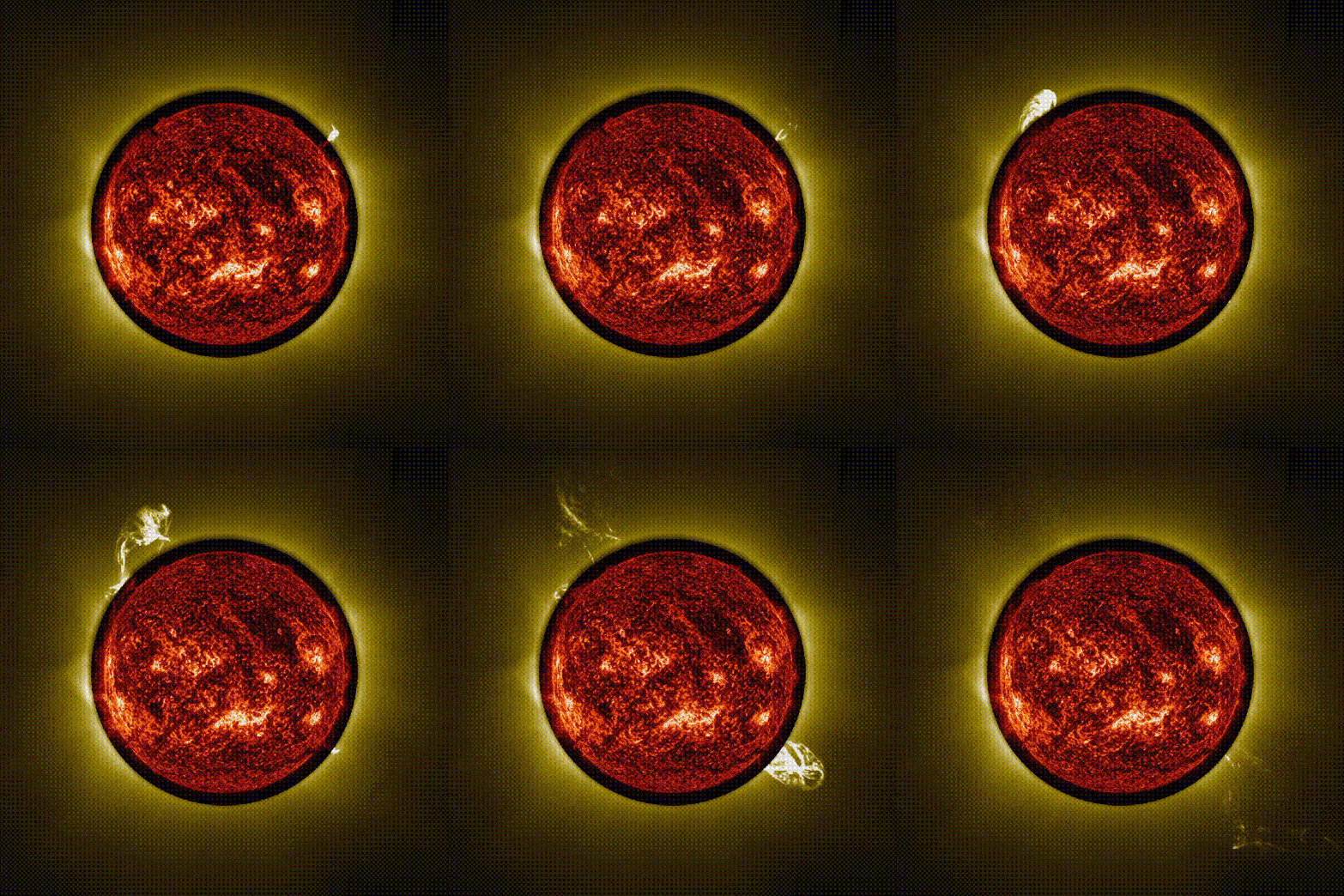
The sun’s rhythmic rise and fall in the sky can make it easy to forget that our star is unpredictable—a roiling, burbling mass of magnetically knotted plasma that governs the entire solar system. But a new video from the European Space Agency’s (ESA’s) Proba-3 mission that shows a string of fountainlike explosions on the sun offers a powerful reminder of our home star’s active nature.
The Proba-3 mission, which launched in December 2024, consists of two spacecraft. Together, the pair of satellites create artificial total solar eclipses that give scientists a glimpse into the corona, the outermost layer of the sun’s atmosphere. In September 2025 the mission captured particularly extraordinary footage of three separate outbursts in just five hours.
“Seeing so many prominence eruptions in such a short timeframe is rare, so I’m very happy we managed to capture them so clearly during our observation window,” said Andrei Zhukov, a senior research scientist at the Royal Observatory of Belgium and principal investigator for one of the Proba-3 instruments, in an ESA statement.
On supporting science journalism
If you're enjoying this article, consider supporting our award-winning journalism by subscribing. By purchasing a subscription you are helping to ensure the future of impactful stories about the discoveries and ideas shaping our world today.
Solar prominences occur when the sun’s plasma, flowing along the magnetic field lines that the sun creates, forms a loop into space along the edge of the sun’s disk. When a prominence becomes destabilized, it can erupt outward into space.
A telescope tool called a coronagraph has long allowed scientists to catch the faint light of the corona by blocking out most of the sun’s light—an artificial version of the moon blocking the solar disk during a total solar eclipse. Proba-3 takes that technology a step further by separating the equipment for this kind of observation onto two spacecraft that must fly in perfect harmony to gather useful observations.
The smaller of the two Proba-3 spacecraft, called the Occulter, serves to block out the sun’s visible disk. The larger spacecraft then carries the observing system itself. With about 150 meters between the two spacecraft, the amount of stray light that can sneak around the edge of the Occulter’s disk is reduced, leading to more precise observations.
That precision allows the trio of prominences to shine in the newly released footage. Though the footage is exceptional, the prominences themselves aren’t surprising—although the sun’s activity has been waning, it is still relatively high, as evidenced by stunning auroral displays in November and again in recent days.