
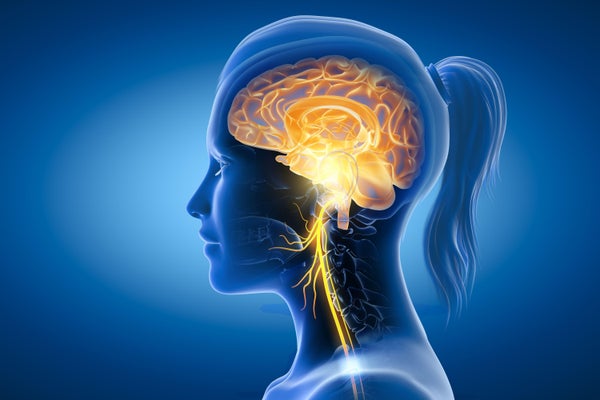
Have you felt butterflies in your stomach or hunger pangs? Those “gut feelings” happen thanks to the vagus nerve, which is a superhighway that connects the brain and the gut.
In recent years the vagus nerve has become an intriguing target for researchers looking to cure disorders of both the brain and the body. Vagus nerve stimulation—usually achieved with an electrode implanted in the neck to deliver electrical pulses directly to the nerve—is an approved treatment for epilepsy and some forms of depression. Scientists are now studying vagus nerve stimulation (VNS) for disorders such as rheumatoid arthritis and the inflammatory bowel disease Crohn’s.
What gives this nerve such widespread impact? The vagus nerve is the longest of the cranial nerves, which emerge directly from the brain rather than traveling through the spinal cord. It begins at an opening at the base of the skull and runs down the neck and into the abdomen, where it collects signals from the viscera and helps regulate the automatic processes of the body, from digestion to sleep to inflammation.
On supporting science journalism
If you're enjoying this article, consider supporting our award-winning journalism by subscribing. By purchasing a subscription you are helping to ensure the future of impactful stories about the discoveries and ideas shaping our world today.
About 80 percent of its signals are sensory ones that travel from the inner organs up to the brain, while the other 20 percent travel from the brain to the body and regulate things such as intestinal contractions and heart rate.
The vagus nerve is the key player in the parasympathetic nervous system, which is the “rest and digest” system that calms the body during times of low stress. “If you are relaxed, if you are sleeping, if you are in a restorative phase, it’s the vagus nerve dominating,” says Gregor Hasler, a psychiatrist at the University of Fribourg in Switzerland, who has written about the gut-brain connection.
Because the vagus nerve beams signals directly into the brain, researchers have long stimulated it to try to influence brain activity without actually having to implant electrodes inside the brain. The Food and Drug Administration approved VNS to supplement epilepsy treatment in 1997. Soon thereafter, doctors began to notice that some of their patients with epilepsy were showing improvements in mood, regardless of whether the treatment was helping to control their seizures, says Ziad Nahas, who studies vagus nerve stimulation and other types of neuromodulation at the University of Minnesota Medical School.
After clinical trials in Europe, Canada and the U.S., in 2005 the FDA also approved VNS for treatment-resistant depression. People who experience recurrent depression and who have tried at least four medications without improvement are eligible for the stimulation, which involves surgery to implant both an electrode in the neck and a power source under the collarbone. After a year of treatment, VNS patients were twice as likely to recover from treatment-resistant depression, compared with treatment-as-usual patients, Nahas says. Doctors think the success has to do with the vagus nerve’s effects on the release of neurotransmitters such as serotonin and norepinephrine, both of which are important for mood, he adds. And the nerve stimulation also activates parts of the prefrontal cortex, which is involved in regulating the limbic regions of the brain that control emotion.
“It does seem to be exerting very specific modulation on key nodes that are critical in mood regulation,” Nahas says.
Relatively few people get treated with VNS for depression, Nahas says, in part because insurance does not readily cover the procedure. An ongoing trial known as RECOVER is testing VNS to reduce depression symptoms in both major depressive disorder and bipolar disorder. The Centers for Medicare & Medicaid Services is collaborating on that study with the intention of allowing federal health insurance to cover the treatment if the results are positive.
Other researchers are testing VNS to calm not the brain but the body. VNS stimulation activates anti-inflammatory pathways in the body, says Sophie Payne, head of the peripheral interface neuromodulation team at the Bionics Institute (BI), a medical device developer in Australia. BI’s VNS stimulation device, which is implanted in the abdomen, is currently in clinical trials for people who have had part of their bowel removed to combat Crohn’s disease. This inflammatory disease of the gut often returns after surgery, Payne says. The researchers hope that VNS stimulation will calm the inflammation and prevent recurrence. In the U.S., medical device company SetPoint Medical is currently running clinical trials using VNS to combat rheumatoid arthritis, an inflammatory condition of the joints.
There may be more conditions on the list in the coming years, Nahas says. The National Institutes of Health has launched a major effort to study the vagus nerve called SPARC (Stimulating Peripheral Activity to Relieve Conditions), and the agency is funding researchers to more precisely map the path of the vagus nerve and to develop technologies to stimulate it for the treatment of a wide variety of disorders.
“The field is really moving to nailing down these effects,” Nahas says, “but obviously we still have a way to go.”