
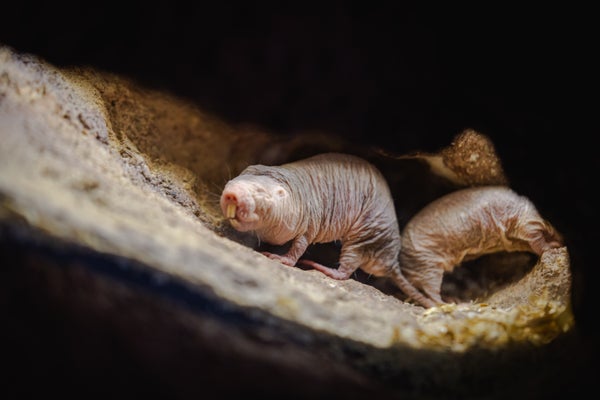
Naked mole rat queens rule with an iron forepaw: these wrinkly, bucktoothed monarchs forbid any other female from reproducing—that is, until they die and all hell breaks loose. Then the once-deferential females rise up and wage bloody battles against one another to vie for the crown. They attack other females, kill pups and wreak havoc until one emerges, dominant and victorious, to claim the throne and become the only breeding female in the colony.
But at the Salk Institute for Biological Studies in California, something unexpected happened: a queen peacefully handed her power to one of her daughters, with no death or gore necessary.
“We found that naked mole rats are capable of peaceful queen succession, suggesting these animals have greater reproductive flexibility than previously appreciated,” says Janelle Ayres, a molecular and systems physiologist at the Salk Institute who co-authored a study on the unusual succession.
On supporting science journalism
If you're enjoying this article, consider supporting our award-winning journalism by subscribing. By purchasing a subscription you are helping to ensure the future of impactful stories about the discoveries and ideas shaping our world today.
Naked mole rats are eusocial, which means they divide their colonies into reproductive individuals and nonreproductive ones—the support staff—with the former consisting of a single female that can give birth. Similar hierarchies exist in beehives and ant colonies. It’s a rigid strategy that works in relatively stable, predictable environments, such as the arid regions of sub-Saharan Africa, where naked mole rats reside in the wild, according to the new study’s researchers.
But the arrangement isn’t without risk. For instance, pups that carry a single female’s genes are not necessarily diverse enough to ensure that some of those individuals will survive hardship from unexpected events, such as disease or an environmental catastrophe. And the queen’s violent enforcement of her dominance is energetically costly and can lead to injuries, according to the researchers. So they wondered whether there might be any wiggle room in the hierarchy—could these bloodthirsty creatures live and reproduce together?
“For years, we’ve known that only one female, the queen, reproduces, and that queen succession occurs through violent queen wars,” said study co-author Shanes Abeywardena, a postdoctoral researcher at Ayres’s lab, in a statement. “We wanted to see if multiple queens could peacefully exist.”
Ayres, Abeywardena and their colleagues began their study in July 2019 with a small, well-functioning family comprised of a single queen named Teré, a single reproductive male and their four pups, one of which was male. To simulate “the queen is dead”–type scenarios—without getting rid of the reigning rodent—the researchers created different scenarios that could change the queen’s reproductive activity, from increasing the number of pups in her kingdom to relocating the colony. It was the relocation, when the researchers moved the family, called the Amigos colony, to a new vivarium, that led Teré to stop reproducing for almost a year.
After that, two of her daughters (siblings from a 2019 litter) began reproducing sequentially. One of them—named Arwen—peacefully assumed the role of sole baby-making queen at the end of 2025.
The study, published today in Science Advances, suggests a peaceful succession is indeed possible in one of the only eusocial (and most bloody) mammals, the researchers say.