
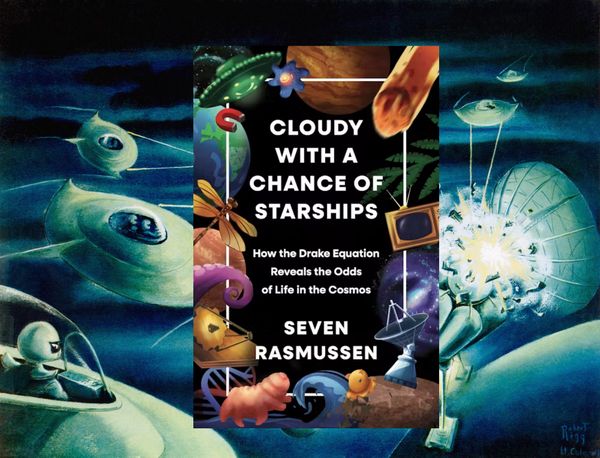
We’ve been looking for aliens for as long as we’ve been looking up at the starry night sky. Wondering, “What’s up there?” quickly leads to asking, “Who’s up there—and why won’t they come down here and say hi?!”
Astrobiology—the study of life in the universe, from how it began and evolved to how it might take shape elsewhere—is the catch-all scientific field in which researchers grapple with such weighty questions about what’s out there. And, at least when we contemplate the existence of little green men rather than little green microbes, one of astrobiology’s cornerstones is the Drake equation, a seven-factor formula devised by astronomer Frank Drake in 1961 that estimates whether extraterrestrial civilizations are vanishingly rare—or common as dirt.
In the new book Cloudy with a Chance of Starships, Seven Rasmussen, an astrobiologist and devoted Star Trek fan, acts as a tour guide to the astrocurious, showcasing how the Drake equation is more than the sum of its parts—it’s not just a tool for quantifying our chances of first contact but also a tracker of astrobiology’s ever changing frontiers.
On supporting science journalism
If you're enjoying this article, consider supporting our award-winning journalism by subscribing. By purchasing a subscription you are helping to ensure the future of impactful stories about the discoveries and ideas shaping our world today.
Scientific American spoke with Rasmussen about what the latest values for the Drake equation are, how the definition of “intelligent life” is slippery and how our unending search for alien neighbors is like gazing in a cosmic mirror.
What exactly is the Drake equation?
In 1961 Frank Drake had a problem. He had just performed the first-ever search for extraterrestrial intelligence (SETI) by pointing a radio telescope at some nearby stars and was hosting a conference to discuss the project. He wanted to start the discussion with something cool, so he came up with a seven-[term] equation that can tell us how many civilizations we could talk to in the galaxy right now. I love the way the Drake equation is organized so much because it starts off with things that we know pretty well, such as the rate of star formation in the galaxy, and then it wades into thornier things, such as how many planets there are per star. And then it gets into really wild things, such as: What are the odds that a planet hosts intelligent life? And finally, it ends with the average lifetime of a civilization, which is something absolutely unknowable to us at present.

You say at one point in the book that astrobiology is “20 sciences in a trench coat,” which I thought was funny. So what is astrobiology, and what’s in this trench coat?
It really is, though. Astrobiology is the study of life in the universe—both as it occurs here on Earth and as it could occur elsewhere. The reason I love to say it’s 20 sciences in a trench coat is because it really draws upon every single science that we can imagine.
It has astronomy and biology in the name, but astronomy is physics, and biology is chemistry. And a lot of the things that we know about all of these different sciences come from the fossil record, and that’s all geology. And, of course, at the foundation of all these things is math. But there’s also network science in there, and if we’re talking about technological civilizations, then there’s engineering and a whole lot more. It’s really the science that encompasses all other sciences.
Another memorable bit from the book is that the most common phrase uttered by exoplanet scientists is probably a curse word, and after that it’s got to be “oops.” I think that’s an observation that says just as much about the researchers themselves as it does about their field. I’m fascinated by these sorts of peeks into the personalities of the people who are drawn to this kind of science, which is so full of big, unanswered questions. So is there anything else you can tell me about the sort of nerds that choose to become astrobiologists?
Well, it’s definitely a very specific type of nerd. You know, it’s somebody who’s adventurous and curious and, most importantly, okay with studying something for which they may never get an answer. And that’s why I first got into astronomy and astrophysics—I loved it because it was just so big. Astrobiology is this bizarre fabric that pulls and weaves together all the threads of physics and biology and intelligence and philosophy. It’s really beautiful, and it’s all about embracing the unknown.
Yeah, these are folks who are seriously, actually looking for aliens all the time—which is like every kid’s dream of what a scientist does. But the reality, I imagine, is different from the dream: What are we actually looking for when we search for alien life? In the book, you talk about “biosignatures” and “technosignatures,” for instance, but what do those actually look like?
Well, biosignatures are basically any evidence that a living creature, past or present, has interacted with whatever environment or material you’re looking at—like if a rover rolling around Mars finds a fossil. Another example would be gases produced by living creatures that leak out into the air—so-called atmospheric biosignatures, a topic I’ve studied in-depth in my research. Earth’s atmosphere, for example, has lots of free oxygen—but it also has methane, which is a gas emitted by some types of microbes that isn’t thermodynamically stable in the oxygen’s presence. I talk a lot more about this in the book, with the upshot being how, if you see a whole lot of methane on a somewhat Earth-like planet, that could be evidence that Earth-like life is there, too.
So a biosignature is really anything that’s evidence of life, anything produced by a living creature. Conventionally, a technosignature is something that’s been produced by technology, presumably built and used by an alien civilization. The most extreme version of a technosignature might be if the Vulcans from Star Trek came down to Earth in a spaceship and said hello to us. We’d say, “Wow, now that is a technosignature!”
Yeah. “Hey, you got a real nice spaceship there!” That would definitely be a signature of alien technology.
Exactly. Other technosignatures are things like if we detected chemicals in a planet’s atmosphere that are only artificially produced. Probably the biggest example of this we know about is chlorofluorocarbons (CFCs), the stuff that [used to make] AquaNet spray out of the can but [was also destroying] Earth’s ozone layer. So if we saw CFCs in an atmosphere, that would be a technosignature—although it wouldn’t necessarily indicate a very intelligent civilization because, as we know, it has very undesirable side effects.
You get at this more in your book, this idea that, if the only astronomically detectable signs of your “intelligence” are related to you severely destabilizing and damaging your environment, then how intelligent are you, really? It’s an interesting question to ponder when we’re looking for signs of alien life.
Yeah. I really took inspiration there from a conversation I had with science historian Rebecca Charbonneau about a concept we call “the cosmic mirror.” The astronomer and SETI researcher Jill Tarter was the first to come up with this, and it basically says that the technosignatures we’re now looking for out in the galaxy are reflective of how we're presently interacting with technology here on Earth. Rebecca gave me this great example of how, after World War II ended, we had all this radio technology we’d invented to spy across the ocean. And astronomers were like, “Well, maybe if someone was trying to contact us from a long distance away, they’d be using radio, too.” So we got radio-based SETI out of that, like the early searches Frank Drake and others performed. And after the laser was invented, we started to think, “Hey, maybe you could use a really big laser to communicate across star systems.” So now we have laser-based SETI programs, too. It’s so remarkable to me, the kind of parallel development of technosignature searches for aliens “out there” with what’s going on, globally and socially, right here.
This relates to something I really wanted to ask you about, which is the Fermi paradox. I loved how you explained in the book that Enrico Fermi was a nuclear physicist “whose only interaction with the SETI community was asking one off-putting question at lunch one time.” Could you walk me through what happened at that awkward lunch and how it gave us this popular concept?
Yeah, so Enrico Fermi, as you said, was a nuclear physicist, and he was part of the Manhattan Project, where the U.S. was racing to develop the atomic bomb before Germany did. And so one day during his lunches with his fellow nuclear physicists, the conversation turned to a recent New Yorker cartoon that lampooned the UFO mania of the time by depicting little green men stealing trash cans in New York City. So they’re talking about this cartoon at lunch, and Enrico Fermi is thinking about it, and the conversation moves on. But then he arrives at the pretty logical conclusion of “Where are the trash-can-stealing aliens?” Dubious UFO sightings aside, if other planets like Earth exist and interstellar communication or even interstellar travel is possible, why haven’t we been contacted yet? And so the Fermi paradox is exactly that question: Where’s everybody else?
Right. And I guess, together or individually, each of the seven terms in the Drake equation could offer some insights about the Fermi paradox’s possible answers. The trouble, as you mentioned, is that our plugged-in values for some of those [terms] are much more certain than for others. Do you think we’ll ever actually figure out, for instance, the average lifespan of technological civilizations or the fraction of planets that they pop up on?
That’s a great question. I’m an optimist—and a Star Trek–brand optimist at that! I believe that, perhaps hundreds of years down the line, when we’ve dealt with climate change and when we’ve denuclearized the world and when we’ve defeated capitalism once and for all, we’ll be able to invent the one thing that will allow us to survey the galaxy, which will be faster-than-light travel. You know, Frank Drake’s equation motivated Star Trek, actually. It was part of the pitch for Star Trek. Gene Roddenberry was like, “I just heard of this new equation that tells us about how much life there is in the galaxy, and here’s a TV show about it.”
I do have to ask you, for “all the peanuts,” as Douglas Adams would say: If you could pick one term out of the Drake equation to know with certainty, which would it be?
It’s got to be fi, the [term] encapsulating the fraction of habitable planets that don’t just develop life but also intelligent life. I want to know: In 100 years, are we going to consider an octopus to be intelligent? Are we going to consider a sperm whale to be intelligent? Will we afford protections for those creatures based on our definition of intelligence? That’s probably the one that, right now, interests me the most.