New Issue: Orbital Catastrophe Ahead? Read Now

Which Knot Is Stronger? Humans Aren’t Great Judges

People are surprisingly bad at guessing knot strength, a study found

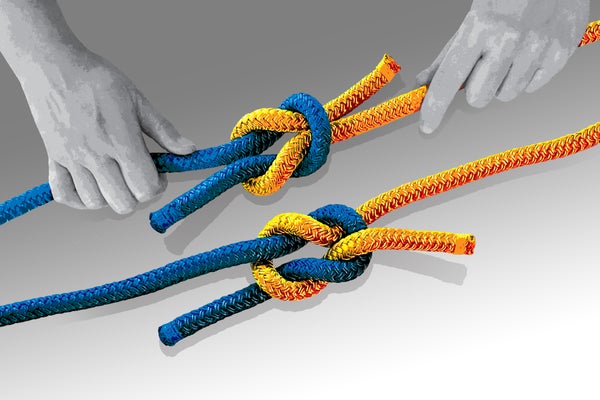
Two simple knots tied with two lengths of string each are shown, with hands pulling at the two longer ends of one of the knots.

Jen Christiansen

Join Our Community of Science Lovers!

Humans are pretty good at guessing whether a towering stack of dishes in the sink will topple over or where a pool ball will go when a cue hits it. We evolved this kind of physical reasoning to navigate our changing and sometimes dangerous environments. But a new study highlights one area of intuitive physics that’s deceptively difficult: judging how strong a knot is.

Take a look at these four knots, which may look similar but are all distinct. Which knot would be hardest to undo if you pulled on the two long ends of its ropes? Rank them in order from weakest to strongest.

Four simple knots tied with two lengths of string each are shown, with hands pulling at the two longer ends of one of the knots.

Jen Christiansen; Source: “Tangled Physics: Knots Strain Intuitive Physical Reasoning,” by Sholei Croom and Chaz Firestone, in Open Mind, Vol. 8; September 2024 (reference)


On supporting science journalism

If you're enjoying this article, consider supporting our award-winning journalism by subscribing. By purchasing a subscription you are helping to ensure the future of impactful stories about the discoveries and ideas shaping our world today.


These four knots can be grouped into two pairs of similar configurations: the “thief” (A) and “reef” (B) knots, and the “granny” (C) and “grief” (D) knots. In both pairs, one knot is vastly stronger than the other. The correct weak-to-strong ranking is grief, thief, granny and reef (D, A, C, B).

If you’re surprised, you’re in good company. Researchers recently asked volunteers to look at photographs of these knots and decide which would take more force to undo. The participants consistently misjudged the strength of the ties by wide margins, Johns Hopkins University brain science researchers Chaz Firestone and Sholei Croom report in the journal Open Mind.

“Reef and thief knots were rated as similarly strong because they’re visually similar, but the position of the bitter ends”—the shorter, cut-off ends in each knot—“is really significant,” Croom says. “A knot with two bitter ends on opposite sides is a lot weaker than if the two sides are the same. The grief knot, aptly named, is so weak you could sneeze on it and it would fall apart.”

KNOT BASICS

The fact that people are bad at evaluating knot strength is surprising because we encounter them in many situations—from tangled electronic cords to hair braids, knitting stitches to medical suture ties, rock climbing to sailing. “Tying a knot properly can spell the difference between safety and peril,” Croom says. The four shown here are among the simplest knots that can be tied with two lengths of string, and they are prevalent in daily life.

PHYSICAL REASONING

Studying areas where our physical intuition fails helps scientists better understand how our brains perceive the world around us. “Knots might be an interesting case study on constraints around our physical reasoning,” Croom says. “Is it something to do with elasticity? Is it the fact that it’s a soft-body object rather than a rigid-body object?” Figuring out why tangles are so tricky could help scientists predict when people’s snap judgments about a physical situation are likely to be wrong, leading to unsafe reactions.

Clara Moskowitz is chief of reporters at Scientific American, where she covers astronomy, space, physics and mathematics. She has been at Scientific American for more than a decade; previously she worked at Space.com. Moskowitz has reported live from rocket launches, space shuttle liftoffs and landings, suborbital spaceflight training, mountaintop observatories, and more. She has a bachelor’s degree in astronomy and physics from Wesleyan University and a graduate degree in science communication from the University of California, Santa Cruz.

More by Clara Moskowitz

Jen Christiansen is an information designer, visual science communicator and author of the book Building Science Graphics: An Illustrated Guide to Communicating Science through Diagrams and Visualizations. She began her publishing career in New York City at Scientific American, moved to Washington, D.C., to join the art department of National Geographic, spent four years as a freelance science communicator and then returned to Scientific American for a second stint, during which she became the magazine’s first graphics-specific art director. In that role, she established a consistent data visualization and diagram philosophy across all articles. She writes and presents on topics ranging from reconciling her love for art and science to her quest to learn more about the pulsar chart on Joy Division’s Unknown Pleasures album cover. Her work can be viewed at www.jenchristiansen.com

More by Jen Christiansen
Scientific American Magazine Vol 332 Issue 3This article was published with the title “Are You a Good Judge of Knot Strength?” in Scientific American Magazine Vol. 332 No. 3 (), p. 90
doi:10.1038/scientificamerican032025-01APnhm6nfNkUNPNdfboJT

Subscribe to Support Independent Journalism

Great science journalism requires human expertise, time, effort and creativity. And it costs money. That’s why I and the journalists here at Scientific American hope you’ll join our community.

When you subscribe, you are supporting staff and freelance journalists who are passionate about telling science stories that are true, important and compelling. Our editors and reporters are often experts in their fields, which means they understand the nuances of big discoveries and can untangle the breakthroughs from the hype. With a subscription, you are also supporting rigorous fact-checking to ensure the words we publish are precise and accurate. And you’re supporting original illustrations, graphics and photos that bring you closer to an advanced laboratory, an ice sheet in Antarctica or a space mission in orbit. You’re helping us craft other types of high-quality journalism as well: Our newsletters are carefully written, edited and curated by staffers you have or will come to know and love. Our Science Quickly podcast is based on original reporting, collaboration with editors and scientists and exacting production.

Subscriptions keep this engine running so we can continue to deliver thoughtful, rigorous and independent science journalism to you. In an era of viral misinformation, this work is crucial. If you value what we do, I hope you’ll consider joining us as a subscriber

Thank you,

Jeanna Bryner, Editor in Chief, Scientific American

Subscribe