
The mathematics community is still in shock. On September 8, 2026, OpenAI announced that an artificial intelligence model may have solved one of the most significant problems in the field, the infamous Navier-Stokes problem, which had baffled countless mathematicians for decades.
Just a year ago, AI programs were only barely capable of solving some problems in the Mathematics Olympiad. Many researchers laughed at the programs’ sometimes embarrassing errors and doubted the models’ utility. But with recent breakthroughs, no one can deny that AI large language models (LLMs) have fully arrived in mathematical research and could dramatically change the field.
Solving the Navier-Stokes problem was a particularly prestigious achievement because it is one of the seven Millennium Prize Problems, mathematical puzzles that, in 2000, were selected by the Clay Institute of Mathematics as challenges that would shape the coming century of mathematics. Solving any of the problems—by, for instance, finding a counterexample that refutes a core conjecture—comes with a $1-million prize. To date, two have been solved: in addition to the recent Navier-Stokes solution, mathematician Grigori Perelman succeeded in proving the so-called Poincaré conjecture in 2003.
On supporting science journalism
If you're enjoying this article, consider supporting our award-winning journalism by subscribing. By purchasing a subscription you are helping to ensure the future of impactful stories about the discoveries and ideas shaping our world today.
Now only five Millennium Prize Problems remain, and major AI companies are racing to solve them. OpenAI told the New York Times that it has already made significant progress on another one of the problems—but didn’t specify which one. In forums, at conferences and workshops and, of course, on social media, people are speculating about which of these remaining problems AI will tackle next. Here’s an introduction to all five, in order of how likely it is that each will be resolved by the technology, according to most experts.
The Birch and Swinnerton-Dyer Conjecture
In the early 1960s mathematicians Bryan John Birch and Peter Swinnerton-Dyer developed a conjecture involving algebraic equations called elliptic curves. Contrary to what their name might suggest, these objects do not describe ellipses but are related to “elliptic integrals,” which, among other things, specify the arc lengths of ellipses.
In general, elliptic curves are generated by the following type of equation: y2 = x3 + ax + b, where a and b can take any value. These curves play a central role in cryptography and were the key to solving Fermat’s last theorem.
These deceptively simple equations contain numerous puzzles. One involves rational elliptic curves, where a and b must correspond only to rational numbers (meaning numbers that can be expressed as fractions). For centuries, experts have been trying to determine how many points on the corresponding curve have purely rational values in this case. Some curves, for example, contain infinitely many fractional points, while others contain only a finite number.

The points of elliptic curves have a remarkable structure: they can be transformed into one another. These transformations form a group.
Amanda Montañez
These rational points are partially interrelated: If you know one point, other rational points on the curve can be calculated using simple arithmetic. But this method may not find all the points. Many independent rational points can be constructed from a different rational starting point. The complexity, or “rank,” of an elliptic curve can be expressed by the number of independent rational starting points. Determining the rank of such a curve, however, proves to be an extremely difficult task.
Through a computer-aided search, Birch and Swinnerton-Dyer found evidence of a criterion that could quickly answer the question of rank. But it remains unclear whether this criterion can truly determine the correct rank for all elliptic curves. One way to resolve this puzzle would be for an AI model to construct a counterexample: an elliptic curve that does not meet Birch and Swinnerton-Dyer’s criterion.
Past experience has shown that language models are particularly good at finding such examples. That’s partly beca
use people often invest more resources in proving a hypothesis they believe to be true than in a possible refutation.
The Hodge Conjecture
A second strong candidate for an AI solution is the Hodge conjecture, which is arguably the most abstract of the seven Millennium Prize puzzles. In 1950 mathematician William Vallance Douglas Hodge put it forward at the International Congress of Mathematicians in Cambridge, Mass. It has since become one of the most important open questions in topology.
It deals with the categorization of geometric figures—specifically, the question of whether an object has holes and, if so, how many it has. To calculate the number of holes even in large dimensions—when people can no longer visualize these figures—mathematicians use special tricks. For example, they can cover the surface of a figure with a net of triangles: as it turns out, the number of vertices and edges of the triangles that are required to cover the surface can reveal the number of holes. That technique works regardless of how fine the net is or how precise the triangles are.
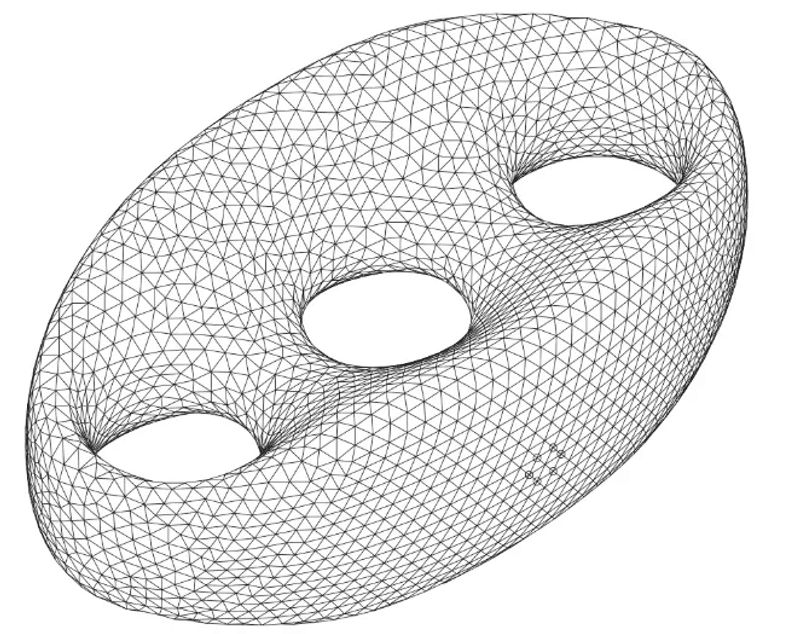
By covering surfaces with a grid of triangles, you can find out all sorts of things about the shapes of an object, including how many holes it has.
Copyright © Ag2gaeh (CC BY-SA 4.0)
Unfortunately, even that method is insufficient in high dimensions because the resulting nets are very difficult to examine. Instead of triangles, however, you could work with smooth curves generated by polynomial equations. These can be investigated using an algebraic equation. You might remember this from school: if you want to find the intersection point of two lines, you can do so graphically, but it is usually easier to equate the two corresponding equations and solve for x and y.
Hodge addressed the question of when it is possible to replace the triangular mesh used to cover a geometric object with smooth curves. He found a supposed criterion for this: a definite integral must equal zero. If this was the case, Hodge realized, experts could continue their calculations using familiar algebraic structures instead of struggling with the triangles. The Hodge conjecture has been proven for certain special cases in low dimensions. It remains unclear, however, whether it holds true for more complex situations.
This is precisely where AI programs could come into play. They could construct situations in which a vanishing integral is not sufficient to guarantee an algebraic structure for determining the holes.
The Riemann Hypothesis
The Riemann hypothesis is arguably the most prestigious of the Millennium Prize Problems. For more than 160 years, it has occupied mathematicians worldwide. In 1900 mathematician David Hilbert included it in his list of 23 major mathematical questions of the coming century—yet it remains unsolved (despite both human and AI efforts).
This puzzle was named after mathematician Bernhard Riemann, who worked primarily in the field of analysis, which revolves around functions and their derivatives. He published a single six-page paper on number theory, and it contained the famous conjecture. This work later proved that prime numbers, while randomly scattered in small sections of the number line, appear to be regularly arranged over sufficiently large intervals.

The colors represent the values of the complex zeta function, with the white dots indicating its zeros.
Jan Homann/Wikimedia
This order is reflected in the prime counting function π(n), which Riemann discovered. The function gives an estimate of how many prime numbers there are up to a given number n. The prime counting function is not exact, however. The actual number of prime numbers deviates from the prediction. And these fluctuations are related to the so-called Riemann zeta function.
Riemann observed that the zeros of this function appear to follow a pattern. Within a certain interval, the zeros appear to all lie on a straight line. If this observation can be proven mathematically, it will have far-reaching consequences, indicating that fluctuation in the number of prime numbers is limited and that people can therefore deduce the distribution of prime numbers very precisely.
Most mathematicians assume the Riemann hypothesis to be correct. But so far, no one has proven that all relevant zeros of the zeta function actually lie on this line.
Should an AI model find a counterexample, such as a zero off the straight line, the achievement would be sensational. This is because there are numerous results in mathematics that were proven under the assumption that the Riemann hypothesis is correct. Such a finding would at least strongly call its validity into question.
Yang-Mills Theory and the Mass Gap Problem
This two-part Millennium Prize Problem originates in particle physics. The theories that describe the interactions of elementary particles are based on certain symmetries, meaning properties of a system that remain unchanged despite transformation. For example, in physicists’ electromagnetic equations, all positively charged particles can be replaced by their negatively charged antiparticles without any change to the math itself.
The first part of the Yang-Mills problem, the so-called existence question, revolves around whether it’s possible to construct a particular kind of theoretical framework—a quantum field theory, which describes subatomic particles with both quantum mechanics and special relativity—for every type of mathematical symmetry of a certain type. These theories are generally referred to as Yang-Mills theories.
A Yang-Mills theory describes elementary particles and the forces acting between them. Evidence from particle physics suggests that the equations describing particles called quarks have a “mass gap,” where there is a minimum amount of energy required to create a particle such that no particle in a given system can have a mass close to zero. The second part of the Yang-Mills problem is therefore proving that these mass gaps exist for the quantum field theory constructed.
In 2015 a team that included physicist Toby Cubitt of University College London demonstrated that the general problem of determining a mass gap is likely undecidable. But it remains unclear whether Yang-Mills theories, specifically, are indeterminate in this way. Still, experts do not expect AI models to resolve these questions anytime soon.
P versus NP
Mathematicians are least optimistic about finding a solution to the “P versus NP” problem, widely considered the greatest puzzle in modern computer science. In a lecture, University of Texas at Austin computer scientist Scott Aaronson went further, calling it “one of the deepest questions that human beings have ever asked.” This puzzle essentially boils down to: How quickly can a computer solve tasks of a certain complexity?
In computer science, a distinction is made between different “complexity classes,” including P and NP. Problems of the first class can be computed in polynomial time; that is, the effort required to calculate the solution increases to a manageable extent with increasing input. An example of such a P problem is the question of whether a value is a prime number. Modern algorithms can check this in a comparatively small number of computational steps.
The situation is different, however, when the effort required to solve the problem grows exponentially with the length of the input, as is the case with NP problems. Such problems can become so extensive that no computer in the world can solve them in a reasonable amount of time. The NP class is characterized, however, by the fact that a given solution can at least be quickly verified. An example of an NP problem is the prime factorization of a large number: calculating the prime factors is very computationally intensive, but verifying a result—multiplying the supposed prime factors—is done quickly.
The P versus NP problem revolves around the question of whether P and NP are truly different. After all, it’s possible that an extremely fast algorithm for prime factorization exists—but no one has yet discovered it. In that case, an AI might be able to provide a solution. But experts consider this highly unlikely: most are convinced that P and NP encompass distinct problems.
Unlike most other Millennium Prize Problems, experts don’t even have a vague idea of what a possible strategy for proving the inequality of P and NP might look like. This applies to the whole of complexity theory: so far, there are very few proven results in this area that distinguish between complexity classes. Therefore, most experts doubt that AI models will make any significant progress in this area.
And now I ask you, dear readers: Which Millennium Prize Problem do you think will be solved next? And will it be humans or AI that claim the prize?
This article originally appeared in Spektrum der Wissenschaft and was reproduced with permission. It was translated from the original German version with the assistance of artificial intelligence and reviewed by our editors.