
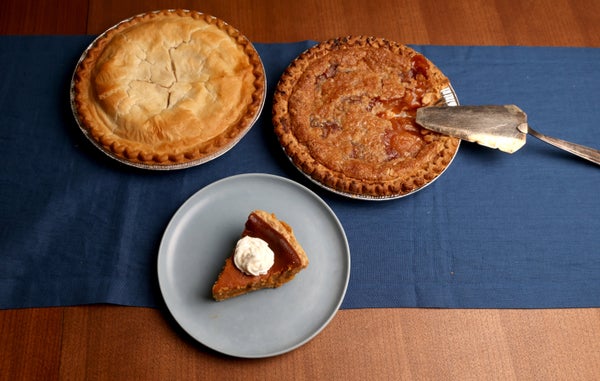
I love a good pie. Every year for Thanksgiving I make a bourbon chocolate pecan pie, which is every bit as decadent—and delicious—as it sounds. But it contains an ungodly amount of corn syrup and sugar, so it got me thinking: Which type of pie spikes your blood sugar the fastest? And is there a “healthier” pie?
Pie varieties abound, so I focused on some of the classics: pecan, pumpkin and apple. Regardless of filling, when you take a bite of pie, the carbohydrates get delivered to your bloodstream as glucose that ultimately gets absorbed by cells. The faster those sugars get into your bloodstream, the quicker you experience a sugar rush. Any guesses on which pie would shuttle the most sugars the quickest?
To get to the bottom of this gooey puzzle, I talked to Sarah Berry, a professor of nutritional sciences at Kings College London, and Sandra Arévalo, director of community health and wellness at Montefiore Nyack Hospital.
On supporting science journalism
If you're enjoying this article, consider supporting our award-winning journalism by subscribing. By purchasing a subscription you are helping to ensure the future of impactful stories about the discoveries and ideas shaping our world today.
Here’s how the different pies really stack up, according to the experts:
Pecan pie
Not all pies are created equally: you have more control over the ingredients in homemade pies, so they tend to be healthier than store-bought ones. In general, though, many pecan pies are on the sweeter side.
“If we think of the average apple, pecan or pumpkin pie, on average, the pecan tends to be higher in sugar, followed by the pumpkin, followed by the apple pie,” Berry says. “But what we also know is the pecan tends to be higher in protein as well and tends to be a little bit higher in fiber.”
So even though pecan pie is high in sugar, the protein and fiber slow down stomach emptying and, in turn, the release of glucose into the bloodstream. Protein also stimulates the release of the hormone insulin, which moves sugar into your cells and out of your bloodstream, Berry says. (Score one point for pecan pie!)
But because pecans aren’t that sweet, people often add a lot of sugar, Arévalo says. If you’re making the pie at home, you can add less sugar or corn syrup. Pecan pie recipes often have corn syrup in them not only for the sweetness but for the texture, she says. So you could reduce the amount of corn syrup and replace it with chia seeds, for example.
Another option for slowing the sugar rush in pecan pie is to serve it with a scoop of plain yogurt or some unsweetened cream, Berry and Arévalo suggest.
Pumpkin pie
Pumpkin pie generally contains less sugar and more dietary fiber than pecan.
“Pumpkin is pretty sweet already,” Arévalo says, “so you might not need to add as much sugar. It has a little fiber, but it has zero protein.”
Here again, you could serve the pie with some plain yogurt or even some nuts on top for a little extra protein. Nuts also give the pie some crunch, she says.
Apple pie
Of the three pies mentioned, apple pie generally contains the least sugar and most fiber.
“The more fruit it has, the better. The less sugar it has, the better. The more protein and fiber, the better,” Arévalo says.
Still, “there’s huge variability from one shop-bought apple pie to another shop-bought apple pie to a homemade apple pie,” Berry notes. If you’re making the pie at home, you can use less sugar, and you can also make a whole-grain crust for the fiber, she says. For the filling, Arévalo recommends using apples with their fiber-rich peels on.
The verdict is in ...
Overall there’s not a huge difference in the fiber or protein content of all three pies, Berry says. “So if I was going to have to opt for the lowest sugar—the pie that’s going to increase my sugar the least—I’d probably say apple pie,” she says.
Arévalo agrees: “Apple pie, I will say, looking at the glycemic load of all of these.” Glycemic load is a measure of how a given food affects blood sugar.
As mentioned already, pecan pies tend to pack the most powerful punch, sugar-wise, and pumpkin pie isn’t necessarily any better.
But apple pie isn’t always the healthier option here. “If the pecan pie doesn’t have a lot of sugar, then I will put pecan pie first. It really depends on how sweet it is,” Arévalo says.
You can make any homemade pie healthier by adjusting the amount of sugar, protein and fiber. And there are other ways to offset the effects of your pie consumption by taking a brisk walk after dessert. Eating breakfast and snacking on protein and fiber throughout the day can help prepare your body for the big meal and prevent a gigantic sugar spike.
Ultimately, you should just enjoy your Thanksgiving feast. “At the end of the day, Thanksgiving is there for joy, for family, for connection, and the food that you eat should bring you joy,” Berry says. “If you enjoyed the pecan and the pumpkin and the apple, and you want lots of sugar in it, I wouldn’t worry about it, personally.”