JOIN US ON THE MONARCH MIGRATION. LEARN MORE.

Why 14 inches of rain fell in Japan in just one day

This extreme rain was deadly, with at least eight people killed and many others stranded

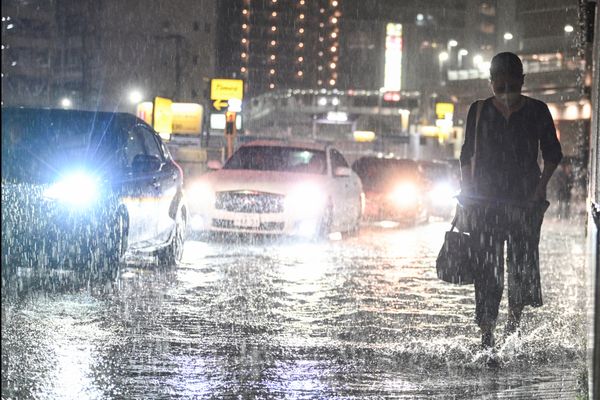
A figure walking in the rain as cars pass.

Cars pass a commuter on a flooded road near the Chiba metro station in Chiba, Japan, on August 13, 2026, as heavy rain sweeps through the area. Torrential rain pummeled eastern Japan, triggering landslides and power outages and prompting the country’s weather authority to issue its highest-level heavy rain warning for the region for the first time.

Philip FONG/Getty Images

Join Our Community of Science Lovers!

Record-breaking rain in Japan’s Chiba Prefecture near Tokyo has killed at least eight people and sparked widespread power outages and travel disruptions, according to Japanese media reports.

In the city of Chiba, a total of 367 millimeters (about 14.4 inches) of rain fell in a 24-hour period ending on Thursday. This was the highest rainfall reading for that area since at least 1976, according to the Japanese Meteorological Agency (JMA), and represented more rain in a full day than has ever been recorded in many U.S. states. Incredibly, 348 millimeters fell in just 12 of those hours—about three times the typical amount of rainfall in the region for the entire month of August.

Thousands of travelers were stranded at Tokyo’s Narita International Airport, while tens of thousands of homes have lost power across the region, according to the Japanese public broadcaster NHK.


On supporting science journalism

If you're enjoying this article, consider supporting our award-winning journalism by subscribing. By purchasing a subscription you are helping to ensure the future of impactful stories about the discoveries and ideas shaping our world today.


The reason for all the rain was humid air flowing north from the southern part of the country and meeting a cold air mass some 6,000 meters (nearly 20,000 feet) above the island of Honshu, which has made the atmosphere “unstable,” JMA officials said at a press conference.

These extreme rainfall events can have lasting health costs, including exacerbating chronic disease, respiratory illnesses, mental health issues, and more, says Kai Chen, an environmental epidemiologist and director of the Yale Center on Climate Change and Health.

Fueling a cycle of extreme weather, climate change is making these events worse. “When you have warmer temperature in the air, the air holds more moisture,” Chen says. More moisture means more rain and more flooding.

“With the warming climate, we are seeing more and more [of] these intense and frequent extreme rainfall events happening,” he says.

Jackie Flynn Mogensen is a breaking news reporter at Scientific American. Before joining SciAm, she was a science reporter at Mother Jones, where she received a National Academies Eric and Wendy Schmidt Award for Excellence in Science Communications in 2024. Mogensen holds a master’s degree in environmental communication and a bachelor’s degree in earth sciences from Stanford University. She is based in New York City.

More by Jackie Flynn Mogensen

It’s Time to Stand Up for Science

If you enjoyed this article, I’d like to ask for your support. Scientific American has served as an advocate for science and industry for 180 years, and right now may be the most critical moment in that two-century history.

SciAm always educates and delights me, and inspires a sense of awe for our vast, beautiful universe. I hope it does that for you, too.

If you subscribe to Scientific American, you help ensure that our coverage is centered on meaningful research and discovery; that we have the resources to report on the decisions that threaten labs across the U.S.; and that we support both budding and working scientists at a time when the value of science itself too often goes unrecognized.

In return, you get essential news, captivating podcasts, brilliant infographics, can't-miss newsletters, must-watch videos, challenging games, and the science world's best writing and reporting. You can even gift someone a subscription.

There has never been a more important time for us to stand up and show why science matters. I hope you’ll support us in that mission.

Thank you,

Jeanna Bryner, Editor in Chief, Scientific American

Subscribe