New Issue: Orbital Catastrophe Ahead? Read Now

Why Storm Surge Is Dangerous—And Becoming More Frequent

How hurricanes push water onto shore in deadly storm surges, and why storm surges are getting worse

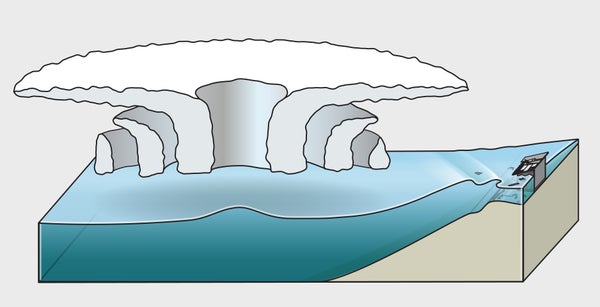
Schematic shows a hurricane over the ocean, with a large wave on the leading edge flooding the coast.

Jen Christiansen

Join Our Community of Science Lovers!

The beginning of June marks the start of the Atlantic hurricane season, the six-month period when strong storms can brew in the ocean and then wreak havoc on land. Among the hazardous consequences of hurricanes are storm surges, in which water rapidly rises above the normal tide level on shore. These dangerous events can cause flooding and pick up and displace homes and other structures. “Water is very powerful,” says Heather Nepaul, a meteorologist at the National Oceanic and Atmospheric Administration’s National Hurricane Center in Miami. “It can be a deadly situation.”

Surges occur when the strong winds of a hurricane interact with ocean waters, piling up water ahead of the storm. As the hurricane heads toward shore, it travels over shallower ocean, and the water it carries has nowhere to go but upward onto land.

How severe a surge will be depends on many factors, including the characteristics of the coastline and the intensity, size and angle of approach of the storm. In general, though not always, stronger and larger storms produce higher storm surges.


On supporting science journalism

If you're enjoying this article, consider supporting our award-winning journalism by subscribing. By purchasing a subscription you are helping to ensure the future of impactful stories about the discoveries and ideas shaping our world today.


As the climate warms, hurricanes are becoming more intense, and sea levels are rising. Both of these effects are likely to worsen storm surges. Coastal areas that are already vulnerable to storm surge could experience worse impacts, and places that aren’t quite vulnerable now may become increasingly at risk.

HOW IT WORKS

The bulk of a storm surge is caused by wind pushing water ashore. A small part of the effect, however, results from the low atmospheric pressure inside a storm, which decreases the amount of downward force on the ocean, triggering a rise in water level.
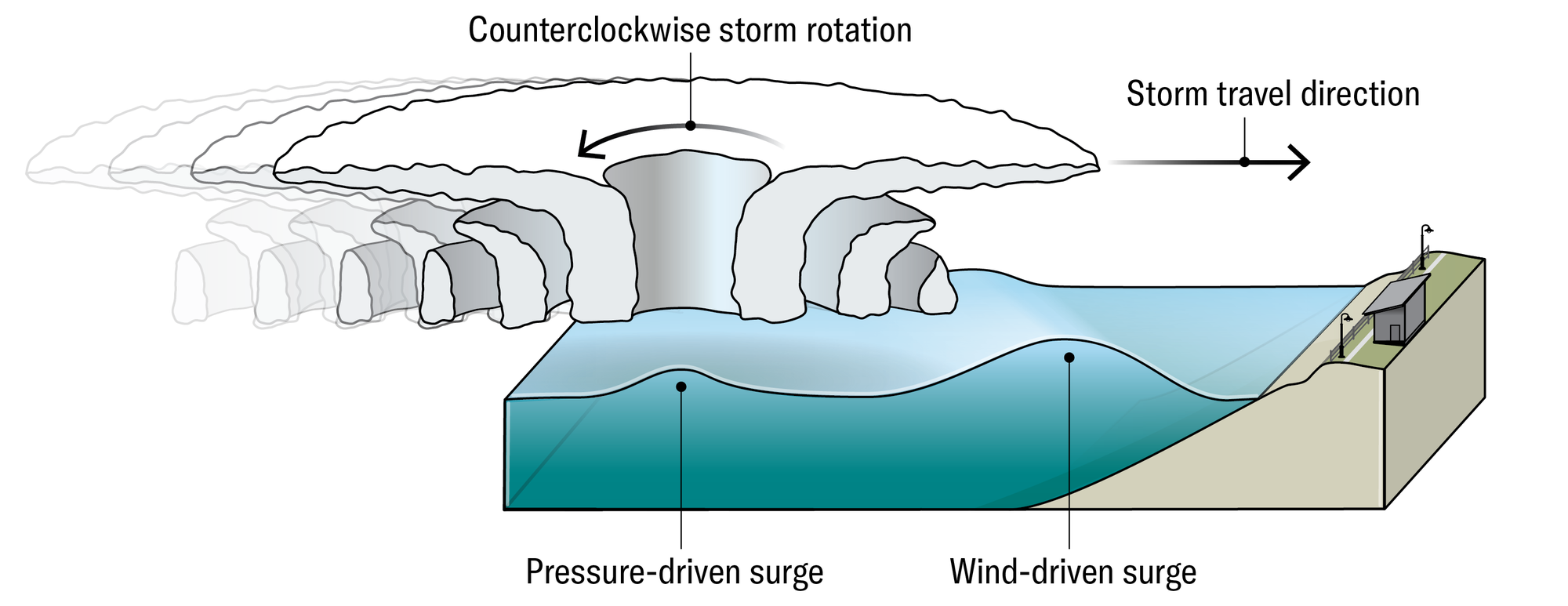
Schematic shows a hurricane approaching the coast, with a large wave on the leading edge. A small bulge in water level is immediately under the eye of the storm.

As the storm advances, its spiral of air pulls ocean water up into its center. When it nears land, the excess water surges over the shore above and beyond the normal tide level.
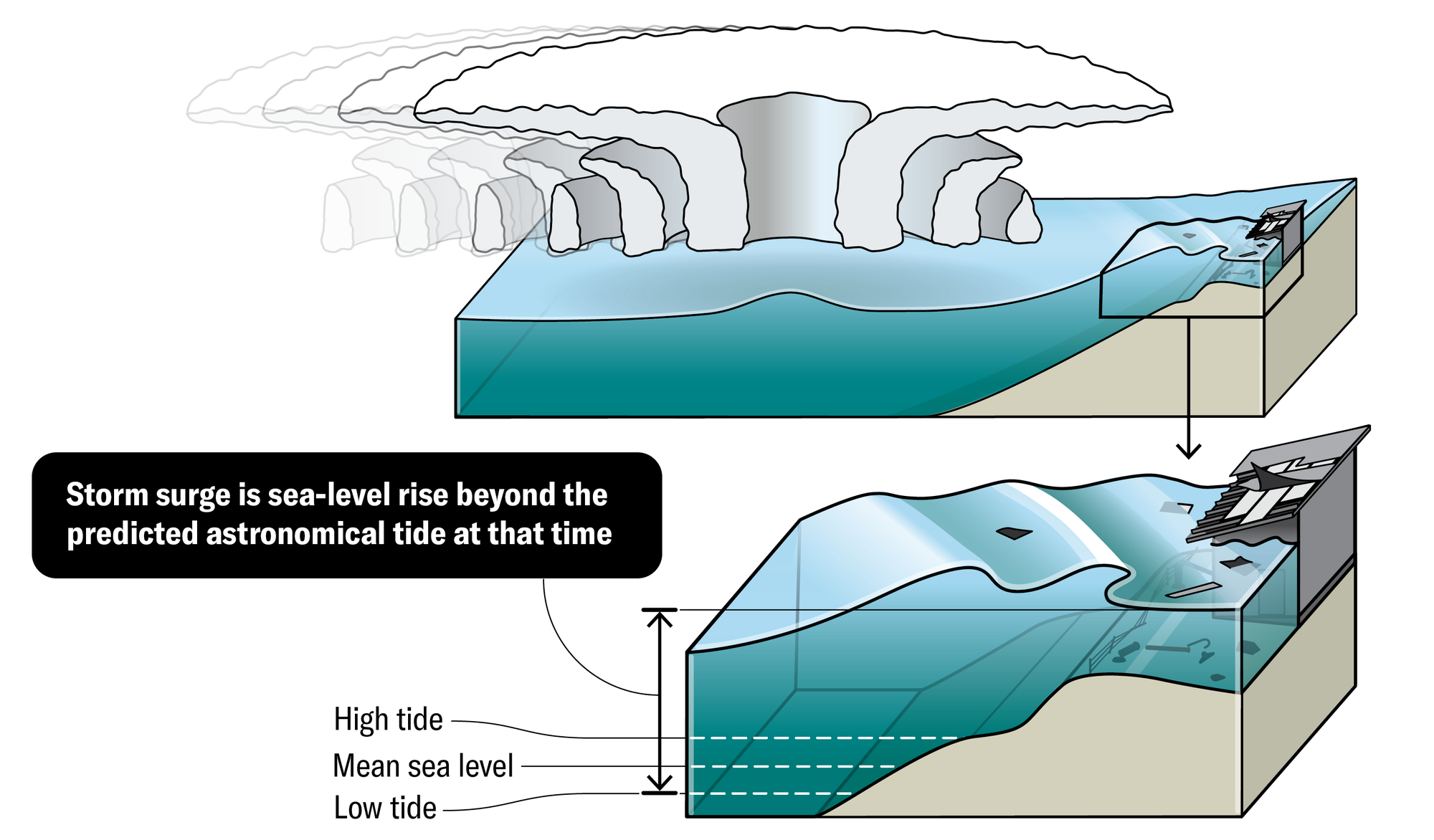
The same scene as above, but the hurricane is closer to shore. The wave breaks up and over the coast, flooding land and destroying property. Storm surge is sea-level rise beyond the predicted astronomical tide at that time.

Jen Christiansen

VARIABLES THAT AFFECT STORM SURGE HEIGHT

The severity of storm surges is hard to predict because it depends on so many variables: the speed and radius of the wind associated with the storm, the hurricane’s size, the speed and angle at which the storm approaches land, and the specific shape of the shoreline where it hits.
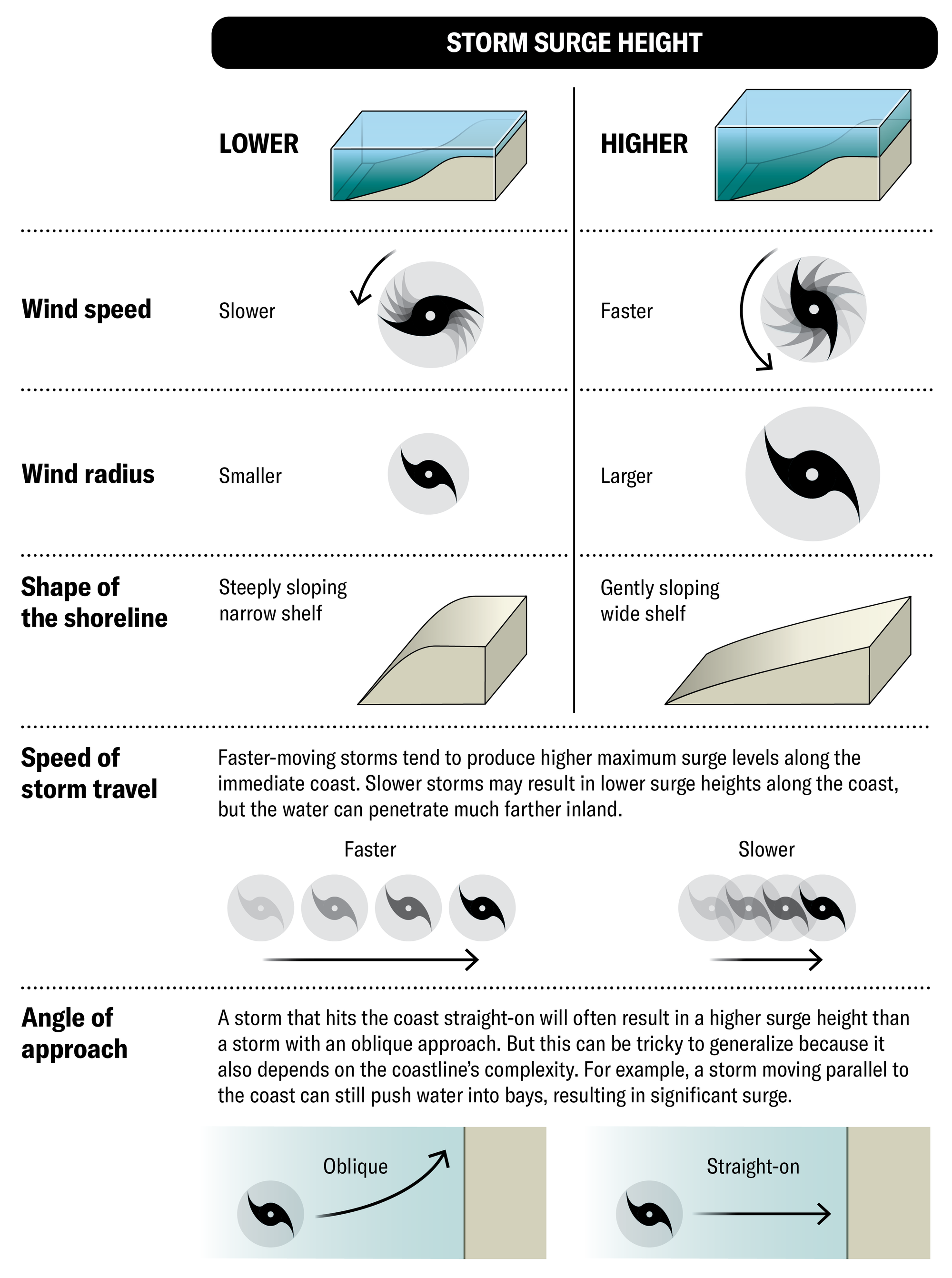
A table of variables indicate that faster wind speed, larger wind radii and gently-sloping wide shelves generally lead to higher storm surge heights.

Jen Christiansen

STORM SURGE RISK

These charts, based on the National Hurricane Center’s National Storm Surge Risk Maps, show the potential amount of surge along the U.S. Atlantic coast for hurricanes of different severity. Storms are categorized along a scale from 1 to 5 based on the strength of their winds, with 5 being the most intense. Surges can affect not just the coastline but locations many miles inland.
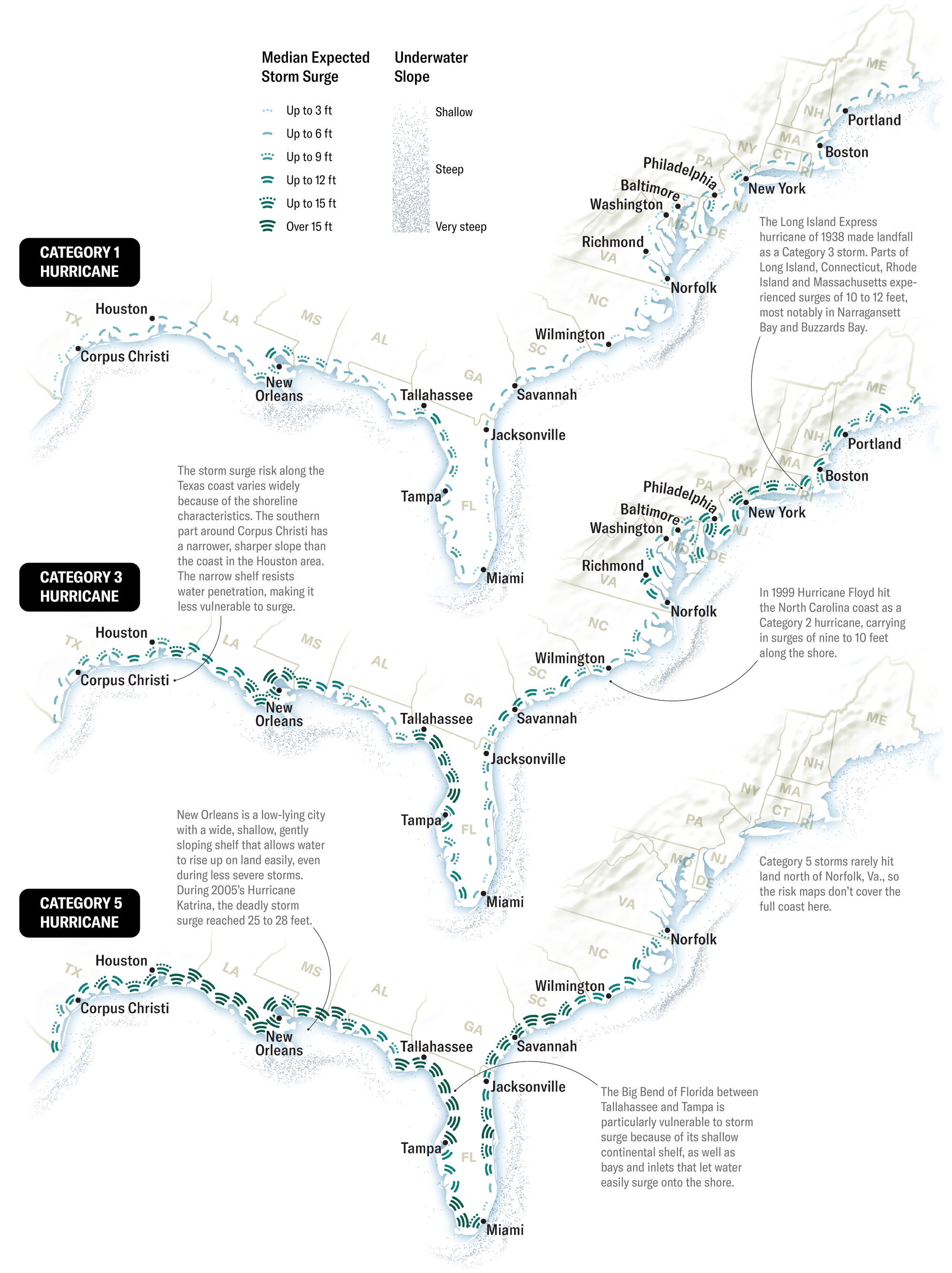
A series of three maps show possible storm surge heights along the Atlantic coast for category 1, 3, and 5 hurricanes.

Daniel P. Huffman; Source: “A National View of Storm Surge Risk and Inundation,” by Brian C. Zachry, William J. Booth, Jamie R. Rhome and Tarah M. Sharon, in Weather, Climate, and Society, Vol. 7, No. 2; April 2015; via www.nhc.noaa.gov/nationalsurge (map data)

Clara Moskowitz is chief of reporters at Scientific American, where she covers astronomy, space, physics and mathematics. She has been at Scientific American for more than a decade; previously she worked at Space.com. Moskowitz has reported live from rocket launches, space shuttle liftoffs and landings, suborbital spaceflight training, mountaintop observatories, and more. She has a bachelor’s degree in astronomy and physics from Wesleyan University and a graduate degree in science communication from the University of California, Santa Cruz.

More by Clara Moskowitz

Jen Christiansen is an information designer, visual science communicator and author of the book Building Science Graphics: An Illustrated Guide to Communicating Science through Diagrams and Visualizations. She began her publishing career in New York City at Scientific American, moved to Washington, D.C., to join the art department of National Geographic, spent four years as a freelance science communicator and then returned to Scientific American for a second stint, during which she became the magazine’s first graphics-specific art director. In that role, she established a consistent data visualization and diagram philosophy across all articles. She writes and presents on topics ranging from reconciling her love for art and science to her quest to learn more about the pulsar chart on Joy Division’s Unknown Pleasures album cover. Her work can be viewed at www.jenchristiansen.com

More by Jen Christiansen

Daniel P. Huffman is an independent cartographer and mapping educator. More of Huffman's work can be found at https://somethingaboutmaps.com.

More by Daniel P. Huffman
Scientific American Magazine Vol 332 Issue 6This article was published with the title “Stormy Waters” in Scientific American Magazine Vol. 332 No. 6 (), p. 90
doi:10.1038/scientificamerican062025-6Ou2VxDP0ZK2rPXiirnZjT

Subscribe to Support Independent Journalism

Great science journalism requires human expertise, time, effort and creativity. And it costs money. That’s why I and the journalists here at Scientific American hope you’ll join our community.

When you subscribe, you are supporting staff and freelance journalists who are passionate about telling science stories that are true, important and compelling. Our editors and reporters are often experts in their fields, which means they understand the nuances of big discoveries and can untangle the breakthroughs from the hype. With a subscription, you are also supporting rigorous fact-checking to ensure the words we publish are precise and accurate. And you’re supporting original illustrations, graphics and photos that bring you closer to an advanced laboratory, an ice sheet in Antarctica or a space mission in orbit. You’re helping us craft other types of high-quality journalism as well: Our newsletters are carefully written, edited and curated by staffers you have or will come to know and love. Our Science Quickly podcast is based on original reporting, collaboration with editors and scientists and exacting production.

Subscriptions keep this engine running so we can continue to deliver thoughtful, rigorous and independent science journalism to you. In an era of viral misinformation, this work is crucial. If you value what we do, I hope you’ll consider joining us as a subscriber

Thank you,

Jeanna Bryner, Editor in Chief, Scientific American

Subscribe