
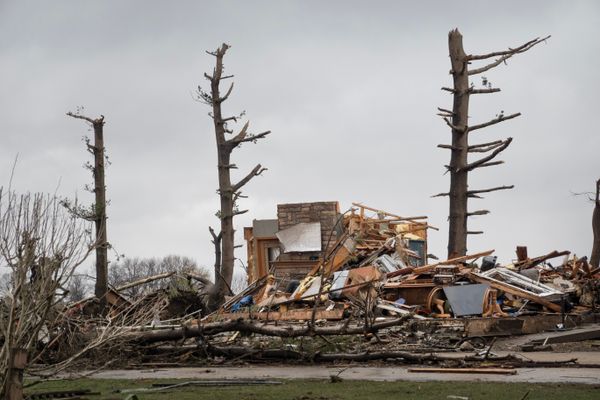
The tornadoes aren’t in Kansas anymore, Toto; they’re in Illinois.
On Tuesday six tornadoes tore through the Chicago area during a derecho—a huge, long-lived wind storm that some call an “inland hurricane.” On the same day, several more twisters touched down across the state, bringing Illinois’s tornado count for the year to 204.
That makes Illinois the most active tornado state in the U.S. in 2026 and only the second state ever to top 200 twisters in a year. The other is Texas, a state with about five times the land area of Illinois.
On supporting science journalism
If you're enjoying this article, consider supporting our award-winning journalism by subscribing. By purchasing a subscription you are helping to ensure the future of impactful stories about the discoveries and ideas shaping our world today.
Tornadoes happen when warm, moist air meets cooler, dryer air and forms a strong thunderstorm. Because of climate warming, the atmosphere over Illinois has gotten warmer and more humid. This spring that air interacted with a jet stream through the Midwest, causing a series of severe thunderstorms and tornadoes.
Meteorologists have also improved in their ability to detect and understand the storms that cause tornadoes, says Brett Borchardt, a senior meteorologist at Chicago’s National Weather Service. That could be part of the reason why Illinois suddenly seems to be beset by so many twisters.
“It’s possible that we’re detecting a more realistic number of tornadoes for this part of the country compared to earlier decades,” Borchardt says. “But even with those factors in mind, this year has still been remarkably busy.”
The Midwest and Great Lakes regions have seen a significant uptick in tornadoes in the past decade. Illinois’s second-busiest tornado year was 2024, when the state was hit with 142 twisters.
The U.S. overall has seen 1,292 tornadoes this year as the typical summer twister season now draws to a close. With four months left in the year, though, Borchadt believes Illinois may top Texas’s all-time record of 244 tornadoes in 2015.
The shift in storms from the traditional “Tornado Alley” region, which includes Texas and Oklahoma, could be a temporary blip, Borchadt says—or not.
“It remains to be seen if this is establishing more of a long-term trend or if we’re just in a three- to five-year cycle here, and it starts to calm down in a few years,” he says. “It is still a reminder that even though we don’t live in the plains, we can still get hit by real bad storms.”