
This article is from Proof Positive, our friendly math newsletter that’s delivered to your inbox every Tuesday afternoon. Sign up today and read it first.
Quadratic functions plague many students during school, popping up everywhere from binomial expansions to the geometry of parabolas and accelerated motion in physics. But the graphs of quadratic functions actually have a use that is often overlooked. They can help us multiply two numbers together. Perhaps more surprisingly, using parabolas for multiplication forms an important branch of cryptography.
On supporting science journalism
If you're enjoying this article, consider supporting our award-winning journalism by subscribing. By purchasing a subscription you are helping to ensure the future of impactful stories about the discoveries and ideas shaping our world today.
One interesting way to visualize these often-overlooked properties of quadratic functions is through an arts and crafts project. You can draw a parabola of the form x2 on some cardboard or poster board and then put little pegs along points on the parabola with integer coordinates. Next get a string with a small weight attached to either end. Let’s say you want to multiply 3 × 4. To solve, loop one end of the string around the peg on the parabola with an x-coordinate of –3 (y = 9) and attach the other end of the string to a peg with an x-coordinate of 4 (y = 16). The string will now form a straight line that intersects the y-axis at 12—giving the answer of 3 × 4 = 12. (Note that you would also get the correct answer if you instead used –4 and 3.)
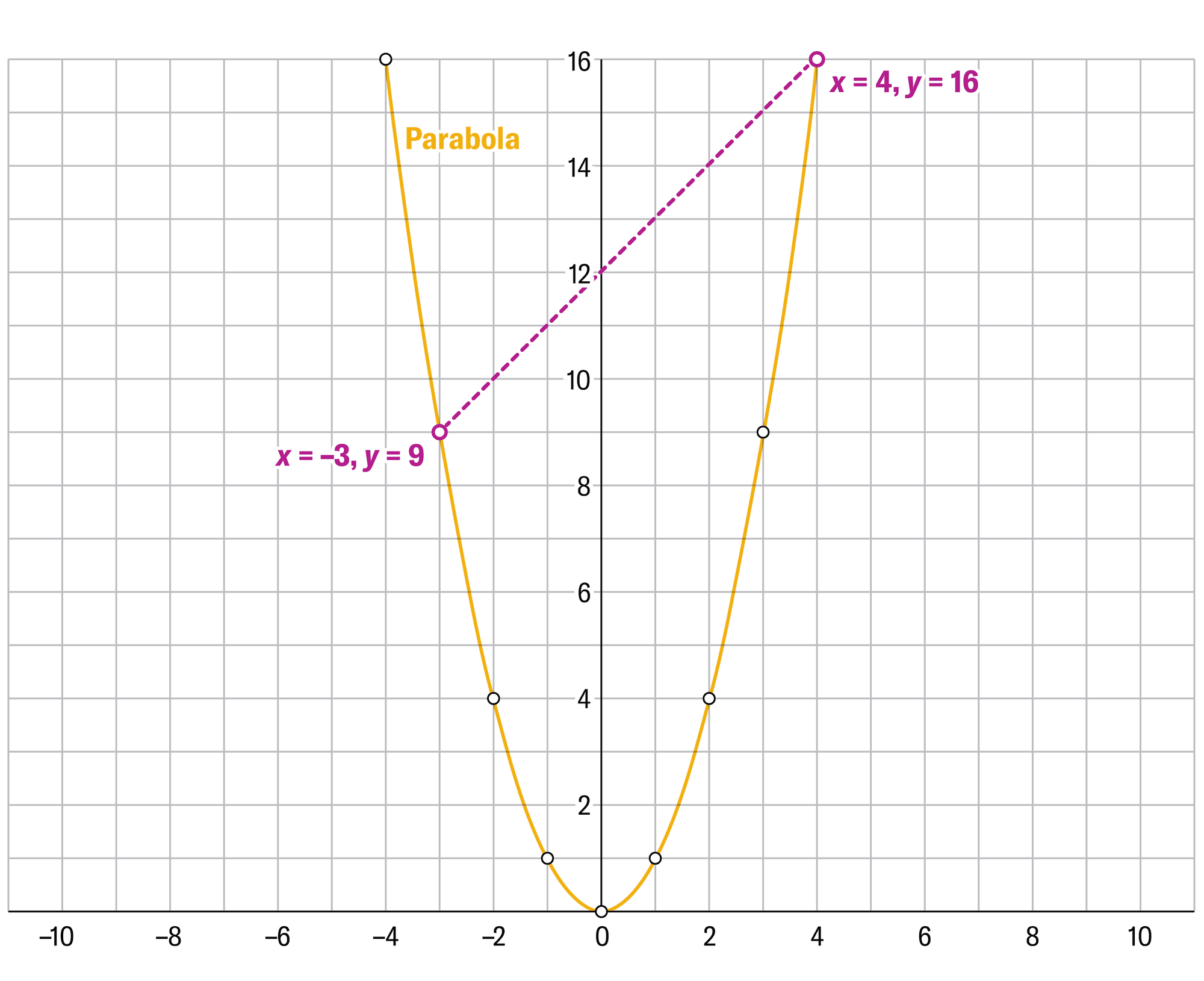
Parabolas can be used to solve multiplication problems, such as 3 × 4 in the example above.
Amanda Montañez
You can also draw a parabola to create an entirely two-dimensional version of the parabolic calculator—or play with an online version of this same demonstration.
Amazingly, you can multiply any two numbers on the number line in this way. Proving that this relationship always holds true is relatively simple. Suppose you want to multiply any two numbers a and b. If you proceed as before, you attach one end of the string to the point (–a, a2) and the other to (b, b2). The resulting line, y = mx + c, intersects the y-axis at point c.
To confirm our hypothesis, we need to calculate c. The equation describing the line consists of two unknowns, m and c, but we know two points that lie on the line: (–a, a2) and (b, b2). This is enough information to determine all the parameters.
Start by substituting the x- and y-coordinates of the two points into the equation describing the line to get two new equations. The first point gives the equation a2 = –ma + c; the second gives b2 = mb + c. You can combine these equations and solve for c. Solving the second equation for m and substituting the result into the first yields a2 = a(c – b2) / b + c. Solving this expression for c gives the result of c = a × b.
So if you ever find yourself without a calculator and need to multiply two numbers, you can draw a parabola to help you. It’s not the most practical method, admittedly, especially when calculating the product of nonintegers where you likely won’t be able to determine the result exactly using a coordinate grid. Nevertheless, you can make a decent estimation.
From Parabolas to Elliptic Curves
Similar calculations are helpful in cryptography. To develop a secure encryption method, cryptographers look for mathematical problems that are easy to solve but difficult to undo. For example, multiplying two large prime numbers is easy, but determining the two prime factors that led to a particular product is difficult. In fact, one of the first modern encryption methods, the so-called Rivest-Shamir-Adleman (RSA) method, is based on math related to this prime factorization phenomenon.
And today a faster approach has come into favor: elliptic curve cryptography. In an approach that is reminiscent of the parabola calculator, cryptographers use points along a special curve in combination with simple arithmetic to create a key. This form of cryptography is secure and involves relatively small numbers, making it a more efficient option than the RSA method, which relies on large prime numbers.
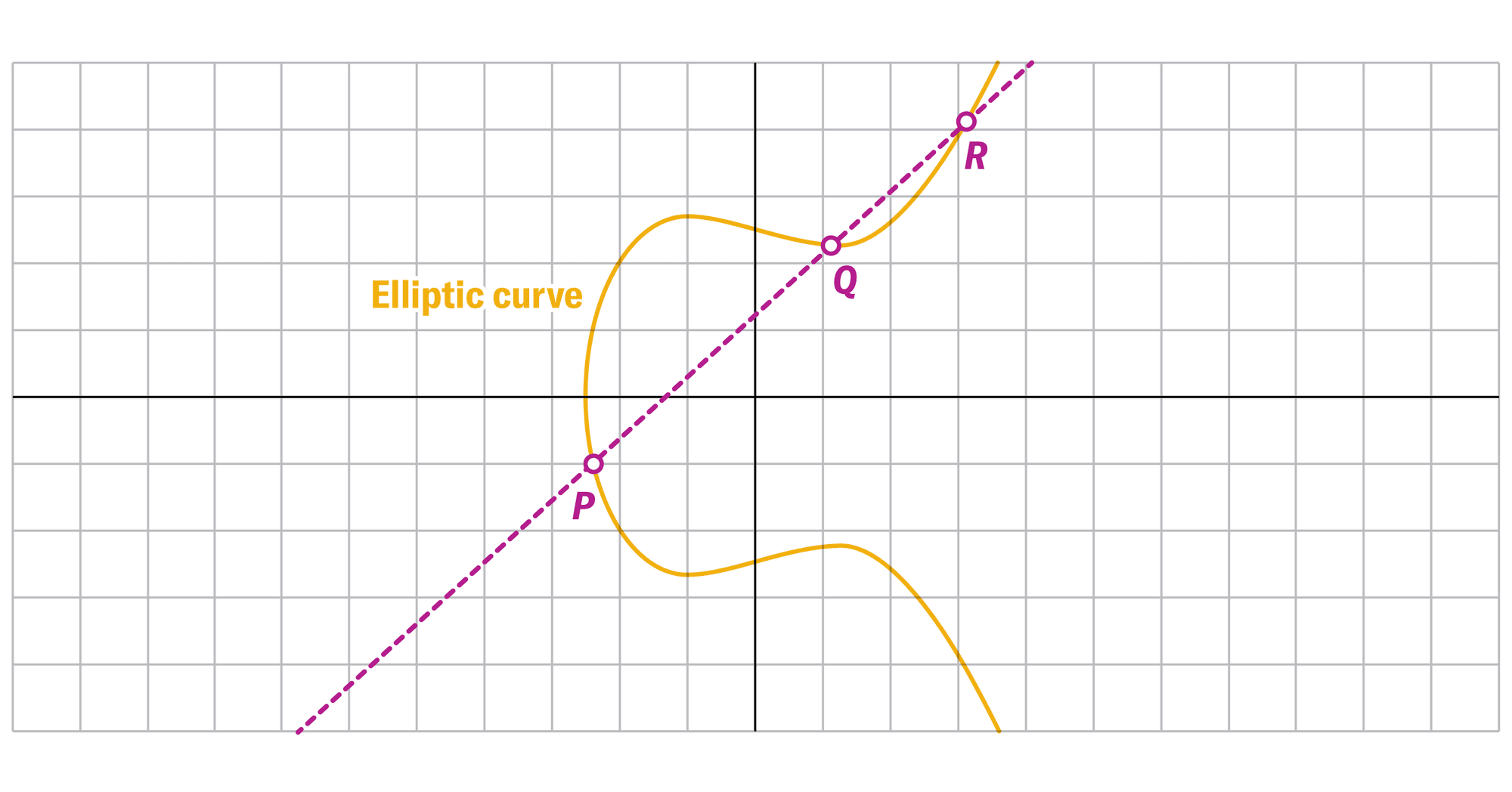
Mathematicians perform simple arithmetic using points on an elliptic curve—a technique that is essential in a form of cryptography.
Amanda Montañez
Quantum computers, unfortunately, may be able to break these barriers. But that’s a story for another day!
This article originally appeared in Spektrum der Wissenschaft and was reproduced with permission. It was translated from the original German version with the assistance of artificial intelligence and reviewed by our editors.