New Issue: Orbital Catastrophe Ahead? Read Now

Why Some Animals Live for Only Days and Others Live for Thousands of Years

Scientists are studying why some species live so much longer than others

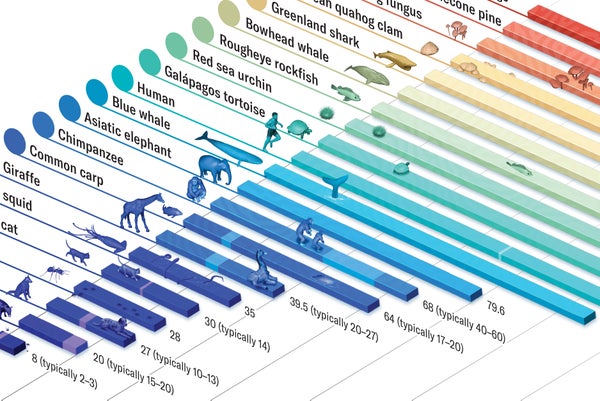
Detail of a bar chart showing the longest recorded lifespan for 24 plants and animals

Mark Belan

Join Our Community of Science Lovers!

Some species seem to live fast and die young. Others, though, “appear not to age,” says João Pedro de Magalhães, a molecular biologist at the University of Birmingham in England. He is project leader of the Human Ageing Genomic Resources program, which keeps the AnAge database of maximum animal lifespans. Some species of turtles, fishes and salamanders, for instance, don’t show any signs of degeneration or senescence as they grow older. If they didn’t die of predation, accidents or infectious disease, they could live extremely long lives, Magalhães says.

“It’s a biological mystery why some species age faster than others,” Magalhães says. “We still don’t understand well the mechanisms behind aging.” Species that face high predation usually evolve to grow quickly and reach sexual maturity rapidly. Other creatures that don’t face pressure to reproduce early can age slowly: Greenland sharks, for instance (the top of their food chain), may take 150 years to reach sexual maturity.

DNA mutations are thought to play a role in determining lifespans, with longer-lived species tending to evolve better DNA-repair systems to help ward off cancer. Short-lived creatures, such as mice, don’t have these abilities, because in the wild they often die of predation before cancer becomes an issue. Laboratory-raised mice, however, have very high rates of cancer.


On supporting science journalism

If you're enjoying this article, consider supporting our award-winning journalism by subscribing. By purchasing a subscription you are helping to ensure the future of impactful stories about the discoveries and ideas shaping our world today.
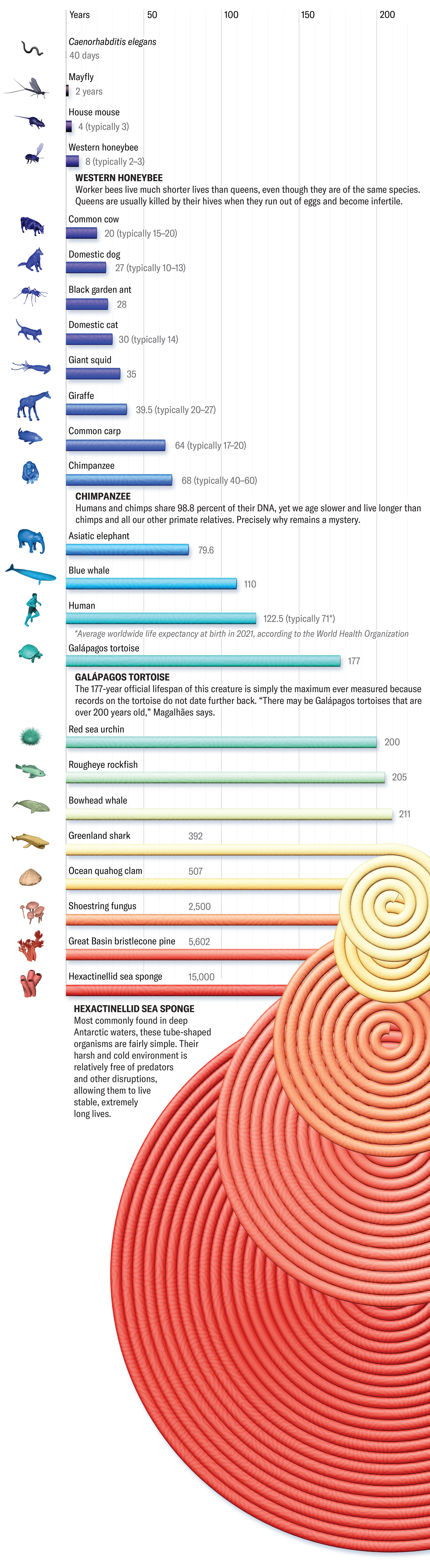

Longest recorded lifespan for 24 plants and animals are shown, from C. elegans (at 40 days) to the Hexactinellid sea sponge (at an estimated 15,000 years)

Mark Belan; Source: AnAge: The Animal Ageing and Longevity Database/Human Aging Genomic Resources (longevity data); Animal Diversity Web (most of the typical lifespan values)

Clara Moskowitz is chief of reporters at Scientific American, where she covers astronomy, space, physics and mathematics. She has been at Scientific American for more than a decade; previously she worked at Space.com. Moskowitz has reported live from rocket launches, space shuttle liftoffs and landings, suborbital spaceflight training, mountaintop observatories, and more. She has a bachelor’s degree in astronomy and physics from Wesleyan University and a graduate degree in science communication from the University of California, Santa Cruz.

More by Clara Moskowitz

Mark Belan is a scientific illustrator and visual communicator. His work translates scientific ideas and data into didactic visuals. His work can be found at www.artscistudios.com

More by Mark Belan
Scientific American Magazine Vol 332 Issue 5This article was published with the title “Lifespan Limits” in Scientific American Magazine Vol. 332 No. 5 (), p. 94
doi:10.1038/scientificamerican052025-7KQTl66lsO56DwxwJTDKE

Subscribe to Support Independent Journalism

Great science journalism requires human expertise, time, effort and creativity. And it costs money. That’s why I and the journalists here at Scientific American hope you’ll join our community.

When you subscribe, you are supporting staff and freelance journalists who are passionate about telling science stories that are true, important and compelling. Our editors and reporters are often experts in their fields, which means they understand the nuances of big discoveries and can untangle the breakthroughs from the hype. With a subscription, you are also supporting rigorous fact-checking to ensure the words we publish are precise and accurate. And you’re supporting original illustrations, graphics and photos that bring you closer to an advanced laboratory, an ice sheet in Antarctica or a space mission in orbit. You’re helping us craft other types of high-quality journalism as well: Our newsletters are carefully written, edited and curated by staffers you have or will come to know and love. Our Science Quickly podcast is based on original reporting, collaboration with editors and scientists and exacting production.

Subscriptions keep this engine running so we can continue to deliver thoughtful, rigorous and independent science journalism to you. In an era of viral misinformation, this work is crucial. If you value what we do, I hope you’ll consider joining us as a subscriber

Thank you,

Jeanna Bryner, Editor in Chief, Scientific American

Subscribe