
Irrational numbers such as pi or the square root of 2 have always fascinated humankind. After all, they symbolize infinity better than anything else: their sequence of digits after the decimal point extends endlessly without ever repeating regularly. The most astonishing thing about this is that these numbers appear in the simplest contexts, such as when calculating the circumference of a circle or the diagonal of a square.
For thousands of years, scholars have investigated the peculiarities of irrational numbers. And yet, even today, we are far from having unlocked their secrets. On the contrary, it seems that even the most fundamental properties of these numbers remain unknown.
We can approximate any irrational number arbitrarily well using fractions of integers (rational numbers). Therefore, you can get closer and closer to a number like pi using fractions. The larger the denominators of the fractions used, the smaller the difference to the irrational number.
On supporting science journalism
If you're enjoying this article, consider supporting our award-winning journalism by subscribing. By purchasing a subscription you are helping to ensure the future of impactful stories about the discoveries and ideas shaping our world today.
More than a millennia ago, Diophantus of Alexandria, an ancient Greek mathematician, was interested in this idea. He wondered if he could find the smallest possible fraction that would still differ as little as possible from the irrational number. This seemingly innocuous question continues to shape mathematical research to this day.
How Irrational Is an Irrational Number?
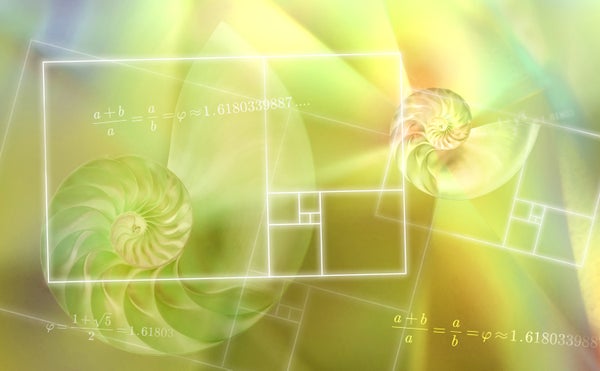
As it turns out, not all irrational numbers can be approximated equally well by fractions. Some require relatively simple fractions to accurately represent many decimal places, while others require very large denominators. For example, the golden ratio, written as (below) is particularly difficult to approach as a fraction and therefore described as the “most irrational” of all numbers.

German mathematician Johann Peter Gustav Lejeune Dirichlet addressed Diophantus’s question in the 19th century. He considered the value obtained from subtracting the fraction p⁄q from an irrational number α and was able to show that their difference is at most 1⁄q^2.
So what does that mean, really? For every irrational number α, there are infinitely many fractions p⁄q. This also means that the accuracy with which an irrational number can be approximated by a fraction scales with the square of the denominator, q: the larger the denominator of a suitably chosen fraction, the more accurately the value of an irrational number can be determined. So the aim for experts is to try to create a larger denominator to improve the fraction’s ability to approximate an irrational number.
Many mathematicians have taken up that challenge. They started with Dirichlet’s inequality:

And again, they wanted to focus on increasing the denominator in the right-hand part of the equation in order to improve the approximation. Therefore, the mathematicians checked whether the fraction on the right side of the equation could be replaced by another that involved a mathematical constant in the denominator.
In 1891 mathematician Adolf Hurwitz found a strong candidate:

That is, for every irrational number α there are infinitely many fractions p⁄q that satisfy the inequality above. Hurwitz’s approach had a limit, however. If α corresponded to the golden ratio, then the equation works but only if the constant involved is within a certain size.
That meant that if mathematicians wanted to get an even better fraction to approximate their irrational number, they had a problem.
Lagrange Numbers as a Measure of Irrationality
At the end of the 19th century mathematician Andrey Markov took another pass at this challenge by omitting the golden ratio and focusing on the remaining irrational values. Could the denominator be further refined in order to get even closer to our irrational target?
The answer was yes. Apart from numbers related to the golden ratio, infinitely many fractions can be derived for all other irrational numbers p⁄q to satisfy the following inequality:

But curiously, this approach also hits a constraint with a particular irrational number—in this case √2. Just like the golden ratio for the earlier inequality, setting α equal to √2 prevents a better approximation result.
So Markov excluded the troublesome √2 as well, which allowed the inequality to be further improved to:

Once again, an irksome irrational number limited further refinement, which prompted Markov to remove it and derive a new inequality. That process, it turns out, can be repeated many, many times over.
What emerges from this exercise is a series of constants that each appear in the denominator of the right-hand side of this inequality. First was √5 from Hurwitz’s work and then√2 from Markov’s initial effort, followed by √221⁄5, and so on.
These constants form an infinitely long sequence called “Lagrange numbers,” named after mathematician Joseph-Louis Lagrange, that gradually approach the limit of 3, as Markov demonstrated in 1880. In fact, for any specific irrational number, you can find the best possible inequality for approximating its value and thereby identify its corresponding Lagrange number.
In number theory, these Lagrange numbers become an indication of just how “irrational” a number is—that is, how well it can be approximated by fractions. The smaller the Lagrange number, the more “irrational” the number.
A Strange Pattern
But the story doesn’t end there. Markov’s work allowed for infinitely many Lagrange numbers between √5 and 3. All of these refer to a specific class of irrational numbers that can be calculated using a quadratic equation.
But as other mathematicians would explore, there are irrational numbers with Lagrange values larger than 3, which puzzle researchers to this day.
If you were to write out all of the Lagrange values, from √5 to 3 and beyond, you would find some curious patterns. Initially, the Lagrange numbers are discrete: they represent individual values such as√5, 2√2 and √221⁄5. There are infinitely many Lagrange numbers in the range, but they are not consecutive. From the number 3 onward, however, the Lagrange spectrum becomes considerably more diverse. The numbers form what’s called a fractal structure consisting of infinitely many continuous segments separated by gaps. This can be visualized as a kind of barcode, with some narrow stripes and some thicker continuous stripes following one another. While the general behavior of Lagrange numbers in this range is known, some details remain unclear, such as which gaps contain no Lagrange numbers at all.
But this fractal structure does not continue indefinitely; it ends at a point known as the Freiman constant, F:

In 1968 the late Gregory Abelevich Freiman proved that every real number greater than or equal to F corresponds to a Lagrange number. They thus form a unique limit for approximating an irrational number.
All of this raises many questions for mathematicians. Why does the Lagrange spectrum consist of three completely different sections: a section of individual points, a section of fractal segments and a section of a continuous line? How do the corresponding irrational numbers differ?
But the Freiman constant F also raises eyebrows among many experts: Where does this value come from, and what defines it? Unlike many other mathematical constants such as pi or Euler’s number e, the Freiman constant has not appeared in any other context so far.
Furthermore, it is unclear which irrational number corresponds to the Lagrange variable F. Freiman derived his proof using complicated number-theoretic considerations rather than concrete calculations of the Lagrange variable of irrational numbers.
We have made progress since Diophantus’s day, but we are still far from having grasped the true nature of numbers.
This article originally appeared in Spektrum der Wissenschaft and was reproduced with permission. It was translated from the original German version with the assistance of artificial intelligence and reviewed by our editors.