New Issue: Orbital Catastrophe Ahead? Read Now

The Surprising Science behind Your Favorite (and Least Favorite) Scents

More familiar smells and scents from complex molecules can often be more appealing

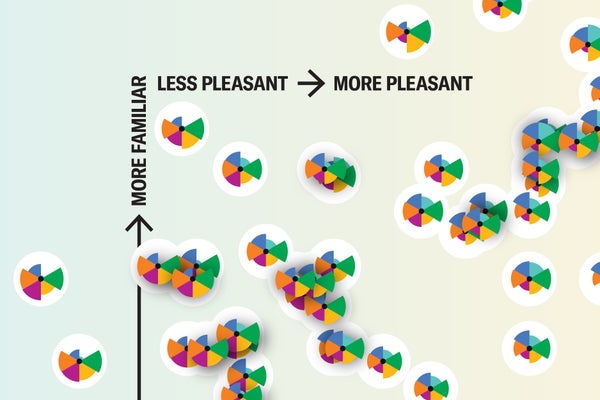
Detail of a scatter plot labelled less pleasant to more pleasant, and less familiar to more familiar. Data points on the plot are brightly colored pinwheels, with wedges of different sizes.

Jen Christiansen

Join Our Community of Science Lovers!

The sense of smell, it turns out, is highly individual—a scent that is enticingly floral to one person may be off-putting and chemical to another. Researchers in Germany -recently asked 1,227 participants to describe and rate 73 odors and found their answers to be strikingly variable. “It depends on what people have associated with the odor,” says psychologist Antonie Louise Bierling of Friedrich Schiller University Jena, who led the study. “In my opinion, it would have been really astonishing if the same odor smelled pleasant to everyone. Why should it?”

The researchers did identify some trends. More familiar scents seem to smell more pleasant, for example, and odors from complex molecules seem to have greater appeal than those of simple compounds.

Scientists hope to use the data to help develop “digital olfaction”—artificial noses that can sense scents as well as or even better than humans. Such devices could be helpful for disease detection or in “smart home” applications: a toaster, for instance, that can tell when toast is done by how burned it smells or refrigerators that can identify putrid decay.


On supporting science journalism

If you're enjoying this article, consider supporting our award-winning journalism by subscribing. By purchasing a subscription you are helping to ensure the future of impactful stories about the discoveries and ideas shaping our world today.


Scatterplot with dots representing the median pleasantness and familiarity ratings of a specific molecular compound’s smell. Participants generally perceived more familiar smells as more pleasant (top right quadrant) and less familiar smells as unpleasant (bottom left quadrant). Six other dimensions are represented by wedges: intense, warm, cold, edible, disgusting and irritating. Some secondary patterns are evident. “Disgusting” is negatively correlated with “pleasant”: smells with high scores for disgust cluster to the left. Odors that smell edible are positively correlated with pleasantness and skew toward the right.

Miriam Quick and Jen Christiansen; Source: “A Dataset of Laymen Olfactory Perception for 74 Mono-Molecular Odors,” by Antonie Louise Bierling et al., in Scientific Data, Vol. 12; February 2025 (data)

HOW WE DESCRIBE SMELLS, GOOD AND BAD

Researchers asked people to respond with “yes” or “no” to whether each smell matched 16 descriptive terms, including “sweet” and “musky.” By comparing these answers with the sliding-scale pleasantness scores the same molecules received, we can see which words were most predictive of pleasant—and unpleasant—smells.

The dots in the graph indicate the difference in pleasantness scores for scents associated with each word. For example, the median pleasantness score for all molecules that the respondents considered “sweet” was 61, and the median pleasantness score for all molecules that were not marked as “sweet” was 34. The difference in scores was +27, making “sweet” the word most frequently associated with scents perceived as pleasant. “Decayed,” with a difference in scores of –35, was the descriptor least associated with pleasant smells.
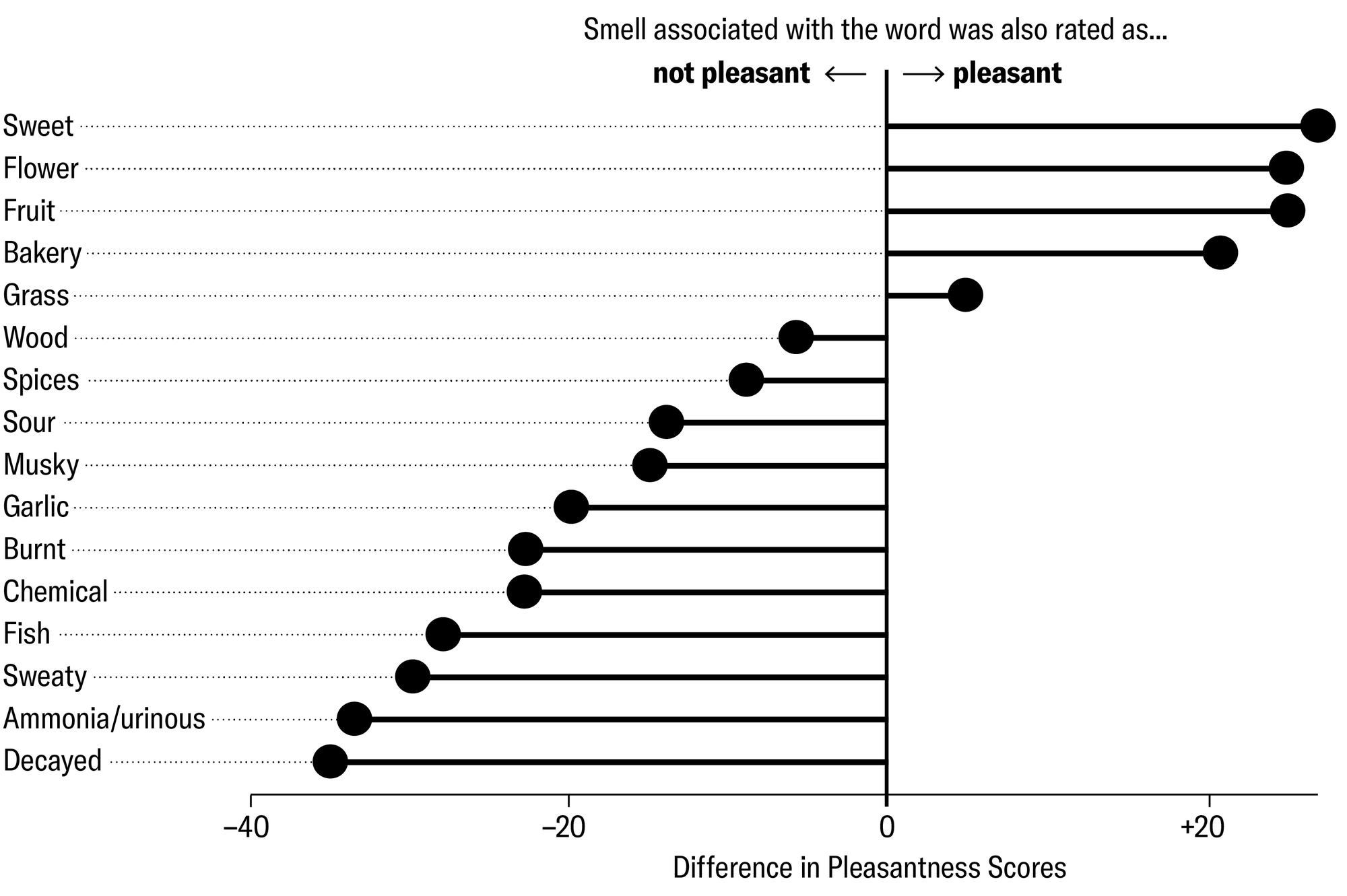
Lollipop chart includes these descriptors ranked in order of how strongly they are associated with the term pleasant, ranging from pleasant (Sweet) to not (Decayed): Sweet, Flower, Fruit, Bakery, Grass, Wood, Spices, Sour, Musky, Garlic, Burnt, Chemical, Fish, Sweaty, Ammonia/urinous, Decayed

Miriam Quick and Jen Christiansen; Source: “A Dataset of Laymen Olfactory Perception for 74 Mono-Molecular Odors,” by Antonie Louise Bierling et al., in Scientific Data, Vol. 12; February 2025 (data)

THE SWEET SMELL OF COMPLEXITY

More complex molecules tend to be ranked as more pleasant. Molecular complexity is a rough estimate of how intricate a compound’s structure is. It runs on a scale from 0 to thousands—in this dataset, from 10.8 (isopropyl alcohol) to 366 (tonalide). Here each dot represents one of 73 molecules. We grouped molecular complexity into three categories: high, medium and low. Vertical bars mark median pleasantness scores per category.
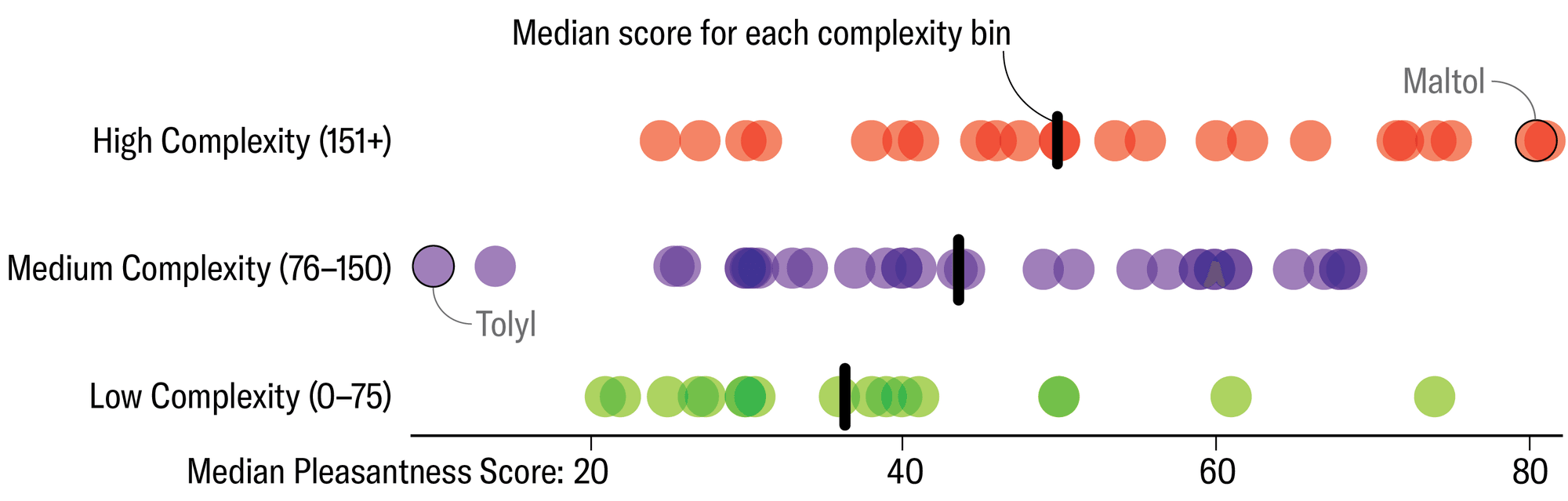
Dot plot shows median pleasantness score for each scent molecule, grouped by molecular complexity. Highly complex molecules are generally ranked as more pleasant than low complexity molecules.

Miriam Quick and Jen Christiansen; Source: “A Dataset of Laymen Olfactory Perception for 74 Mono-Molecular Odors,” by Antonie Louise Bierling et al., in Scientific Data, Vol. 12; February 2025 (data)

Clara Moskowitz is chief of reporters at Scientific American, where she covers astronomy, space, physics and mathematics. She has been at Scientific American for more than a decade; previously she worked at Space.com. Moskowitz has reported live from rocket launches, space shuttle liftoffs and landings, suborbital spaceflight training, mountaintop observatories, and more. She has a bachelor’s degree in astronomy and physics from Wesleyan University and a graduate degree in science communication from the University of California, Santa Cruz.

More by Clara Moskowitz

Miriam Quick is a data journalist who investigates scientific, environmental, economic and cultural issues. Her analyses and storytelling have been featured by major international media outlets, including the BBC, the New York Times, Scientific American and Sentient Media. Her book I Am a Book. I Am a Portal to the Universe (Particular, 2020), co-authored with Stefanie Posavec, won the Royal Society Young People’s Book Prize 2021.

More by Miriam Quick

Jen Christiansen is an information designer, visual science communicator and author of the book Building Science Graphics: An Illustrated Guide to Communicating Science through Diagrams and Visualizations. She began her publishing career in New York City at Scientific American, moved to Washington, D.C., to join the art department of National Geographic, spent four years as a freelance science communicator and then returned to Scientific American for a second stint, during which she became the magazine’s first graphics-specific art director. In that role, she established a consistent data visualization and diagram philosophy across all articles. She writes and presents on topics ranging from reconciling her love for art and science to her quest to learn more about the pulsar chart on Joy Division’s Unknown Pleasures album cover. Her work can be viewed at www.jenchristiansen.com

More by Jen Christiansen
Scientific American Magazine Vol 333 Issue 2This article was published with the title “Why We Love Some Smells and Loathe Others” in Scientific American Magazine Vol. 333 No. 2 (), p. 90
doi:10.1038/scientificamerican092025-1qXzHHbf8u1iJenMFJPMvA

Subscribe to Support Independent Journalism

Great science journalism requires human expertise, time, effort and creativity. And it costs money. That’s why I and the journalists here at Scientific American hope you’ll join our community.

When you subscribe, you are supporting staff and freelance journalists who are passionate about telling science stories that are true, important and compelling. Our editors and reporters are often experts in their fields, which means they understand the nuances of big discoveries and can untangle the breakthroughs from the hype. With a subscription, you are also supporting rigorous fact-checking to ensure the words we publish are precise and accurate. And you’re supporting original illustrations, graphics and photos that bring you closer to an advanced laboratory, an ice sheet in Antarctica or a space mission in orbit. You’re helping us craft other types of high-quality journalism as well: Our newsletters are carefully written, edited and curated by staffers you have or will come to know and love. Our Science Quickly podcast is based on original reporting, collaboration with editors and scientists and exacting production.

Subscriptions keep this engine running so we can continue to deliver thoughtful, rigorous and independent science journalism to you. In an era of viral misinformation, this work is crucial. If you value what we do, I hope you’ll consider joining us as a subscriber

Thank you,

Jeanna Bryner, Editor in Chief, Scientific American

Subscribe