
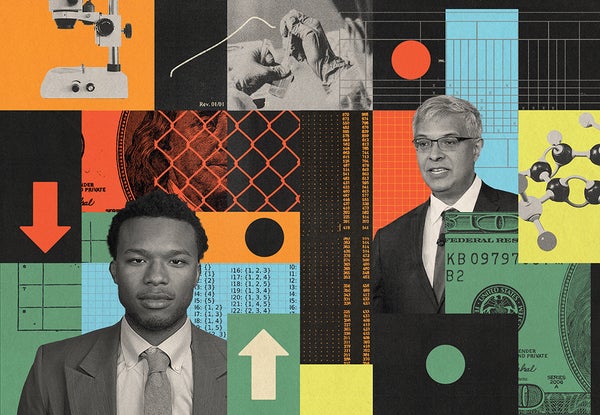
Michael Green hadn’t planned to start his scientific career by confronting the head of the National Institutes of Health. But his research funding was unexpectedly stalled at the science Goliath, and its chief, the health economist and Trump administration appointee Jay Bhattacharya, was taking questions.
On the February 26 episode of the science podcast Why Should I Trust You?, the head of the federal biomedical institution was giving a “message to early-career researchers” and fielding their queries. Green asked via recorded message why his NIH grant—funding, first awarded in 2024, to investigate the reasons sick people don’t seek medical care—was now held up. His grant officer had reached out last July, giving him a week to remove “any DEI language” from the project. Green, then a 26-year-old Ph.D. student at Duke University, didn’t know what that meant—and his grant officer couldn’t tell him.
He tried removing the word “Black” from his proposal, as well as links to studies showing that many Black patients felt discriminated against in doctor’s offices. But four months later, he still was waiting. “I went into this thinking, ‘There’s a chance that [Bhattacharya] hears this and then just decides to terminate the project, and that’ll be a disaster,’” Green says. But he wanted clarity on his future.
On supporting science journalism
If you're enjoying this article, consider supporting our award-winning journalism by subscribing. By purchasing a subscription you are helping to ensure the future of impactful stories about the discoveries and ideas shaping our world today.
With the grant portion of his salary for 2026 in limbo, Green, who graduated from his Ph.D. program last December, was bartending without health insurance or better job prospects. He is not the only one facing uncertainty. For many scientists working during the second Trump administration, the old rules have changed.
Last year the NIH unexpectedly terminated nearly 5,900 grants, a move disproportionately striking younger researchers and women. The National Science Foundation, an agency that has traditionally funded all fields outside of clinical medicine, has been directed to favor research into artificial intelligence, a White House priority. NSF employees who spoke anonymously because they feared retaliation say the shift has hurt science education, long a key priority of the agency. Similar shifts have played out at the Department of Energy, the Environmental Protection Agency, NASA, and elsewhere throughout the U.S. government.
These changes have rocked scientists, but many say the cracks in how research is conducted in this country predate the present administration. Funding disproportionately goes to older scientists, for instance, and researchers increasingly must devote much of their time to administration and grant writing rather than science.
Amid the current tumult, some see an opportunity to reimagine our aging research-funding scheme for the 21st century and beyond. We should look to the future, suggests former NIH chief Francis Collins. “It can’t just be a return to the exact same framework,” he says. “It has to be better. This could be an opportunity to fix some issues that we’ve known about for a while but had insufficient momentum and clout to reform.”
Some see an opportunity to reimagine our aging research-funding scheme for the 21st century.
The NIH, the $48-billion agency that Green applied to for his grant, is the 800-pound gorilla of U.S. biomedical research. It provides nearly half of all federal basic research spending, more than $22.6 billion in 2024. Since the 1980s, however, less and less of that money has been released to young investigators, who traditionally have done the bulk of the basic science research that leads to fundamental discoveries.
As far back as 2008, the average age of a first-time recipient of an R01 independent research grant—the agency’s most common independent investigation grant—or similar grants was 43. Consequently, many young scientists in their 20s, 30s and 40s today end up “trapped” in precarious, poorly paid and overworked laboratory positions, notes a 2023 Organization for Economic Co-operation and Development report. Faced with unreliable career prospects, these young scientists often leave research, particularly if they are women or have children.
Older investigators, meanwhile, spend ever more of their time submitting grants to pay for their lab workers. At the NIH, grant applications were up 12.9 percent last year compared with the number in 2024, but grant success rates are down 29.6 percent. The paperwork required for these grant applications—often more than 100 pages describing data and proposed experiments, as well as yearly progress reports—is notoriously nightmarish. In a 2018 survey, researchers reported spending more than 40 percent of their time on administrivia, a number that has increased over the past decade.
“Scientists should be spending their time not writing grant applications and not attending to a huge amount of administrative work but instead doing great science,” says former NIH deputy director for extramural research Michael Lauer. (The “extramural” in his title refers to the great bulk of the agency’s money spent outside its walls, more than $35 billion on research grants in 2025.) “People were warning about this 20 years ago,” says Lauer, who retired last year. “This is not a Trump problem. This is a systems problem that goes quite far back.”
Lauer points to three historical culprits. First, federal agencies intentionally rely on small grants to individual scientists, which keeps scholars forever fundraising instead of experimenting. Second, scientists’ increased reliance on “soft money” funding from grants to pay salaries (instead of “hard” money from universities) has led to, as the authors of one 2014 paper put it, “unsustainable hypercompetition” for jobs, grants, publications and trainees. And third, congressional politics deliver yearly funding gyrations that disrupt the steady pursuit of experimental questions. These changes target “big science” projects, which more often tackle technocratic problems such as building moon rockets or semiconductor factories instead of basic research. All of these factors, Lauer says, create “perverse incentives” that lead to exploitation of young researchers, often from overseas, and that frustrate older researchers struggling to keep labs funded.
In 2009 the NIH tried to reverse the youth drain by requiring that grant success rates be the same for first-time grant awardees as for more experienced ones. But the policy might have led to fewer grants for mid-career researchers. So in 2017 the NIH instead started reserving 400 new grants a year for early-career researchers and at-risk researchers further along in their careers.
A promising model for retaining young scientists comes from China, which started a “Ten Thousand Talents” program in 2012 to up its scientific firepower. Among other rewards, it offers upward of one million yuan RMB (about $147,000) to promising researchers younger than 40 to work in Chinese labs. A related “Young Thousand Talents” program to return promising expatriate scientists to China provides access to larger research teams and better funding than they’d get abroad. Returnees in the program have ended up outperforming their peers.

Max-o-matic (illustration); Kata Sasvari and Willander Girón (photographs featured in illustration)
And several ideas have been floated for fighting the paperwork tide. A 2025 National Academy of Sciences report suggests paring back regulations to reduce the administrative load on scientists, for example. Of the new paperwork-generating regulations that have been implemented since 1991, 62 percent came out after 2014, notably in areas of security, export controls and misconduct, the report shows. Last November a congressional commission on biotechnology called for creating a single platform for submitting scientific funding applications across federal agencies, eliminating time-consuming preliminary data requirements, and other measures that would modernize the scientific enterprise.
The so-called transition grant that Green applied for is part of a long-standing program meant to help young scientists like him make the leap to full-fledged investigator. The money gives young researchers direct control over their employment and guarantees them five to six years to do research and build careers, not write proposals. Yet “the sheer amount of paperwork was probably the most daunting task” in winning the money, Green says. It took him nine months to put together his proposal in 2023. The things that mattered most for doing the research—assembling a network of collaborators and addressing critiques of his proposed methods from his mentors and other experts—took most of his time. But filling out forms ate up many hours.
It all seemed worth it, though, when Green got word in February 2024 that his proposal had received a very high score from the scientist review panels at the National Institute on Aging. That put it well above the “payline” funding cutoff point for his type of grant at the NIH. Green’s grant salary put him in the same league as the typical plumber or electrician, a dream for many of his peers. For a young researcher, he had hit a home run—or so he thought until last year, when his grant was put on ice. Green’s dilemma illustrates the “soft money” problem, Lauer says, which makes individual scientists extremely vulnerable, whether to politics or peer review or paylines.
The system rests on a layer cake of false premises, Lauer says. The first one is that scientists can predict the future in their grant proposals—that they can say with certainty they’re going to be doing said research one, two or five years from now. That isn’t how experiments work, clinical trials aside. The second flawed notion is that peer reviewers can predict which projects are going to be successful. The assumption that peer reviewers will favor breakthrough ideas is likewise untrue. A robust scientific literature instead shows that peer reviewers are inherently biased against novelty and innovation, which are the main engines of scientific progress.
The “most false” premise of all, Lauer says, is that science agencies should run the same way as government agencies that enforce laws or fight wars or run community programs. Basic science proves out over decades, not years, even for clear breakthroughs; the average Nobel Prize winner now waits 26 to 30 years for recognition. Meanwhile Congress limits most R01 grants to four years (with competitive renewals) and subjects science agencies to yearly fluctuations in funding.
Starting in 2004, the NIH began making a small number of “high risk, high reward” grants to researchers to deal with the underfunding of breakthrough ideas. Although Lauer oversaw such programs at the NIH, he favors replacing the current system of small, individual grants with longer-term, larger ones. This plan would mirror the funding scheme at New Jersey–based Bell Labs, which made significant fundamental scientific and technological advances in the 20th century. Stable funding, long-term thinking and a focus on basic research drove the advances at Bell Labs, which was the birthplace of the transistor, the laser and information theory, for instance. That strategy would cut through the false-premise layer cake, Lauer argues, by not requiring researchers to promise what they can’t know and freeing them to risk uncertain outcomes in the knowledge that cautious reviewers won’t knife their careers. Labs set up this way would also handle the paperwork now robbing senior researchers of their lab time.
One promising example is the Howard Hughes Medical Institute (HHMI) Janelia Research Campus in Ashburn, Va., which brings together researchers to broadly study neurobiology, free from worries about tenure, grants and paperwork. It’s a home for “brilliant misfits,” in the words of HHMI senior group leader Gerald Rubin and president Erin O’Shea. Lauer foresees academic, nonprofit and industry participants as all being foundational to his vision for these 21st-century successors to Bell Labs.
In its attempts to reform the federal system for funding scientific research, the Trump administration has implemented various efficiency measures at the NIH, including centralizing its peer-review panels into one center, which the agency projected would save $65 million annually. But such efforts overall don’t address the fundamental weaknesses of a system built on small grants, soft money and politics, Lauer says: “This is not being pejorative, but what they’re not doing is addressing what I see as the fundamental problems.”
To save U.S. science, Lauer suggests that Congress should convene a commission akin to the National Commission on Social Security Reform in the early 1980s that saved the federal retirement system.
“The institutions that we have now we’ve inherited from the World War II era,” says Pierre Azoulay of the Massachusetts Institute of Technology Sloan School of Management. “It would be very surprising if those that worked, kind of, for the later part of the 20th century would still be optimal for the 21st century.” With research labs largely dependent on foreign-born workers, one piece of “low-hanging fruit” for reform, he suggests, would be to “staple a green card” to every Ph.D. awarded to any foreign student who graduates from a U.S. research university.
Money is the big question hanging over the future of science. A recent Congressional Research Service report notes that NIH funding, adjusted for inflation, was 8.8 percent less in 2025 than it was in 2003, its peak year, during the George W. Bush administration. Some observers have suggested that for that reason, more funding for science agencies is overdue. But although the Trump administration’s budget proposals to slash science spending have been rejected by Congress, there appears to be little appetite to greatly increase funding for 2027. The current outlook is for flat spending.
Stability, not chaos, is the key funding ingredient for researchers, says addiction medicine expert Daniel Ciccarone of the University of California, San Francisco. A past investigator on numerous NIH grants and a central figure in scholarly investigations of the overdose-crisis waves of the past two decades, he has still at times feared losing his funding as the field endured ups and downs worsened by the pandemic and, now, Trump administration cuts to addiction and mental health services.
“We need more minority researchers,” Ciccarone says, to deal with the problems of an increasingly diverse, larger population and to generate unexpected ideas. The structural problems and funding uncertainty in research can drive the disadvantaged away from scientific careers. “This will entail pipeline development starting in middle and high schools, as well as incentives,” he says.
Science has survived and thrived all these years, despite persistent problems, in large part because of the perseverance of the people who do it. In March the NIH sent word that Green’s grant had gone through, even after his podcast brush with Bhattacharya. He could quit bartending and start his delayed investigation at the Johns Hopkins Bloomberg School of Public Health, albeit having used up almost all his savings in the four months when he didn’t get paid.
“As a scientist, you have to kind of be optimistic about the future and the importance of your work,” Green says. “I don’t think all my work is going to face these roadblocks forever.”