
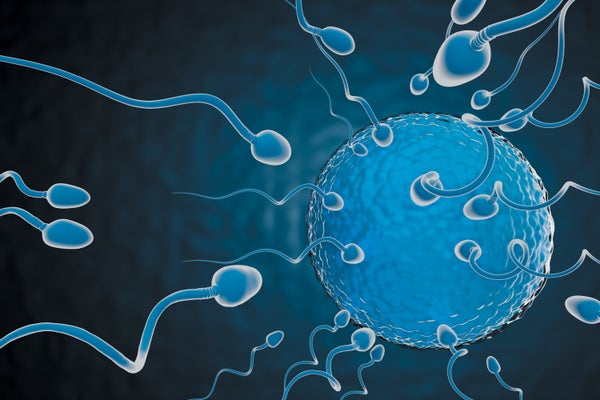
Sperm have to wiggle vigorously to reach an egg, and that motion is key to a clever new fertility test. The technique, tested with bull semen and detailed in Advanced Materials Interfaces, harnesses physics to make fertility testing easier and more cost-effective—and, if it works for human sperm, too, it might eventually help people tackle some conception issues from home.
“Fifty percent of families are facing a big challenge in terms of addressing fertility,” says Sushanta Mitra, a mechanical engineer at the University of Waterloo and co-author of the recent study. “Our aim is to democratize that process.”
Current laboratory tests for male fertility involve examining a semen sample under a microscope. Experts check the sperm cells’ liveliness, which is considered a good proxy for fertility because the gametes need to quickly swim more than 1,000 times their body length to reach an egg. But these lab tests can be expensive and time-consuming. Meanwhile at-home tests tend to be less accurate because they often only detect the presence of certain proteins in sperm rather than assessing how the cells move.
On supporting science journalism
If you're enjoying this article, consider supporting our award-winning journalism by subscribing. By purchasing a subscription you are helping to ensure the future of impactful stories about the discoveries and ideas shaping our world today.
The newly described method uses basic physics to measure sperm activity without costly equipment. The researchers placed droplets of bull semen at the end of a flexible plastic strip suspended next to a water-resistant surface. Next, they moved the surface toward the drop until it made contact and then moved it back to its original position. They measured how strongly each semen droplet stuck to the surface, via weak hydrogen bonds, as it was pulled away. If many highly active sperm were wiggling around inside the fluid, the hydrogen bonds broke more quickly, disrupting the drop’s surface adhesion and making it break away earlier; the livelier the sperm, the less sticky the drop. “It’s exciting to be able to come up with a way to quantify sperm mobility at home,” says Stanford University urologist Tony Chen, who was not involved in the study.
Mitra and his team hope to develop this technique into a cheaper, easier and more accurate home fertility test. “There is a lot of stigma around male fertility,” Mitra says. Easier private testing could encourage people to evaluate semen quality more often, allowing them to check in while making lifestyle adjustments to perk up lethargic sperm, such as quitting smoking or reducing alcohol use. Such tests could also potentially be useful for breeding livestock.
The researchers’ next steps will be to standardize the tests and obtain benchmarks for different types of sperm, including human and bovine. Chen says clinical trials that evaluate droplets from many different patients will also be necessary to ensure the tests work with samples that have varying pH levels, white blood cell counts and fructose concentrations. “There’s more than just sperm in semen,” he says.