

With just a sniff and a sip, trained sommeliers can often tell what region a wine came from: Douro in Portugal, Barossa in Australia, Napa or Sonoma in California. Experts in a specific locale can name the hillside—even how far up the hill—where a wine's grapes were grown because of the terroir, the combination of soil, topography and microclimate that imparts a characteristic taste. The geographic and genetic journeys that brought those grapes to those places, however, have been poorly understood.
A massive new study gives us the clearest picture yet of the prehistory of wine, overturning several commonly accepted narratives about when and where humans cultivated grapevines to make the world's wines. A large international group of researchers collected and analyzed 2,503 unique vines from domesticated table and wine grapes and 1,022 wild grapevines. By extracting DNA from the vines and determining the patterns of genetic variations among them, they found some surprises.
For centuries grape growers in different communities passed down lore about where their grapes came from. Some governments, particularly in Europe, designated appellations—strictly circumscribed regions with rules on how and where a wine such as burgundy, rioja or barolo was legally allowed to be produced.* But genetic studies to discover where vines originated thousands of years ago began in earnest only 10 or 15 years ago.
On supporting science journalism
If you're enjoying this article, consider supporting our award-winning journalism by subscribing. By purchasing a subscription you are helping to ensure the future of impactful stories about the discoveries and ideas shaping our world today.
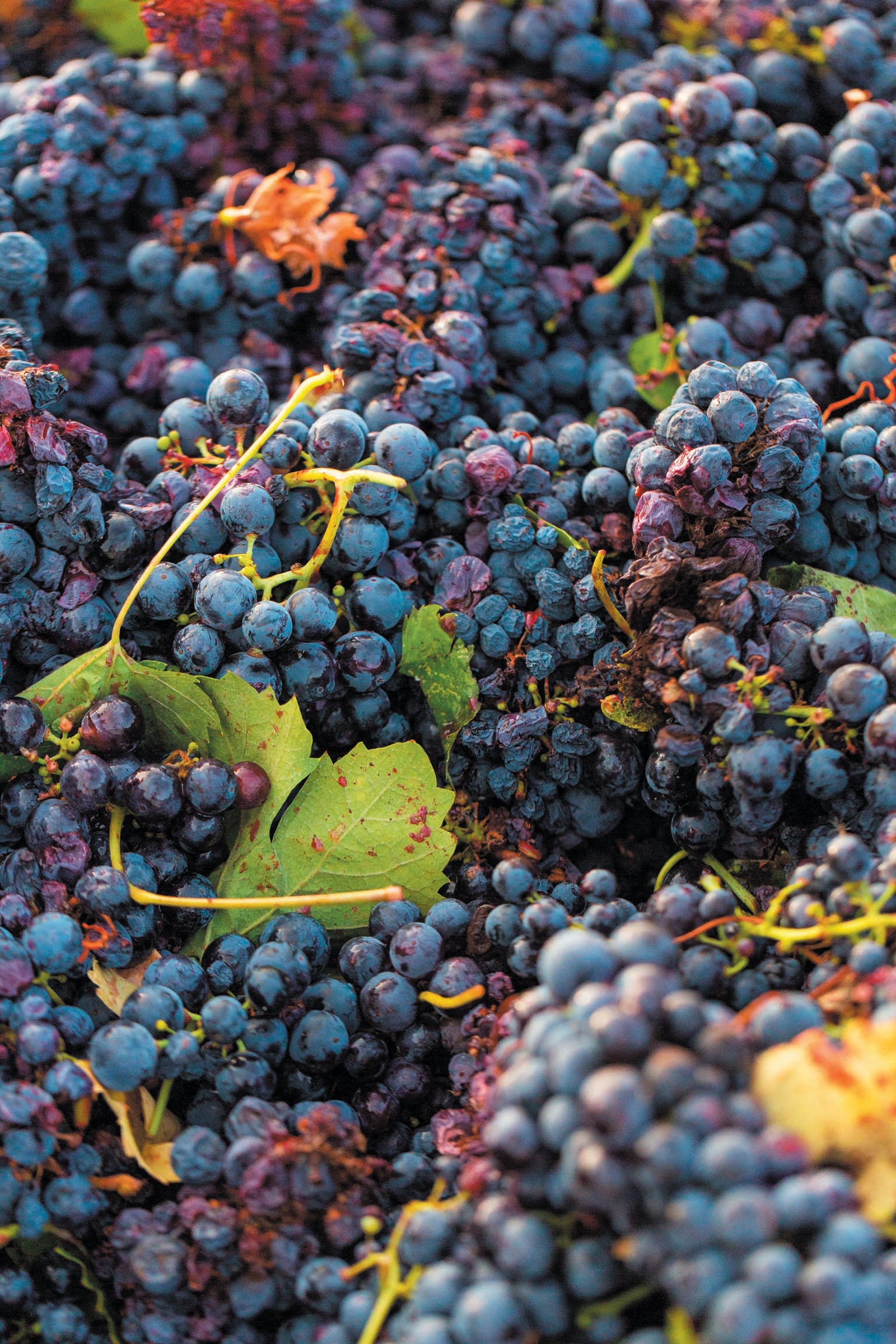
Primitivo grapes are harvested in Puglia, one of Italy’s famous wine regions. Credit: Cosimo Calabrese/Getty Images
One theme that emerged from these studies was that wild grapes grew in central Asia and dispersed westward as early humans migrated in that direction. But the genetic data in the huge study correct this story, says Wei Chen, a senior research scientist at Yunnan Agricultural University in China and one of the study's leaders. Genetic data indicate that 400,000 and 300,000 years ago grapes grew naturally across the western and central Eurasian continent. Roughly 200,000 years ago a cold, dry, ice-age climate slowly killed off vines in the central Mediterranean Sea region, cleaving vine habitat into two isolated areas: one to the west of the sea (today Portugal, Spain and France) and one to the east (roughly Israel, Syria, Turkey and Georgia). Around 56,000 years ago the eastern region separated again into smaller isolated areas: the Caucasus (Georgia, Armenia and Azerbaijan) and western Asia (Israel, Jordon and Iraq).
Until recently, researchers also thought humans domesticated grapevines from wild progenitors as long as 8,000 years ago as an early agricultural revolution spread across what is now western Asia and Europe. Some experts thought vines were first cultivated in Iberia (primarily Portugal and Spain) around 3,000 years ago. Other investigators thought domestication first happened in the Caucasus. To make matters murkier (not a good trait in wine), there was disagreement on whether grapes were used first for food (“table grapes”) or for fermentation.
The recent study settles this debate: humans in western Asia domesticated table grapes around 11,000 years ago. Other people, in the Caucasus, domesticated wine grapes around the same time— although they probably didn't master winemaking for another 2,000 or 3,000 years.
Early farmers, the revised story goes, migrated from western Asia toward Iberia and brought table vines with them. Along the way the farmers crossbred the table vines with local wild grapevines. The earliest crossbreeding probably happened in what is now Israel and Turkey, creating muscat grapes, which are high in sugar—good for eating and fermenting. Gradually the table grape was genetically transformed into different wine grapes in the Balkans, Italy, France and Spain.
But if people in the Caucasus already had wine grapes, why didn't they bring them to Europe? “We just don't know yet,” Chen says. People migrating from there—notably Yamnaya nomads 4,000 to 5,000 years ago—might have brought vines, but the genetic analysis shows that Caucasus grapes have had very little influence on the makeup of European wine grapes.
Once farmers did begin cultivating wine grapes in Europe, they developed many of the varietals we enjoy today. Some grapes, such as cabernet sauvignon, have the same name everywhere they are grown. Other varietals farmed in different regions took on different names even though the grapes are genetically identical, such as zinfandel and primitivo. Sadly, it is almost impossible to trace a current varietal back to western Asia or the Caucasus, the two early domestication centers. Over the centuries grape growers crossbred table and wine grapes, as well as domesticated and wild grapes, and even back bred offspring with parents. “Once they had a superior vine, they usually destroyed the prior vines,” Chen says, making it hard to construct a family tree. You may never know where your favorite wine came from—really came from. In that sense, the mystique lives on.
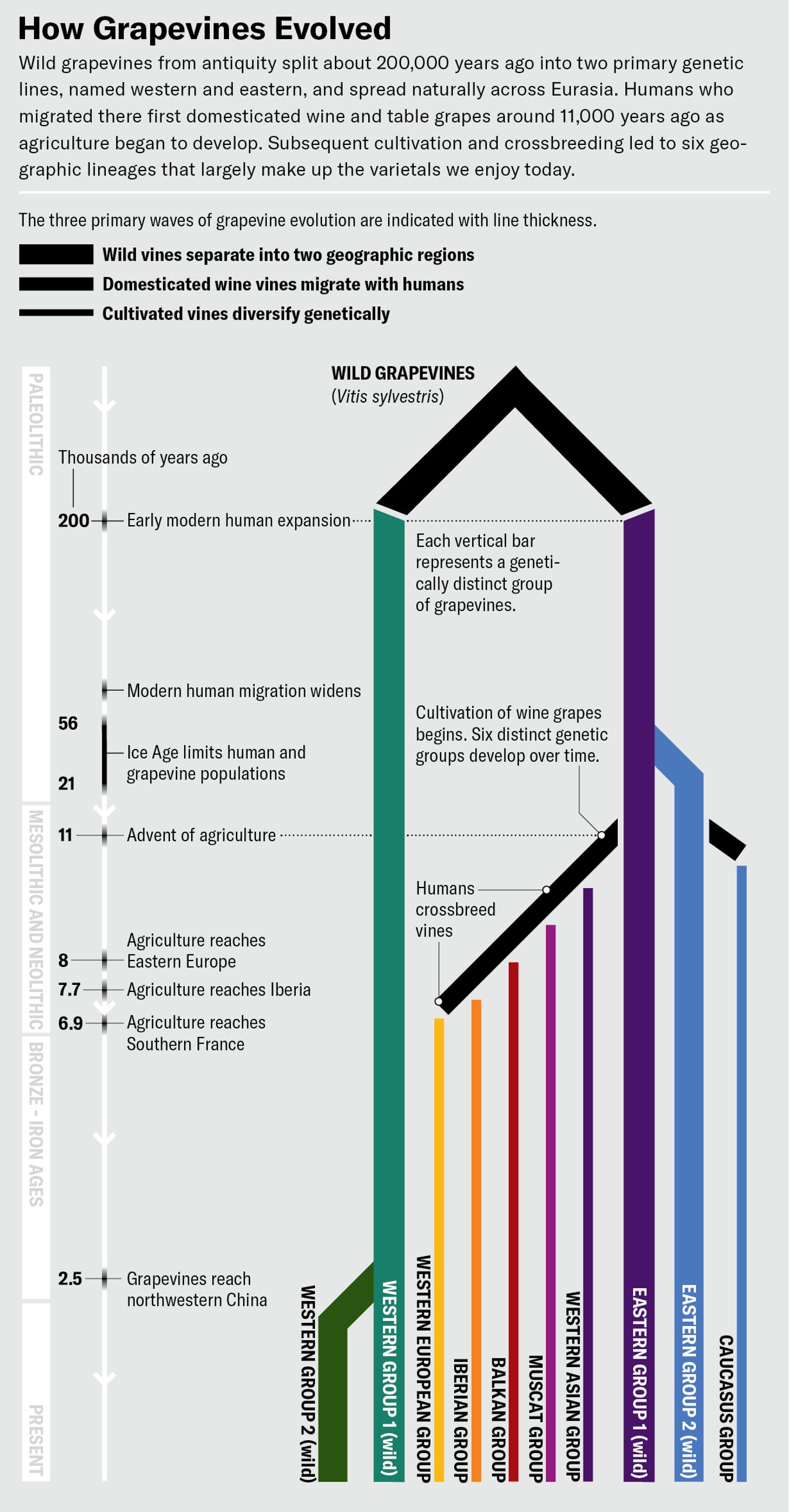
Credit: Francesco Franchi; Source: “Dual Domestications and Origin of Traits in Grapevine Evolution,” by Yang Dong et al., in Science, Vol. 379; March 2023 (data); Consultant: Wei Chen/Yunnan Agricultural University
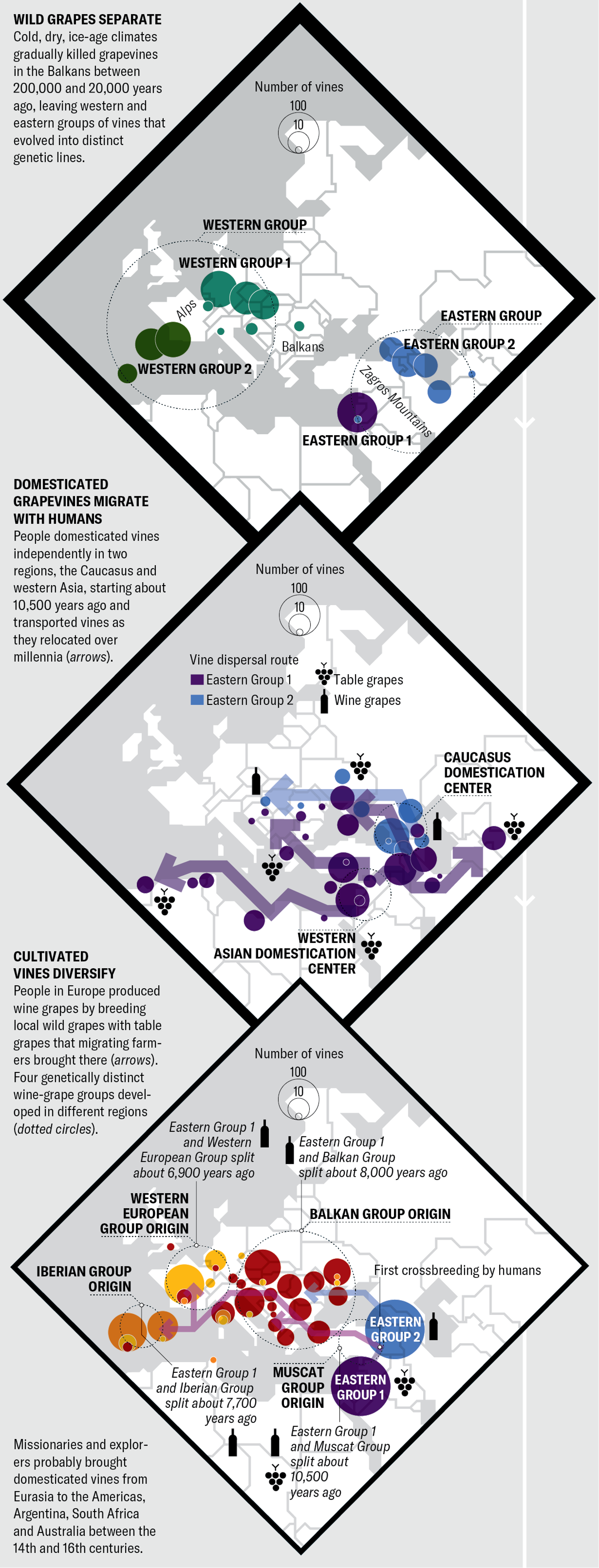
Credit: Francesco Franchi; Source: “Dual Domestications and Origin of Traits in Grapevine Evolution,” by Yang Dong et al., in Science, Vol. 379; March 2023 (data); Consultant: Wei Chen/Yunnan Agricultural University
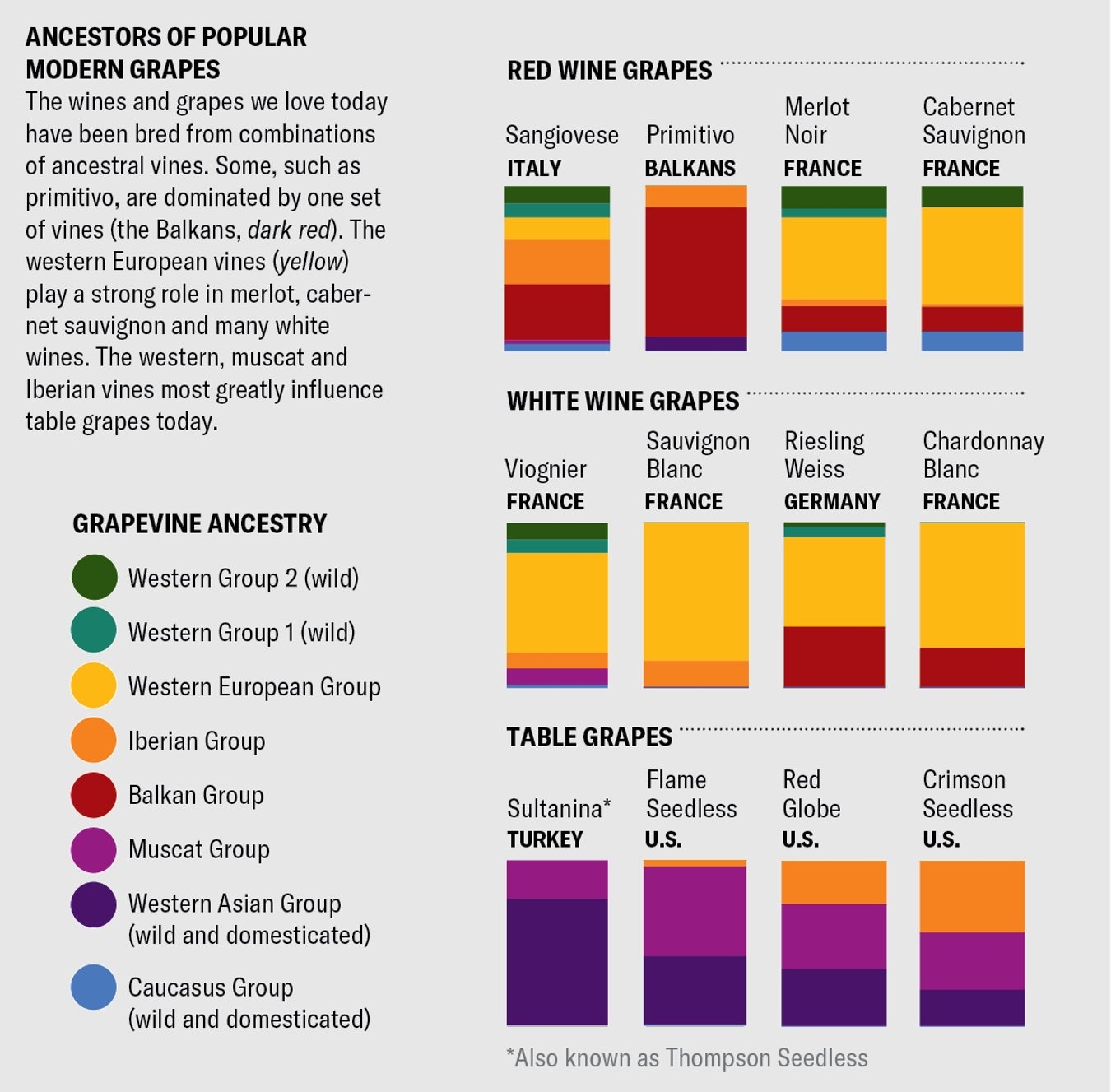
Credit: Francesco Franchi; Source: “Dual Domestications and Origin of Traits in Grapevine Evolution,” by Yang Dong et al., in Science, Vol. 379; March 2023 (data); Consultant: Wei Chen/Yunnan Agricultural University
*Editor’s Note (12/6/23): This sentence was edited after posting to correct the description of wines such as burgundy, rioja or barolo.