
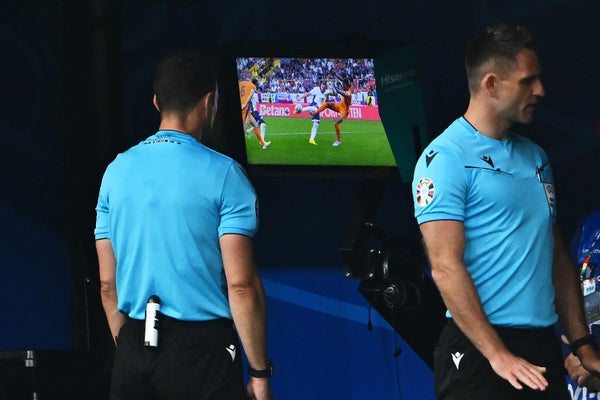
I can already imagine the shouts that will erupt this summer during the International Federation of Association Football (FIFA) World Cup: “That was a bad call!” “That wasn’t a foul!” “The other team should have had a penalty!”
Fortunately, video replay allows people to validate—or refute—a referee’s decision. Of course, that technology also sparks heated debate among fans. But my interest is in the mathematics that accompany video evidence and video assistants.
A dear colleague recently approached me with a seemingly harmless question: How many cameras are needed, at minimum, to cover a playing field as accurately as possible, and where is the best place to position them to guarantee that every action is recorded? As it turns out, this question is anything but easy to answer.
On supporting science journalism
If you're enjoying this article, consider supporting our award-winning journalism by subscribing. By purchasing a subscription you are helping to ensure the future of impactful stories about the discoveries and ideas shaping our world today.
From a Soccer Field to an Art Museum
In mathematics, this type of question is more familiarly encountered as the “art gallery problem.” In 1973 mathematician Václav Chvátal asked his colleague Victor Klee for an interesting geometry problem. Klee responded by challenging him to find how many guards are needed, at a minimum, to protect a gallery.
It’s a classic optimization problem that depends on the shape of the gallery. For a rectangular room with pictures hanging on the walls, assuming there are no columns or people to block one’s view, a single guard is theoretically sufficient. The guard stands in a corner and can easily oversee the entire area.
For more complex spatial shapes, finding an answer is not so easy. In 1975 Chvátal published a paper that proved that the minimum number of guards in a room with n corners is at most n⁄3, rounding down the result if it is not an integer.
To visualize this proof, imagine the space as being divided into triangles. Each triangle’s endpoints coincide with the vertices, or corners, of the area. A guard can completely survey a given triangle. Now imagine taking three colors—say red, blue and green—and coloring each point on each triangle such that no two adjacent points are the same color. By placing a guard at each point corresponding to one specific color, such as blue, the entire area can be guarded. Because the n vertices of the area can be colored by three colors, at most, n⁄3 guards are needed.
This line of reasoning provides a solution but not necessarily the optimal one. Determining the smallest number of guards for arbitrarily shaped rooms and their placement proves to be a notoriously complex problem, one that computers sometimes reach their limits trying to solve—experts refer to it as an nondeterministic polynomial-complete (NP-complete) problem.
A Playing Field with 22 Holes
A soccer field has a fairly simple structure: a rectangle. A camera placed in one corner should be able to cover the entire field, provided its viewing angle is at least 90 degrees.
But filming an empty field is pointless. You want to film a match where up to 22 players are moving around and battling for the ball, which makes the task considerably more complicated because the players constantly obscure one another during the game.
Let’s start simple with a static problem. Suppose the 22 players are distributed motionless across the field. From a mathematical perspective, this situation corresponds to the museum guard problem but with 22 areas, or holes, where our guard or video camera cannot see.
In 2009 mathematicians Hemanshu Kaul and YoungJu Jo, both then at the Illinois Institute of Technology, proved that 10 guards or cameras would suffice in this case. Their proof involved dividing the area into polygons instead of triangles, defining a network of points and lines from those polygons and then determining the best way to color the points of that network.
Once again, Kaul and Jo’s result is only a single possible solution, however, and not necessarily the optimal one. Fewer guards might suffice.
The Complicated Reality
But let’s consider the more realistic and complicated situation in which our 22 holes, or players, are moving around. To think it through further, it’s worth noting that significant parts of a soccer match have a three-dimensional component—it’s not just about a ball and feet on the ground. Additionally, the capabilities of cameras are limited: they don’t cover a 360-degree field of view, as mathematicians could assume in the case of the museum guards.
All these factors complicate the problem to such an extent that only computer-aided analyses can be found for such tasks. Although this approach provides a tailored approximation for certain special cases, it doesn’t allow for a general and definitive statement that at least y cameras are needed at specific locations on a playing field for perfect game monitoring.
But when it comes to filming soccer, you can add another element as an assist: simulations and past experiences. These matches have been filmed and broadcast for decades—and it’s that history that has helped organizers determine the best place for each camera.
At the previous World Cup in Qatar, a total of 42 cameras were focused on the 22 players on the football pitch, including eight superslow-motion and four ultraslow-motion cameras. FIFA unfortunately doesn’t provide a precise explanation for why it uses so many cameras. The number seems quite high, but it’s presumably to ensure that the entire pitch is covered as comprehensively as possible. Given its financial resources, FIFA probably doesn’t need to search for an optimal solution with as few cameras as possible.
Still, the placement of the cameras is revealing. Most are located near each goal and at the halfway line, where exciting situations likely occur most frequently.
Many smaller clubs and organizations, however, face entirely different challenges than optimal camera placement. The devices need to be properly calibrated and aligned to deliver reliable video evidence—and that’s not always easy.
So, if you happen to hear impassioned and irate spectators complaining about video evidence while watching this year’s World Cup, perhaps you could calm them down by talking about the mathematical complexity behind the task. Let me know if that works.
This article originally appeared in Spektrum der Wissenschaft and was reproduced with permission. It was translated from the original German version with the assistance of artificial intelligence and reviewed by our editors.