
This article was published in Scientific American’s former blog network and reflects the views of the author, not necessarily those of Scientific American
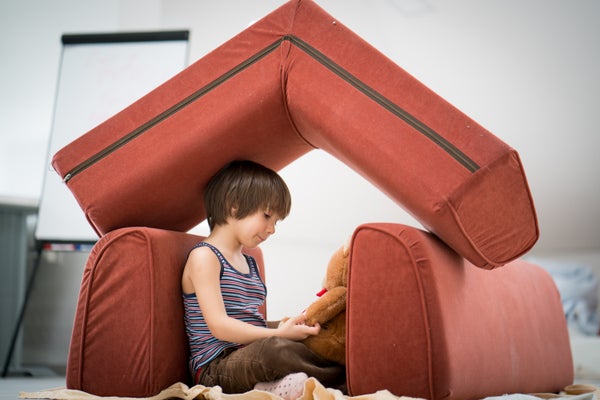
Every adult who has ever spent time with a child has some version of the same story: an exciting new toy abandoned in favor of the ribbon, wrapping paper, or cardboard box it came in. It’s a charming anecdote that becomes more interesting the longer the adult and the child occupy the same space. As relatively new parents, my husband and I have listened to so many parenting audiobooks and podcasts that we can’t even remember the source of a quote that has become a bit of a mantra in our home. The exact phrasing has left us at this point, but it goes something like this: Subverting the intended use of objects is a normal and important part of a child’s cognitive development.
When our son refuses to crawl through his play tunnel and instead fills it with books and cars and drags it around the house, he is subverting the intended use of the tunnel. The same goes for laying across the bottom of an upside-down chair to flip through books, and wearing stackable rings on his four limbs like giant, pooh-themed bangles. The number of items that can be used as impromptu speed skates on a wooden floor has been revealing. And when it becomes tempting to “correct” the use of stacking blocks or a blanket, I take a moment to assess whether anything is in danger of being hurt or broken and remind myself again: Subverting the intended use of objects is a normal and important part of a child’s cognitive development.
This is not to argue that all rules and norms should be thrown out the window. Learning to interact well with others, recognize and avoid danger, and respect what items are breakable or off limits are still hugely important. But for people who are perhaps inclined to be more rule-oriented than others, remembering that unstructured and unexpected play is a vital developmental tool can be important too – even for adults.
On supporting science journalism
If you're enjoying this article, consider supporting our award-winning journalism by subscribing. By purchasing a subscription you are helping to ensure the future of impactful stories about the discoveries and ideas shaping our world today.
While there are many arguments for the incredible value of unstructured play out there, one of the highlights tends to be that it provides the opportunity for kids not only to find creative solutions to problems, but also identify and define the problems they would like to solve themselves. Rather than seeing the toys and furniture in the room like items in a kit, children seem gifted at seeing them as resources with particular qualities: squishy, tall, long, foldable, slippery, and maybe sticks well to glass. It’s a bit like the chefs on Chopped looking at the non-ideal ingredients as something sweet, crunchy, starchy, salty, or maybe able to melt.
I am reminded of a birthday trip to an escape room where our escape required us to repurpose the hardware from inside of a toilet tank, use unexpected objects to complete a circuit, and construct an impromptu cantilever. Coming up with the ideas was only part of the process – there has to be some basic understanding of the qualities and function of an object before it could be used for something else. Learning to look at objects for potential beyond their pre-defined function takes practice. While I am sure my brother would have happily destroyed a calculator in kindergarten, taking it apart with parental permission and supervision let him ask questions, try things, and gave him the confidence to reconstruct it with a still-working, reversed display. An open mind can make it possible to look at an object as a series of parameters and functionalities, and opportunities to practice can build the confidence to experiment in a constructive rather than destructive way.
STEAM outreach programs and curriculum often have stated goals about creative problem solving, but watching young kids mix LEGO and My Little Pony can be a good reminder that it isn’t something that has to be started from scratch. It might start simply, like using white paper to scatter the beam of a flashlight to brighten a dark tent or a metal bowl as an impromptu amplifier for a smartphone. But taking small and successful risks can lead to the confidence and know-how to take bigger ones in the future.