
This article was published in Scientific American’s former blog network and reflects the views of the author, not necessarily those of Scientific American
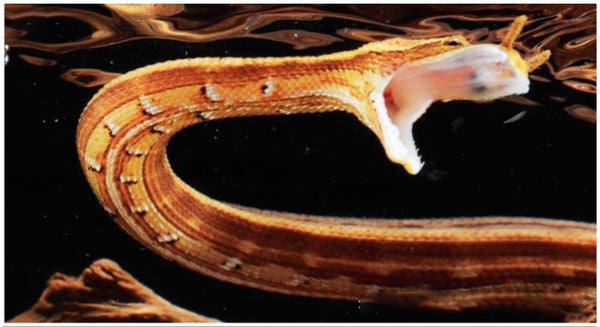
The tentacled snake lies in wait. Erpeton tentaculatum—an aquatic ambush hunter—has set the tableau by first curving its head towards its tail, assuming the shape of a perfectly stationary "J". Unsuspecting little fish swim innocently around the predator—who remains utterly still—until one yummy sashimi morsel wanders into the J. Then the snake literally pulls a fast one: it feints an attack by lurching a small portion of its long body towards the fish. The disturbance in the water triggers the fish's escape away from the snake's twitching body... and right towards its jaws. The predator seals the deal with explosive force, springing its head towards the oncoming fish to engulf the meal in its mouth, aided by the fish’s own momentum. Less than 30 milliseconds have elapsed from the snake’s feint to the sinking of its fangs into the fresh fish dinner. The feint-escape-attack-and-capture sequence is way too fast for the human eye to parse in real time. We can only appreciate it when we watch a slowed-down video of the maneuver— recorded by Vanderbilt University biologist Kenneth Catania—at 0.5 to 2 milliseconds per frame.
Credits: Recorded by Vanderbilt University biologist Kenneth Catania
On supporting science journalism
If you're enjoying this article, consider supporting our award-winning journalism by subscribing. By purchasing a subscription you are helping to ensure the future of impactful stories about the discoveries and ideas shaping our world today.
Both fish and snake are specialized in quick and agile reactions. The fish's escape response, known as the C-start, makes the animal curve its body into a C-shape (in just 5 to 6 milliseconds), propelling it away from an approaching predator. Two giant neurons located in the fish brainstem—neuroscientists call them Mauthner cells— mediate this response. The Mauthner neuron closest to the predator originates a C-start in the opposite direction, by simultaneously inhibiting the muscles in the same side of the fish body and activating those in the opposite side. The snake takes advantage of the fish’s stereotyped behavior, by triggering it to its own ends: the hunter’s body-feint gets the fish to C-start right into the snake’s mouth. The savage attack that follows the feint is inescapable, because the fish is still engaged in the C-start and unable to change course.
Prey-and-predator arms races are not unusual in the animal kingdom, and neither is deception. Deceptive evolutionary adaptations in animals support the case that illusions are not simply "errors of perception," but provide significant advantages to the creatures that produce them through their motion, coloration, or by manipulating their surroundings.
From Aesop's wolf in sheep's clothing, to Old Man Coyote in Plains Indians myths, to the Br'er Rabbit stories of the Southern United States, animal cunningness is a universal theme in human folklore. Yet, as it is often the case, reality surpasses fiction. For animal illusionists engaged in offense and defense trickery, every day is Halloween.