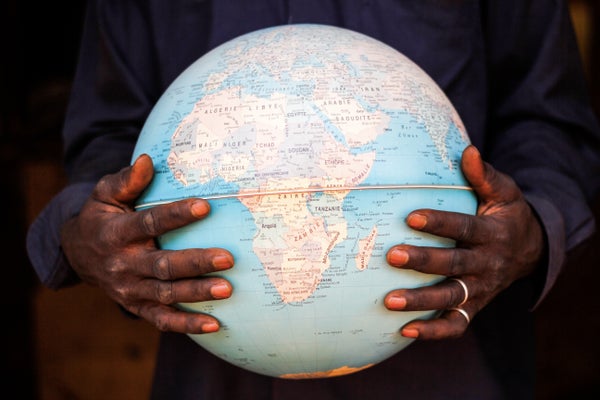
Africa Is Way Bigger Than You Think

Africa is bigger than China, India, the contiguous U.S. and most of Europe—combined!

Join Our Community of Science Lovers!

This article was published in Scientific American’s former blog network and reflects the views of the author, not necessarily those of Scientific American


Look at the usual flat map of the world and it appears that Greenland is nearly as big as Africa. But it’s not even close. Africa is 14 times larger. Flat maps significantly distort the sizes of countries and continents, the result of converting a spherical surface to a handy rectangle. The area of landmasses becomes increasingly exaggerated toward the poles.

As a result, we tend to underestimate the size of countries close to the equator, and substantially overestimate the size of countries closer to the poles. On our actual planet, Africa is bigger than China, India, the contiguous U.S. and most of Europe—combined! Scientific American just published a correctly proportioned image to show how Africa swallows up these nations, with Japan thrown in. It also turns out that Saudi Arabia has more area than France, Spain, Germany, Poland and Italy together.


On supporting science journalism

If you're enjoying this article, consider supporting our award-winning journalism by subscribing. By purchasing a subscription you are helping to ensure the future of impactful stories about the discoveries and ideas shaping our world today.


For the record, then, a list of geographic sizes is below. Indeed, Africa is a continent, not a country, but I think you’ll be impressed at how much larger it is than you probably thought. Realizing the true size of Africa also helps us appreciate how daunting it may be to solve Africa’s poverty and food challenges.

Geographic Area (millions of square kilometers)

Top 15 countries

(Africa)

30.4

Russia

17.1

Canada

10.0

China

9.6

U.S.

9.5

Brazil

8.5

Australia

7.7

India

3.3

Argentina

2.8

Kazakhstan

2.7

Algeria

2.4

DR Congo

2.3

Greenland

2.2

Saudi Arabia

2.1

Mexico

2.0

Indonesia

1.9

Other nations and city-states

South Africa

1.2

Venezuela

0.9

Afghanistan

0.65

Somalia

0.64

France

0.55

Spain

0.51

Germany

0.36

Poland

0.31

Italy

0.30

Luxembourg

0.003

Monaco

0.000002

Vatican City

0.0000004

Mark Fischetti was a senior editor at Scientific American for nearly 20 years and covered sustainability issues, including climate, environment, energy, and more. He assigned and edited feature articles and news by journalists and scientists and also wrote in those formats. He was founding managing editor of two spin-off magazines: Scientific American Mind and Scientific American Earth 3.0. His 2001 article “Drowning New Orleans” predicted the widespread disaster that a storm like Hurricane Katrina would impose on the city. Fischetti has written as a freelancer for the New York Times, Sports Illustrated, Smithsonian and many other outlets. He co-authored the book Weaving the Web with Tim Berners-Lee, inventor of the World Wide Web, which tells the real story of how the Web was created. He also co-authored The New Killer Diseases with microbiologist Elinor Levy. Fischetti has a physics degree and has twice served as Attaway Fellow in Civic Culture at Centenary College of Louisiana, which awarded him an honorary doctorate. In 2021 he received the American Geophysical Union’s Robert C. Cowen Award for Sustained Achievement in Science Journalism. He has appeared on NBC’s Meet the Press, CNN, the History Channel, NPR News and many radio stations.

More by Mark Fischetti

It’s Time to Stand Up for Science

If you enjoyed this article, I’d like to ask for your support. Scientific American has served as an advocate for science and industry for 180 years, and right now may be the most critical moment in that two-century history.

I’ve been a Scientific American subscriber since I was 12 years old, and it helped shape the way I look at the world. SciAm always educates and delights me, and inspires a sense of awe for our vast, beautiful universe. I hope it does that for you, too.

If you subscribe to Scientific American, you help ensure that our coverage is centered on meaningful research and discovery; that we have the resources to report on the decisions that threaten labs across the U.S.; and that we support both budding and working scientists at a time when the value of science itself too often goes unrecognized.

In return, you get essential news, captivating podcasts, brilliant infographics, can't-miss newsletters, must-watch videos, challenging games, and the science world's best writing and reporting. You can even gift someone a subscription.

There has never been a more important time for us to stand up and show why science matters. I hope you’ll support us in that mission.

Thank you,

David M. Ewalt, Editor in Chief, Scientific American

Subscribe