Do Genes Direct Our Behavior? [Video]

Studying the acute sense of smell may provide some answers

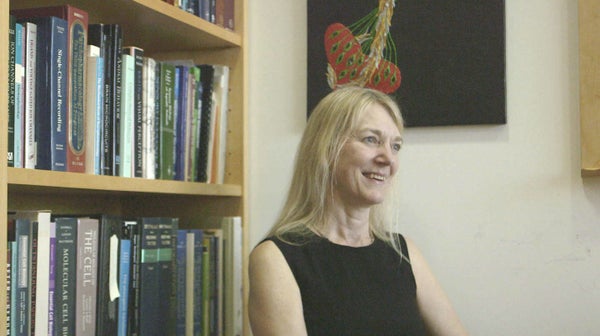
Cori Bargmann.

Join Our Community of Science Lovers!

This article was published in Scientific American’s former blog network and reflects the views of the author, not necessarily those of Scientific American


What do we do when we’re hungry? How do we react when people gather around us? Where do we go when we want to be alone? Humans have so many complex behaviors, yet researchers think many of them have developed directly from the ways animals act and react. Whether that is true can be revealed by studying how genes direct biological functions, and how those functions result in action.

Cori Bargmann, a neurobiologist at Rockefeller University, is hot on this trail. She’s trying to determine the roots of animal behavior, from worms to humans, by studying how genes affect the brain, and how that affects what animals do. Among many experiments, she is investigating the worm C. elegans, a popular species among neuroscientists. It has about 20,000 genes in its genome, compared with about 25,000 for humans, yet it only has 302 neurons in its brain, versus 86 billion in ours, according to Bargmann. That means researchers can test links between specific neurons and specific behaviors. Bargmann is focusing on the sense of smell, and how chemicals called pheromones that animals emit and smell, affect mating behavior and how animals behave in groups.


On supporting science journalism

If you're enjoying this article, consider supporting our award-winning journalism by subscribing. By purchasing a subscription you are helping to ensure the future of impactful stories about the discoveries and ideas shaping our world today.


Bargmann explains her fascinating work in simple, clear terms, in an engaging video titled “Roots of Behavior,” created by N.Y.U. neuroscientist Joseph LeDoux, an expert on the emotional brain. The video is the fifth in a series he is putting together with director Alexis Gambis called My Mind’s Eye. (The first episode featured Ned Block on the mind–body problem, the second video was with Michael Gazzaniga on free will, the third was with Nobel laureate Eric Kandel on how neurons in the brain learn and create memories, and the fourth featured Liz Phelps on why our memories change over time.) LeDoux and Gambis have given Scientific American the chance to post these videos first, on our site.

For fun, the Bargmann interview comes with snippets of a related song that LeDoux recorded with his band, The Amygdaloids, called “Roots.” Enjoy.

Mark Fischetti was a senior editor at Scientific American for nearly 20 years and covered sustainability issues, including climate, environment, energy, and more. He assigned and edited feature articles and news by journalists and scientists and also wrote in those formats. He was founding managing editor of two spin-off magazines: Scientific American Mind and Scientific American Earth 3.0. His 2001 article “Drowning New Orleans” predicted the widespread disaster that a storm like Hurricane Katrina would impose on the city. Fischetti has written as a freelancer for the New York Times, Sports Illustrated, Smithsonian and many other outlets. He co-authored the book Weaving the Web with Tim Berners-Lee, inventor of the World Wide Web, which tells the real story of how the Web was created. He also co-authored The New Killer Diseases with microbiologist Elinor Levy. Fischetti has a physics degree and has twice served as Attaway Fellow in Civic Culture at Centenary College of Louisiana, which awarded him an honorary doctorate. In 2021 he received the American Geophysical Union’s Robert C. Cowen Award for Sustained Achievement in Science Journalism. He has appeared on NBC’s Meet the Press, CNN, the History Channel, NPR News and many radio stations.

More by Mark Fischetti

It’s Time to Stand Up for Science

If you enjoyed this article, I’d like to ask for your support. Scientific American has served as an advocate for science and industry for 180 years, and right now may be the most critical moment in that two-century history.

I’ve been a Scientific American subscriber since I was 12 years old, and it helped shape the way I look at the world. SciAm always educates and delights me, and inspires a sense of awe for our vast, beautiful universe. I hope it does that for you, too.

If you subscribe to Scientific American, you help ensure that our coverage is centered on meaningful research and discovery; that we have the resources to report on the decisions that threaten labs across the U.S.; and that we support both budding and working scientists at a time when the value of science itself too often goes unrecognized.

In return, you get essential news, captivating podcasts, brilliant infographics, can't-miss newsletters, must-watch videos, challenging games, and the science world's best writing and reporting. You can even gift someone a subscription.

There has never been a more important time for us to stand up and show why science matters. I hope you’ll support us in that mission.

Thank you,

David M. Ewalt, Editor in Chief, Scientific American

Subscribe