
This article was published in Scientific American’s former blog network and reflects the views of the author, not necessarily those of Scientific American
Carbon dioxide is bad—it causes global warming. Carbon dioxide is political—U.S. democrats want regulations to reduce emissions into the atmosphere and republicans, led by president-elect Donald Trump, want to scrap such rules. But William McDonough says all that is wrong. “Carbon is not the enemy,” he said in a keynote speech at the recent SXSW Eco conference. The same phrase headlines his new commentary published today in Nature. “It is we who have made carbon toxic,” he writes. “In the right place, carbon is a resource and a tool.”
McDonough, founder of William McDonough + Partners, is a world-renowned architect, designer and urban planner. He has spearheaded several design movements—reflected in titles of his bestselling books such as Cradle to Cradle, and The Upcycle—as well as the idea of a circular economy. They all champion smarter ways to design products, buildings and communities to use resources more sustainably, generate less waste and create positive impacts rather than just minimize negative ones.
His latest point is that citizens and their politicians have to change the conversation about carbon. Climate change, he maintains, is a design failure, a breakdown in the natural carbon cycle caused by humans. By rethinking how we design things, especially cities, we can restore the natural carbon cycle and exploit it for human gain, creating positive environmental impacts rather than harm.
On supporting science journalism
If you're enjoying this article, consider supporting our award-winning journalism by subscribing. By purchasing a subscription you are helping to ensure the future of impactful stories about the discoveries and ideas shaping our world today.
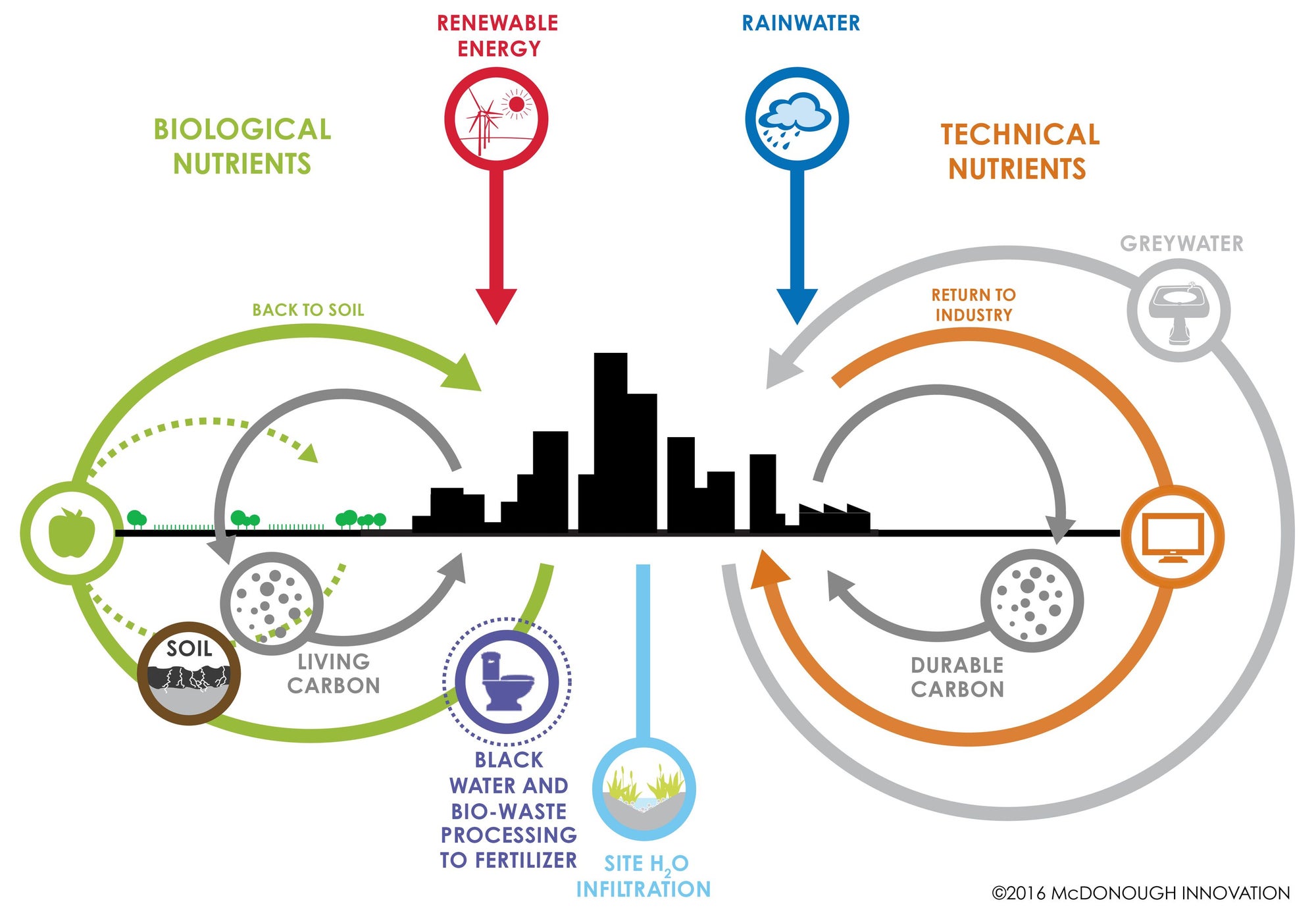
The “carbon positive” city. Credit: William McDonough & Partners
He claims that the focus of carbon regulation is also out of whack. “Striving for less pollution means we will do less bad,” he noted at SXSW Eco. “Instead we should ask, what can we do that creates more good?”
Urban design is the real prime mover here. Buildings and cities can be “carbon positive.” Indeed, to move toward that goal, the world has to talk about carbon in new ways. McDonough lays out a lexicon in his Nature article, based on the idea that instead of releasing carbon to the atmosphere, it should be channeled into durable forms, from new trees to plastics, and into soils, to rebuild them. In this outlook, “living carbon” flows back into nature to create healthier soils, crops and forests. “Durable carbon” is a raw material for reusable products such as paper, fiber and recyclable plastics, or is locked away in underground limestone. And “fugitive carbon” is gas that has escaped or been pumped into the atmosphere, which instead can be captured and turned into durable or living carbon. “CO2 in the atmosphere is a liability,” McDonough said at SXSW Eco. “But in the soil it is an asset.”
The outcome of this design philosophy, he maintains, is a world that is not struggling against becoming carbon negative—polluting the air, land and water—but one that is at minimum carbon neutral. Better yet, the world could become carbon positive, by focusing on “actions that convert atmospheric carbon to forms that enhance soil nutrition or to durable forms such as polymers and solid aggregates,” he notes in Nature. A carbon positive society also includes recycling “organic materials, food waste, compostable polymers and sewage” as soil nutrients.

Hero MotoCorp Garden Factory in India. Credit: William McDonough & Partners
The new outlook can also revamp regulatory philosophy. A big part of the political and business backlash against existing and proposed emissions regulations such as the Clean Power Plan is the claim that they will add cost to products and electricity. But at SXSW Eco McDonough said, “we can remove the cost of a regulation by removing the cause of the regulation—stop emitting carbon and you won’t have any need to comply.” Designing products, buildings, cities and transportation to be carbon positive makes such compliance moot.
McDonough does more than write and talk, of course. He designs big projects that exemplify the philosophy. Among them are the Adam Joseph Lewis Center for Environmental Studies at Oberlin College, which among other things purifies wastewater and sewage into rich organic compost and generates a large surplus of solar energy. Other examples include the sprawling Park 20|20 business park and the Schiphol Trade Park in the Netherlands, the Hero MotoCorp Garden Factory in India, and the Ford Motor Company’s River Rouge plant in Michigan. The goal, he concludes in Nature, can be “a delightfully diverse, safe, healthy and just world—with clean air, soil, water and energy—economically, equitably, ecologically and elegantly enjoyed.”